

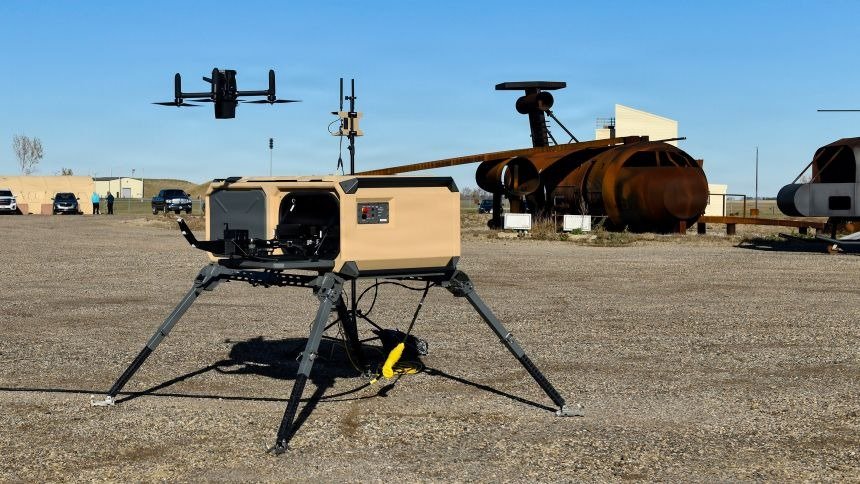
In the spring of 2025, authorities launched a targeted operation at the White Sands Missile Range in New Mexico after a quadcopter-style drone was observed flying in a suspicious, repetitive pattern over the sensitive Army missile testing facility. This incident followed a similar event in the fall of 2024, when border agents tracked a drone for approximately 35 miles before it crossed into Mexican airspace, forcing them to abandon the pursuit. During that earlier encounter, agents utilized helicopters and drones to capture what one former official described as “absolutely beautiful video” of the craft.
Determined to prevent another escape, officials established a multi-agency task force—including representatives from the Army, FBI, Department of Homeland Security, and the Pentagon’s UFO-tracking office—to monitor the drone’s movements. For five days, despite challenging weather and dust storms, the team tracked the device. They eventually employed electronic warfare tools to force the drone to land in a base parking lot, where they immediately verified it was not carrying explosives.
Simultaneously, investigators focused on a group of Chinese nationals stationed nearby in a rented Mercedes RV. Intelligence indicated these individuals had flown into New York, rented the vehicle, and traveled across the country to Las Vegas to recruit a third person before heading to White Sands. A separate Chinese national, who had arrived in Texas via cruise ship, was also identified in the vicinity. The FBI later informed military and Customs and Border Protection officials that these individuals were suspected of having ties to Chinese intelligence. While the group in the RV was detained by military personnel and turned over to federal authorities, the woman in the park was ticketed and released by the Department of the Interior.
The operation was hailed as a success, yet it underscored the persistent vulnerability of US restricted airspace. The challenge of identifying the true nature of these incursions remains, as counterintelligence officials often struggle to distinguish between hobbyists and those engaged in what one official termed “nuisance surveillance.” While some observers caution against assuming every operator is a state actor, the government remains concerned about potential threats to critical infrastructure, including the risk of lone-wolf terrorist attacks or the use of swarms to overwhelm air defenses.
The incident at White Sands highlights a broader systemic issue regarding who holds authority over domestic airspace security. One official noted that because the problem belongs to everyone, it effectively belongs to no one, as there is no single agency tasked with detecting and deterring such incursions. The situation has previously reached chaotic levels, such as in late 2023 when a drone swarm hovered over a Virginia Air Force base for 17 days, prompting the Joint Chiefs of Staff to intervene in a situation described by one source as a “circus” and “embarrassing.”
In response to these gaps, the Department of Defense has empowered Northern Command to manage protocols for errant drones, leading to a more unified response system. Additionally, a 2025 Pentagon task force was established to coordinate counter-drone technology. Despite these efforts, failures persist, including instances where the FAA closed airspace over El Paso due to confusion and the military accidentally shot down a Customs and Border Protection drone. Furthermore, while the CIA received new authorities in 2026 to disable drones over domestic facilities, significant security gaps remain, particularly regarding the protection of large civilian gatherings and critical infrastructure that fall outside military jurisdiction. The report also notes that or why, they never learned who was operating the drone. The report also notes that officials set a trap, but this time. The report also notes that according to the former official familiar with the incident, their first step was to make sure the drone wasn’t armed with explosives. The report also notes that trying to understand how they related to each other and to the drone itself, officials watched the two vehicles. The report also notes that was unable to learn what happened to any of them afterward. The report also notes that the Army did not respond to a request for comment before publication.