

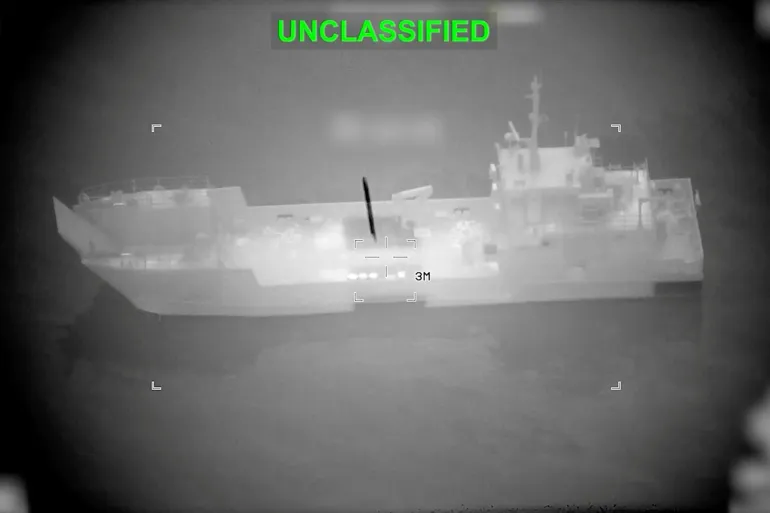
The United States military ended a month-long period of relative calm in its conflict with Iran on Sunday by conducting strikes on Larak Island. US officials stated the operation was a “limited, precise action” intended to neutralize Iranian rocket launchers that they alleged were being prepared to deploy sea mines within the Strait of Hormuz.
CENTCOM spokesperson Tim Hawkins reported that US forces, currently maintaining a blockade of Iranian ports in the region, observed the Islamic Revolutionary Guard Corps (IRGC) preparing to utilize rocket systems for mine-laying operations. In response, Iranian leadership condemned the strikes as an “act of aggression.” The IRGC confirmed that the attack resulted in casualties among its personnel and civilians, while the semi-official Tasnim news agency reported at least two fatalities and two injuries. Following the incident, the IRGC launched retaliatory strikes against two US military bases in Jordan.
The US assertion that rockets could be used to seed the strait with mines has sparked debate among military experts. Harlan Ullman, a retired senior US naval officer, described the claim as “implausible,” noting that the physical impact of a rocket hitting the water would likely cause significant damage to the mines themselves. Ullman suggested that the US might be downplaying intelligence regarding more conventional Iranian mine-laying methods by focusing on the novel, albeit questionable, rocket-based theory.
Despite skepticism from some analysts, Iran has previously showcased such capabilities. During naval exercises in January 2025, Iranian state media broadcast footage appearing to show the IRGC using the Fajr-5 Multiple Launch Rocket System (MLRS) to deploy mines. The Fajr-5, a 333mm medium-range system developed in the 1990s, is typically mounted on trucks and fires rockets equipped with 175kg fragmentation warheads. With a standard range of 75km and newer variants like the Fajr-5c reaching up to 130km, the system could theoretically cover the entire Strait of Hormuz.
Technically, experts suggest that if such a system were used for mining, the rockets would need to be modified to carry mines instead of explosives. Upon reaching target coordinates, the rocket casings would open mid-air, releasing the mines with parachutes or similar mechanisms to ensure a soft landing in the water. This method could potentially allow for the rapid dispersal of numerous mines while keeping Iranian launch crews at a distance from US naval patrols.
Historically, sea mines are deployed via specialized warships, submarines, or aircraft. Iran has traditionally relied on small, fast attack boats to drop explosives into the strait, though many of these vessels have been targeted by US forces. Last week, President Donald Trump claimed that CENTCOM had cleared the Strait of Hormuz of mines, warning that any further deployment attempts would be met with force. Experts note that effective mine-sweeping is a slow, methodical process typically requiring specialized vessels like the US Navy’s Avenger-class ships, which are designed to minimize magnetic signatures.
The US military itself maintains an aerial mine-laying capability, utilizing the Quickstrike mine system. These 2,000lb (907kg) bombs are fitted with guidance kits, such as the Joint Direct Attack Munition (JDAM), and can be deployed from aircraft with high precision from ranges of up to 25km. In April, the US Navy reported testing a new guided munition, the GBU-75, which is capable of striking naval targets or deploying sea mines from significant distances, demonstrating that the concept of aerial-delivered naval ordnance is a recognized military strategy. The report also notes that “They (Iran) have got a lot of options they could use to plant these mines. The report also notes that waiting to detect the magnetic signature or vibration of passing ships before detonating, they can be dropped to the seabed or moored slightly above the bottom. The report also notes that exploding when they come in contact with vessels, mines can also be positioned to bob just beneath the water surface. The report also notes that to clear Hormuz of mines to make it safe for general shipping, CENTCOM would have needed to launch a painstakingly slow operation to find and trigger controlled detonations of every single mine, experts say. The report also notes that high-impact tactics or asymmetric warfare, iran has long been known for its innovation in low-cost. The report also notes that analysts at the time called it “innovative” but also “concerning” as it meant the IRGC could now send thousands of mines over vast areas of water with a single launch. The report also notes that multi-tube truck system, the system can fire up to four artillery rockets from a mobile.