

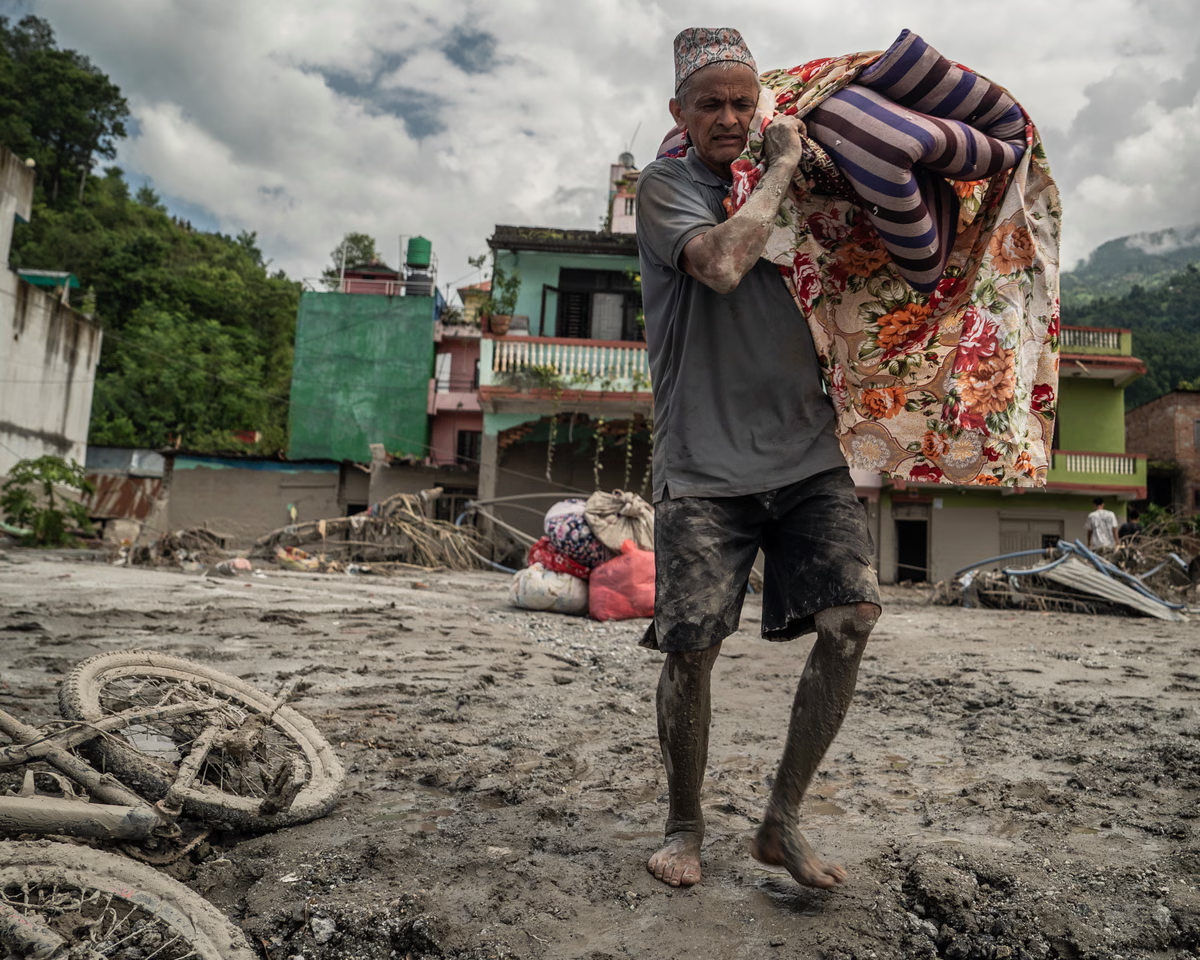
The death toll from the catastrophic floods that swept through the Himalayan valleys of Nepal and Tibet has climbed to 804 as of Sunday. As receding waters reveal the extent of the destruction, search and rescue teams continue to recover victims from the thick, sludge-like mud that has blanketed the region. With more than 3,000 people still reported missing, officials warn that the number of fatalities may rise significantly as rescue operations reach isolated areas currently accessible only by army helicopter.
Local morgues have reached capacity, forcing authorities to implement emergency measures. In the district of Bharatpur, officials have begun conducting mass burials for unidentified victims. Before interment, each body is assigned a location number and a tag, and DNA samples are collected in the hope that families will eventually be able to claim their loved ones for proper funeral rites.
In Chitwan, located roughly 100 miles downstream from the epicenter of the flash floods and mudslides, more than 250 bodies have been recovered from riverbanks. Due to the severe state of decomposition, only nine individuals have been positively identified thus far. Many of the remaining victims are being temporarily laid to rest in a forest on the city’s outskirts.
To accelerate the identification process, authorities have turned to digital tools, including uploading photographs of recovered items and victims to the Nepal police website. In Kathmandu, images of the deceased are displayed on walls outside the morgue. Officials are also presenting relatives with PowerPoint slideshows featuring recovered bodies, asking them to scan for identifying marks such as tattoos, scars, wedding rings, or necklaces.
The scale of the crisis has prompted the government to request more than 1,000 freezer units to ensure the dignified and safe storage of the dead. Foreign Secretary Amrit Bahadur Rai confirmed the request on Sunday as the government struggles to manage the overwhelming volume of casualties.
In the sacred town of Devighat on the Trishuli River, search teams are laboring through the ruins of homes. Police Superintendent Amabadutta Bhatta noted the difficulty of the operation, stating that 10 bodies have been retrieved from the site so far, with the potential for more as mud is cleared. “It is very tough work,” Bhatta said, adding that the destruction of multi-story homes means it may take months to fully clear the debris.
Survivors in Devighat are returning to find their homes reduced to rubble. Usha Nepali, 49, who raised four children and three grandchildren in her home, described the total loss of her property. “I invested everything to build this house, so now I don’t know where to go and what to do,” she said, noting that she has been left with nothing but the clothes on her back.
The situation remains volatile as the Trishuli River continues to swell. On Sunday, rising water levels forced rescuers to urge remaining residents to evacuate to higher ground. Jamuna Magar, 36, whose family has lived in Devighat for generations, managed to save only her gold before fleeing. Clutching a plastic vat of cooking oil—the only item she managed to salvage—she expressed doubt that the town could ever be rebuilt, fearing the process could take decades. The report also notes that local officials have adopted a macabre approach of simply asking people to go through pictures of the bodies and look for identifying features: a necklace, a wedding, in an effort to speed up the identification exercise. The report also notes that search and rescue teams have struggled to retrieve all those killed and buried in the mud, even in areas lower down the river valley that were decimated by the floods but have remained accessible by road. The report also notes that reduced to a few concrete blocks and twisted metal, Usha Nepali, 49, wept for the home where she had raised her four children and then her three grandchildren, standing next to the carcass of her house. The report also notes that but the morgues have already run out of room. The report also notes that many mangled beyond recognition and turning up miles from home, authorities say they are overwhelmed with the task of trying to identify the dead. The report also notes that where entire villages were wiped away by the tidal wave of mud, water and debris, are still inaccessible except by army helicopter, many of the worst-hit areas.