

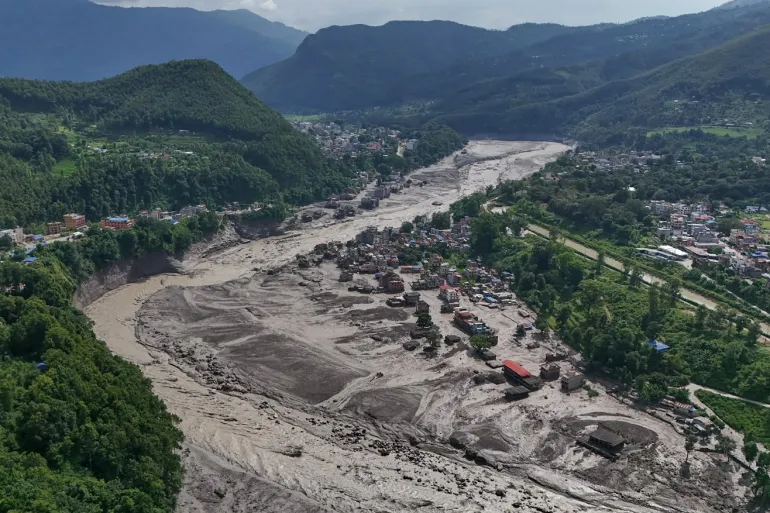
A catastrophic flash flood has claimed at least 160 lives and left hundreds more missing after surging through mountainous regions along the Nepal-Tibet border. The disaster, which struck on Wednesday, obliterated entire villages and caused widespread destruction to critical infrastructure, including roads, bridges, and power facilities.
Nepali authorities reported that 157 bodies had been recovered by late Wednesday. The nation’s tourism ministry indicated that 403 tourists were missing, 341 of whom are foreign nationals. Among the missing are 142 Indian citizens, along with travelers from the United Kingdom, Australia, Malaysia, the Netherlands, Portugal, South Africa, South Korea, and the United States. Additionally, police spokesman Abi Narayan Kafle confirmed that 28 police personnel remain unaccounted for.
Across the border in China, authorities in Tibet’s Gyirong county reported at least three deaths and 265 people missing. A mudslide in the region severed communication lines, power grids, and road access, prompting President Xi Jinping to call for an all-out search and rescue operation while emphasizing the need for improved early warning systems.
Nepal’s Prime Minister Balendra Shah has appealed for national unity, assuring citizens that the government is prioritizing rescue, medical care, and shelter. An emergency meeting of the National Disaster Risk Reduction and Management Authority was convened to coordinate the response, involving the Nepal Army, medical teams, and the Red Cross. The government has also formally requested assistance from both India and China to bolster rescue efforts.
The flooding has severely impacted the energy sector, with the Nepal Electricity Authority reporting damage to approximately 430 megawatts of production capacity. Among the missing are eight South Korean workers employed by Korea Energy and Doosan Enerbility Co. at a hydropower site. The South Korean government has established a task force and is preparing to deploy a rapid-response team to assist in the search.
The exact cause of the surge is believed to be an ice-rock avalanche from a glacier on the Nepali side, which blocked the Lhende Khola—a tributary of the Bhote Koshi River—before releasing a sudden, massive volume of water downstream. Saswata Sanyal, a disaster risk reduction specialist, noted that the Lhende Khola has experienced similar flooding twice in the last 14 months.
Climate justice activist Prayash Adhikari warned that the region is facing a climate catastrophe, noting that while the trend cannot be fully reversed, better early warning systems are essential to protect vulnerable communities. The Bhote Koshi River, which originates in Tibet and flows into Nepal’s Trishuli River before reaching India, has a history of such disasters; a previous flood last year, triggered by a draining supraglacial lake, destroyed the Friendship Bridge and disrupted regional trade for months.
As rescue teams struggle to reach isolated areas like Syapru Besi and Timure in the Rasuwa district, where high water levels have grounded helicopters, local officials have urged residents near the riverbanks to move to higher ground. In neighboring India, officials in Bihar state have begun preemptive evacuations across six districts in anticipation of the floodwaters moving downstream.
Social media footage shared by police and witnesses captured the intensity of the event, showing torrents of debris-laden water surging through the valleys. Many residents were caught completely off guard, as the disaster occurred without the precursor of heavy rainfall, according to local observers. The report also notes that state broadcaster CCTV said that specific casualty figures were still being verified. The report also notes that treatment, food and shelter, the government takes full responsibility for your rescue. The report also notes that with a population of about 50,000, officials said, the waters were too high for helicopters to land in Nepal’s affected areas of Syapru Besi and Timure in the mountainous district of Rasuwa. The report also notes that pointing to reports that nearby villages and infrastructure project sites were washed away, district administrator Narendra Pariyar urged those living on the banks of the Bhote Koshi River in the area to seek higher ground. The report also notes that cutting off roads, communications and power in the Shigatse region, Xinhua added, without giving details, the mudslide hit China’s Gyirong port. The report also notes that “Hundreds of people are missing,” Adhikari said from Kathmandu, stating it wiped out buildings, schools, bridges and highways. The report also notes that “[People] were at home … several houses have been washed away, swept away by the river,” Koirala told.