

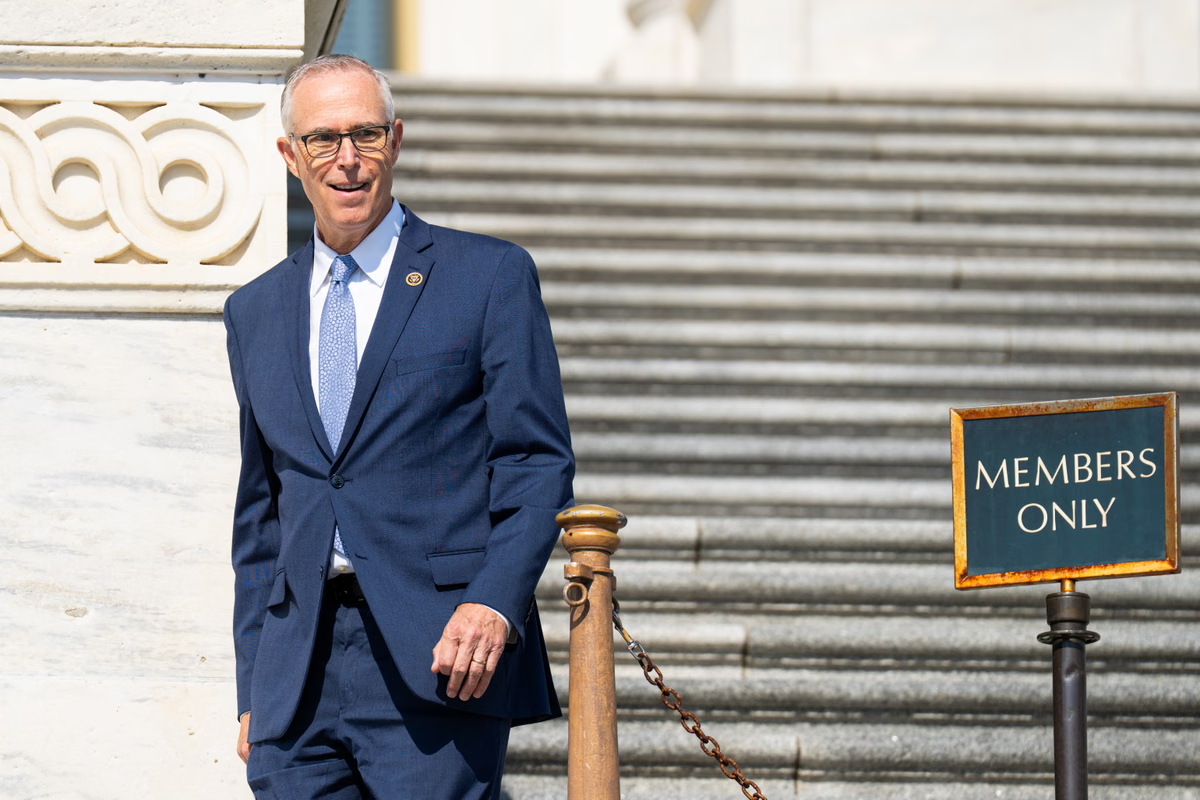
The January 6, 2021, insurrection remains etched in the American consciousness as a violent assault on democracy. For Representative Jared Huffman, however, the day revealed a more specific and alarming trend: the open manifestation of a militant Christian nationalist movement. From his home in Marin County, California, the 62-year-old congressman recalls the imagery of that day—crosses, shofars, and “Appeal to Heaven” flags—alongside rioters praying with hands raised while assaulting police officers. Huffman argues that this movement has only gained momentum since Donald Trump’s return to the White House, positioning it as a primary threat to scientific progress, education, and the foundational Enlightenment values established in 1776.
In his new bookNo Prophets: The Fight to Save Democracy from Christian NationalismHuffman contends that the United States suffers from a “Bible-sized blind spot.” He suggests that the nation failed to heed the warning signs of January 6, allowing a theocratic insurgency to entrench itself further. Huffman is uniquely positioned to offer this critique; he is currently the only member of Congress to openly identify as a non-believer. Raised in Independence, Missouri, he began questioning his faith during his sophomore year at UC Santa Barbara following his father’s sudden death. He eventually embraced humanism, finding it a more affirmative and inclusive framework than the supernatural tenets of his upbringing.
For decades, Huffman kept his secular views private to avoid political fallout. He recalls his first day in Congress in 2013, when then-Speaker John Boehner asked, “Alright, who’s going to hold the Bible?” for a photo-op. Caught off guard, Huffman complied, though he later described the experience as “sullied and hypocritical.” The turning point for his public disclosure came in 2017, following the death of his mother and the inauguration of Donald Trump. Despite warnings from family, staff, and political advisers that being an “atheist” was a career-ending label, Huffman went public. He received support from figures like Nancy Pelosi, Jamie Raskin—with whom he co-founded the Congressional Freethought Caucus—and the House chaplain, who encouraged more members to be honest about their beliefs.
Huffman’s public stance has not been without friction. He reports being subjected to harsh judgments and prejudices from colleagues who view his secularism as an insult to their faith. He attributes this hostility to “Christian privilege,” which he defines as a cultural taboo shielding domestic religious radicalism from the same scrutiny applied to foreign or minority faiths. This privilege, he argues, was evident during the January 6 committee’s investigation. While the committee’s “Purple Team” meticulously documented the role of right-wing Christian extremists in the insurrection, Vice-Chair Liz Cheney demanded the findings be removed, fearing they would distract from Trump’s personal culpability. While Huffman credits Cheney for her courage in opposing Trump, he maintains that her suppression of the religious evidence did the country a disservice.
The congressman asserts that if the rioters had been carrying Qurans or wearing hijabs, the committee would have dissected their religious motivations with “surgical precision.” Instead, the influence of religious extremism remains largely unexamined in mainstream political discourse. Huffman describes modern Christian nationalism not as a monolith, but as a volatile coalition of subcultures, including the New Apostolic Reformation (NAR)—a network of self-declared “prophets” and “apostles” who reject traditional authority—and the “Rad Trads,” a Catholic faction hostile to Vatican II reforms.
Huffman’s critique extends to the legislative arena, where he highlights figures like Illinois Representative Mary Miller. He notes that Miller began her tenure in 2021 by quoting Adolf Hitler and has dismissed climate science on the grounds that God controls the weather. For Huffman, such rhetoric signals the unraveling of the long-standing truce between fundamentalist Christianity and Enlightenment principles. Drawing a grim parallel to the 1930s, he warns that the nation is witnessing a dangerous erosion of democratic norms. Quoting Voltaire, he emphasizes the urgency of his message: “Those who can make you believe absurdities can make you commit atrocities.” The report also notes that who was locked down alone in his office that day, something else stands out, january 6 2021 is widely remembered as a deadly insurrection by supporters of Donald Trump; but for Congressman Jared Huffman. The report also notes that “I truly believed January 6 would be the wake-up call our country needed to confront this movement to understand it and to hold it to account. The report also notes that “Unfortunately, the country went back to sleep and many of my own colleagues who the mob wanted to kill that day didn’t even seem to notice the religious elements of the group that was trying to kill them.”. The report also notes that he grew up in Independence, Missouri – the home of former president Harry Truman and historic headquarters of the Reorganized Church of Jesus Christ of Latter-Day Saints (now the Community of Christ ), an offshoot of Mormonism. The report also notes that a devout Christian, Huffman was ordained into its priesthood. The report also notes that “The bottom line is the supernatural tenets of my faith, the God belief, the notion of heaven and hell and miracles and so forth, no longer worked for me. The report also notes that that’s a hard thing when you lose your faith. The report also notes that “It took me years of reflecting and thinking about it to determine that the things I liked about my religious upbringing, the universal values that are very much part of the Christian gospel, are available in all sorts of faith perspectives, including non-belief.