

We shouldn’t fool ourselves into thinking that dickovers—those moments where technology fails in a particularly humiliating way—are the only terrible thing about technology in 2026. Until now, we have lacked the vocabulary to describe these daily frustrations, so here are some suggestions to help articulate our collective digital misery.
The worst part of the internet is that it is now impossible to escape AI features because they are shoehorned into everything. My car recently switched from Google Assistant, which would simply say, “Sure, navigating to KFC,” to Google Gemini. Now, it responds with, “OK, great. I’ve noticed a number of locations within 100 miles of you that contain the letters ‘K’, ‘F’ and ‘C’. Give me a little more information on where you’re heading and I’ll get straight to showing you the way.” This unnecessary verbosity is a hallmark of our current tech hellscape.
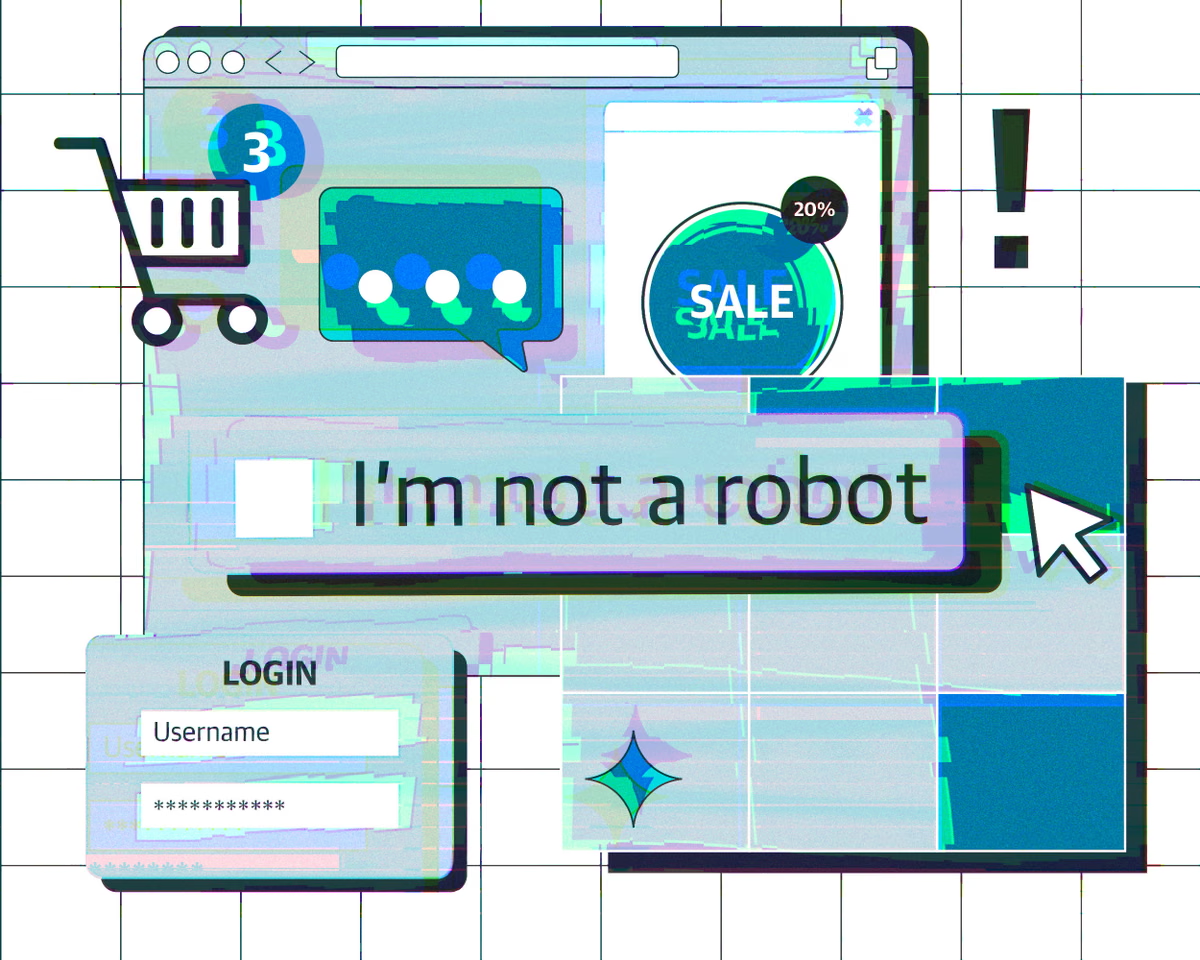
How much time do you think we have collectively spent, as a species, convincing robots that we are not robots? By now, we must have wasted several millennia ensuring we have clicked all the various parts of a bicycle on a captcha grid of someone’s front garden, or sliding a jigsaw puzzle precisely into a pixellated hole, or clicking a box that says “I am not a robot” a thousand times over. It is a humiliating ritual that defines the modern web experience.
In the year 2026, cancelling an unwanted subscription should require exactly one mouse click. Often, though, this is not the case. If things are going well, the company will simply make you click through a series of increasingly desperate pages, as it pleads with you not to cancel. They offer a pause, a discount, or emotional manipulation, hoping you will stay. It is a far cry from the simplicity we were promised in the early days of the internet.
Consider the phenomenon of baggravation, which occurs when you are lured to a website by a sale and seduced into adding an item to your basket. Perhaps you add a £140 yoga mat, but then you regain clarity—I don’t have a spare £140! I don’t even do yoga!—and try to leave. The site then triggers a series of messages: “Whoops! You accidentally left something in your basket!” followed by, “Don’t forget that yoga mat you liked! Please buy it! I have children to feed! Why do you hate me?” Browsing products online has become like trying to break up with a needy partner.
Large language models are designed for retention, which they achieve by agreeing with almost everything the user says. This makes the user feel special, but it can backfire spectacularly—as when ChatGPT confused a couple of my prompts and told me that decorating a cake with icing made of ham would be “unconventional, but potentially delicious.” This sycophantic behavior is a core component of the modern AI experience.
Sometimes, the easiest way to resolve a customer service dispute is via online chat. But now these interactions are marked by a nagging uncertainty: are you talking to a person or a bot? This new piece of social etiquette, which we might call botiquette, requires us to navigate interactions where the machine pretends to be human, often failing to understand the nuance of the problem at hand.
The privacy implications of our devices are also increasingly invasive. A family member recently became unwell, and the idea arose of buying an alarm pendant. The conversation moved on, and nothing was looked up, but since that moment, every single device in the house has been bombarded with advertisements for medical alert systems. It is a constant reminder that our private conversations are being harvested for data.
Passwords remain a persistent annoyance. Let your phone suggest a “strong password” on your behalf and your laptop won’t remember it, leaving you fruitlessly trying to recall a string of ampersands and semicolons. Worse still is when a website won’t tell you its requirements for a password, leaving you to guess whether it needs an uppercase letter, a number, or a special character.
We are also plagued by persistent marketing. “Thanks for buying a new sofa three weeks ago,” the email will go, as if you are in the market for another one immediately. There is no faster way to sound old than by complaining about self-checkout machines, which have been around for more than 20 years. When I buy any new electronic device, I open the package in front of my children, sigh deeply and say: “In my day, these used to come with plugs. Real plugs, Daddy, that you could put straight into the socket without having to hunt around the house for a three-pin adapter.” They look at me blankly, while I lament that the past was a wonderland.
Finally, there is the monetization of everything. Want to be able to play the £70 game you bought for your £500 console online? That’ll be £7 a month for some reason. Everything is now a subscription, from your software to your hardware features, costing us £30 a month here and there until our bank accounts are drained by the sheer weight of digital overhead. The report also notes that google gives you an AI overview before you get to your search results. The report also notes that spotify has an AI DJ that can talk between songs for some reason. The report also notes that shut up you water-guzzling idiot and give me my chicken. The report also notes that listen, if we ever want to pretend to be robots, let’s do it the old-fashioned way, by covering ourselves in tinfoil and beep-booping our way into an enemy moon-lair. The report also notes that consumers have the right to back out of a purchase before completion, in a forward-thinking free-market economy. The report also notes that and throw down your phone in a panic. The report also notes that sadly, your torment has just begun. The report also notes that all niceties are redundant, but with bots.