

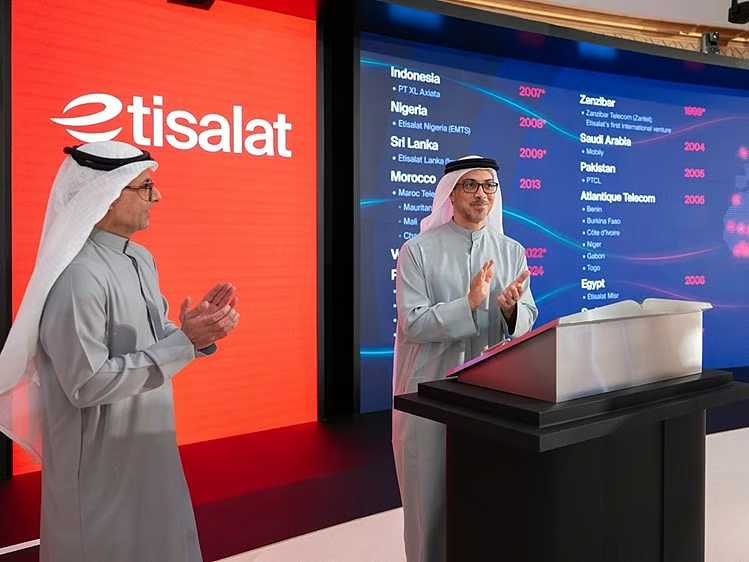
The United Arab Emirates has officially embarked on a major strategic initiative to overhaul its digital infrastructure, with the goal of increasing its international connectivity capacity to more than 500 terabits per second (Tbps) by 2030. This target represents a 25-fold increase over the country’s current capacity of 20 Tbps, signaling a significant push to accommodate the surging global demand for data processing and flows driven by the rise of artificial intelligence.
Sheikh Mansour bin Zayed Al Nahyan, Vice-President of the UAE, Deputy Prime Minister, and Chairman of the Presidential Office, presided over the launch event. The project, spearheaded by the telecommunications firm e&, focuses on developing advanced digital infrastructure both domestically and across the group’s international markets. Mansour bin Zayed meets Mohammed bin Salman in Riyadh. Sheikh Mohammed explores Al Khuzam’s cultural roots. Sheikh Mansour: Parents’ duties continue after divorce.
The announcement occurred during a briefing where Sheikh Mansour, acting in his capacity as Chairman of the Emirates Investment Authority (EIA), reviewed e&’s roadmap for the coming decades. He emphasized that building robust digital capabilities is essential for supporting future economic growth, fostering innovation, and maintaining the nation’s competitive edge in the global technology sector.
“Artificial intelligence represents a major pillar of the development journey in the next phase,” Sheikh Mansour stated via a post on X. He noted that enhancing digital infrastructure would provide the necessary environment for government and private institutions to innovate with confidence. The initiative also aims to ensure that the UAE is not merely keeping pace with global technological shifts but actively shaping the future of the digital economy. In a post on X, Sheikh Mansour said: “Today, we witnessed a new milestone in e&’s journey as it celebrates 50 years of achievements and launches its vision for the next phase.
Jassem Mohamed Bu Ataba Al Zaabi, Chairman of e&, highlighted that the project is designed to meet the rigorous requirements of AI clusters and global cloud service providers. He underscored that the strategy involves utilizing diverse connectivity routes to ensure the fastest possible latency and maximum network stability. More stable connections, it will also develop diverse connectivity routes designed to improve efficiency and reliability and deliver faster.
“This project reflects our conviction that the UAE’s role is not limited to adopting artificial intelligence, but extends to governing it and innovating through it,” Al Zaabi explained. He added that the endeavor is critical to achieving full digital sovereignty, as it relies on owning the underlying infrastructure that powers these advanced services.
The initiative also marks the beginning of e&’s 50th-anniversary celebrations. During the event, the company reaffirmed its commitment to its historic identity, “Etisalat,” which has served as a cornerstone of the nation’s telecommunications trust for half a century. Looking forward, the firm has set a vision to become a leader among companies that are both powered by and enablers of artificial intelligence.
Beyond the headline capacity increase, the infrastructure plan is structured around four primary business pillars: telecommunications, AI-driven business solutions, infrastructure, and financial technology. These elements are designed to work in tandem to support the broader national objective of establishing the UAE as a premier global hub for advanced technology.
Sheikh Mansour stressed the necessity of integrating national efforts to support this strategic direction. By investing heavily in these digital foundations, the leadership intends to create a resilient network that can withstand the rapid transformations characterizing the current digital landscape.
The project represents the first major commitment under the company’s refreshed strategy, which prioritizes the advancement of the telecommunications sector through the integration of AI. Officials confirmed that this expansion is not only about capacity but also about ensuring that the UAE remains at the center of the global digital economy. Why a degree alone won’t prepare you for tomorrow’s job.
As the country prepares for the next 50 years of development, the focus remains on equipping national institutions with the tools to innovate and expand efficiently. The transition toward a 500 Tbps network is viewed as a foundational step in ensuring that the nation’s digital backbone is robust, secure, and ready for the next generation of technological challenges.