

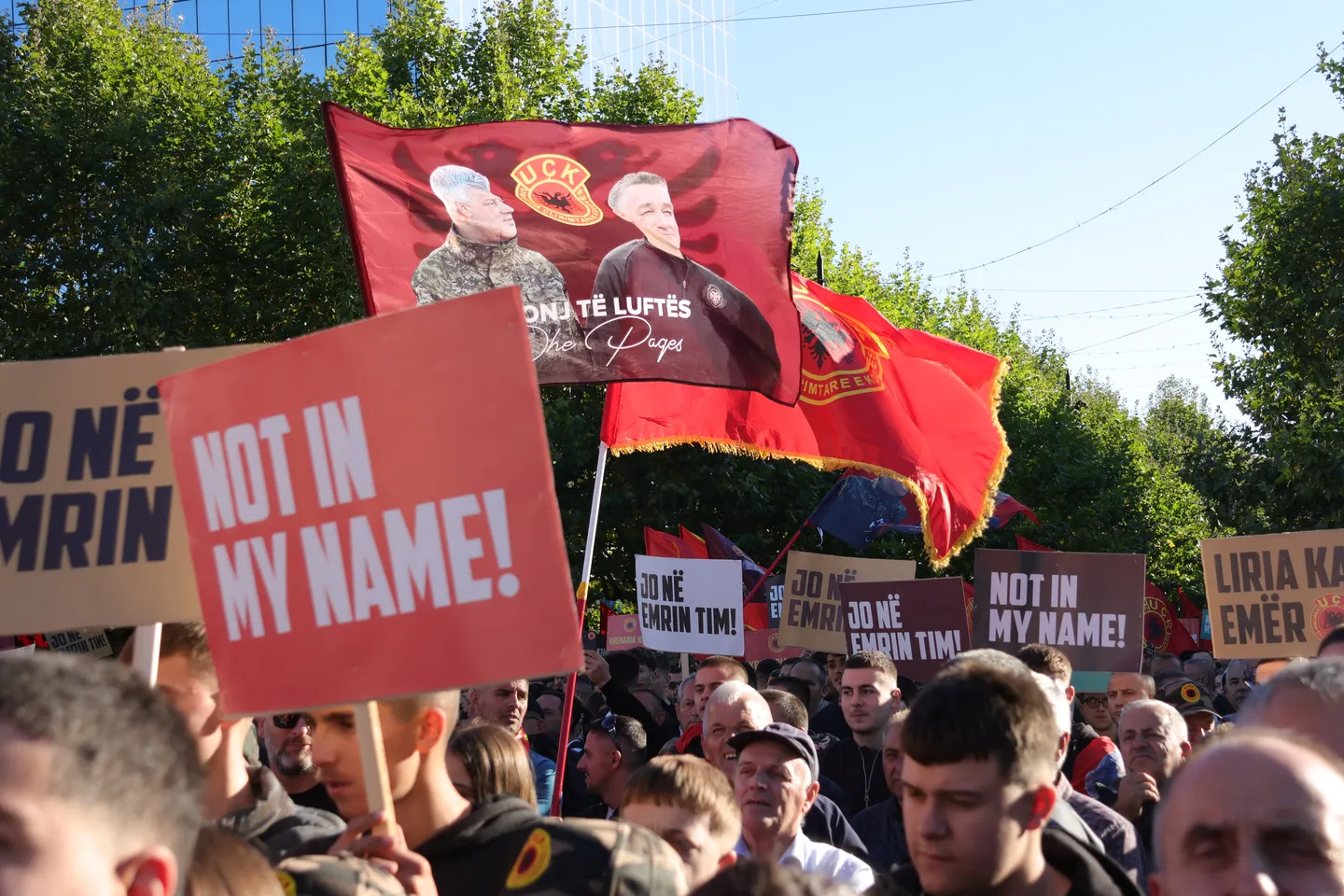
Thousands of citizens have taken to the streets in Pristina, marking a wave of daily protests that began on September 16. The demonstrators are voicing strong opposition to the war crimes conviction of former President Hashim Thaci by the special court in The Hague. Protesters have been carrying placards displaying the phrase “Jo ne emrin tim,” which translates to “not in my name,” signaling their refusal to accept the court’s judgment against the former political leader of the Kosovo Liberation Army (KLA). Last week, when thousands of Kosovars and Albanians converged in Pristina for a massive rally, there was a sense of deju vu among the people of Europe’s youngest country.
The intensity of the public response reached a peak on October 1, a date historically significant as the anniversary of a 1997 student-led uprising against the regime of Slobodan Milosevic. That earlier movement served as a pivotal moment in the fight for independence, during which students faced severe state violence, including the use of tear gas and batons, while protesting the banning of their native language in schools. Today’s protesters draw parallels between their current indignation and the struggle for survival that defined that era. On Thursday, their numbers swelled tenfold as the rally coincided with a historic commemoration that directly illuminates the current unrest. Back in 1997, Kosovo was officially still part of a crumbling Yugoslavia. Tens of thousands of students had gathered in the city on October 1 to protest the outlawing of their native language by the regime of convicted war criminal Slobodan Milosevic, as he strove to hold onto the remnants of Yugoslavia after the Balkan wars. Forcing Kosovar Albanian students into underground learning centres, it was followed by a formal ban from national schools and universities. With student leader Bujar Dugolli even releasing white doves at the beginning of his speech to symbolise their intentions, they had assembled for a peaceful protest. Tear gas and water cannons, serbian police greeted them in riot gear and did not wait long before unleashing unrestricted violence with batons.
Hashim Thaci, 58, led the KLA during the conflict that sought liberation from Serbia, a struggle that claimed the lives of more than 13,000 people and forced roughly one million ethnic Albanians from their homes. The conflict only concluded following a 78-day NATO air campaign that compelled Serbian forces to withdraw. Although Kosovo declared independence on February 17, 2008, and has since gained recognition from over 100 countries, Serbia continues to maintain its opposition to the state’s sovereignty.
The court’s decision to convict Thaci and three of his former KLA associates has been met with defiance across the region. In Tirana, the capital of Albania, the City Council has designated the four convicted men as honorary citizens in an act of solidarity. Domestically, the Kosovo parliament has issued a formal declaration, unanimously labeling the court’s ruling “unacceptable.” Lawmakers explicitly rejected any legal attempts to undermine the history of their liberation war or to equate the individuals who fought for independence with the forces that oppressed them.
Public anger is particularly fueled by the methodology of the prosecution, which relied heavily on anonymous witness testimony. Critics argue that these accounts fail to capture the reality of life for Albanians under the former regime. Agron Leka, a former member of the Kosovo Youth Assembly, highlighted the hardship of that period, noting that civilians often lived in hiding or crowded conditions under the constant threat of violence, including sniper attacks against non-combatants.
This sentiment is mirrored in local exhibits, such as those at a war museum in Pristina, where staff members like Besnik Tafa express frustration over what they perceive as a legal imbalance. Many citizens find it difficult to reconcile Thaci’s conviction with the lighter sentences handed down to high-ranking Serbian officials in the past. Tafa pointed to cases such as former Serbian police chief Sreten Lukic, who received a 20-year sentence for crimes against humanity, and Yugoslav army chief Dragoljub Ojdanic, who was sentenced to 15 years, as examples of perceived judicial inconsistency.
Gazmend Syla of the KLA Veteran’s Association described the ongoing protests as the only logical response from a nation that once faced an existential threat. For his part, Prime Minister Albin Kurti is navigating a delicate political position, attempting to validate the public’s frustrations while maintaining the diplomatic and financial support of Western nations that fund the court. As the country approaches an October 6 deadline for electing a new president, the unrest continues to reflect the deep-seated friction between the court’s legal proceedings and the historical narrative held by the Kosovar public.