

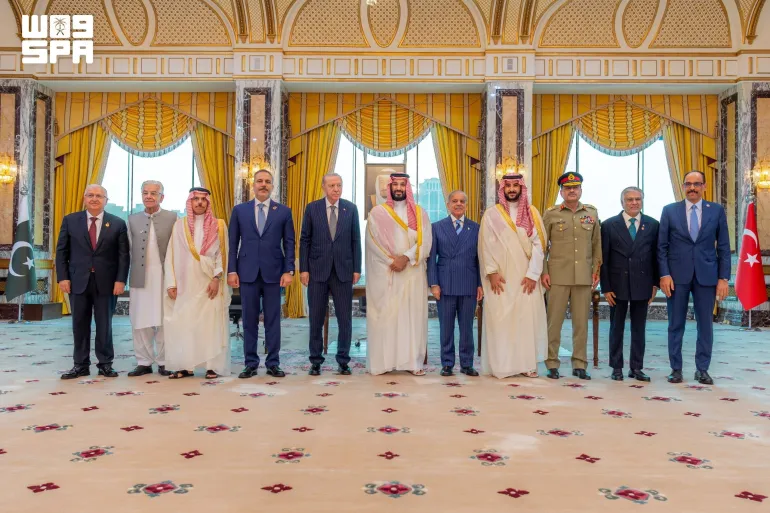
A tripartite agreement known as the Mecca pact, signed between Saudi Arabia, Pakistan, and Turkiye in August, has officially moved into the implementation phase. During an emergency session held in Riyadh on Monday, the pact’s primary committee finalized the deployment of military assets and personnel to the kingdom, aiming to bolster collective defense against rising regional threats. According to “The Committee decided to move immediately to the practical implementation of the collective defense commitments and to take the necessary measures to provide the agreed military forces and capabilities and ensure their rapid deployment in the Kingdom, in accordance with the approved arrangements and the national legislation of the Parties,”, A joint statement shared by Pakistan’s Foreign Office. The statement did not specify the size or role of the forces. But the combat is practically being conducted by Saudi Arabia’s own forces, and they are the ones retaking those areas,” Asif told Geo News, speaking from Riyadh on Monday night, we are definitely involved in reconnaissance and such things. During the 1990-91 Gulf War, Pakistan also sent a large contingent to the kingdom for defensive duties. ISPR did not respond to request for comment on the deployment agreed upon in Riyadh. According to dania Thafer, executive director of the Gulf International Forum,, Riyadh wants the pact to carry real weight.
Official documentation from the meeting confirms that participating nations have committed to providing military capabilities to ensure rapid deployment. While the specific scale and strategic roles of these forces remain undisclosed, the move signals a transition from a political declaration to a functional military deterrent. Saudi-led coalition spokesperson Major General Turki al-Malki noted that approximately 100 fighter jets are currently supporting a Yemeni government counteroffensive intended to reclaim territory lost to Houthi forces.
Pakistani Defence Minister Khawaja Asif confirmed that Pakistani forces are already engaged in supporting roles, specifically highlighting reconnaissance activities. While emphasizing that combat operations remain under Saudi command, Asif noted the current involvement of both Pakistani and Turkish assets. Despite this, Ankara has yet to formally confirm any standing military deployment to the region, and experts like international relations specialist Gokhan Ereli point out that any significant Turkish troop movement would legally require ratification by the Turkish parliament under Article 92 of their constitution.
Pakistan’s military engagement in Saudi Arabia is not new, as the two nations have maintained a defense partnership dating back to 1967. A 1982 agreement formalised the deputation of troops, and historical records, including a declassified 1985 CIA assessment, estimated that 13,000 to 14,000 Pakistani personnel were serving in the Saudi army at that time, with an armored brigade stationed at Tabuk. A Strategic Mutual Defence Agreement signed in September 2025 further solidified these ties, classifying any aggression against one signatory as an attack on both.
In April, Riyadh confirmed the arrival of a Pakistani force, including various fighter and support aircraft, at the King Abdulaziz Air Base. Lieutenant-General Ahmed Sharif Chaudhry, director general of the military’s media wing, the Inter-Services Public Relations, stated in September that Pakistani forces are physically deployed to protect the kingdom’s holy sites, asserting that the country is prepared to go to any extent to fulfill this commitment.
The current operational strategy faces scrutiny regarding the distinction between defensive and offensive mandates. Saudi Defence Minister Khalid bin Salman has described the initiative as a measure of collective deterrence, with official statements warning that the alliance may target those responsible for attacks, leaving room for interpretation regarding potential preemptive strikes. Houthi forces recently conducted attacks that hit two Saudi airports, resulting in at least three injuries.
Analysts suggest that Riyadh is leveraging the Mecca pact to create a security umbrella that extends beyond simple missile interception. However, officials in Islamabad have maintained a more cautious public stance. Deputy Prime Minister Ishaq Dar underscored that the pact remains strictly defensive in nature, explicitly stating it contains no offensive agenda against outside parties.
Experts anticipate that Pakistan’s contribution will likely emphasize air defense units, drone technology, and battlefield communication systems rather than ground combat operations. Similarly, observers expect Turkey’s input to be restricted to intelligence sharing, diplomatic coordination, and the logistical resupply of equipment, given the current lack of a formal Turkish ground presence.
The situation creates a complex two-tier operation: one focused on the static defense of Saudi territory and a second aimed at shifting the military balance within Yemen. The scope remains a subject of debate, particularly as the Yemeni government has expressed ambitions beyond local counteroffensives, aiming to retake the capital, Sanaa, which has been under Houthi control since 2014. As the conflict intensifies, observers caution that the current strategy tests how long partner nations can avoid direct involvement in the broader regional war.