

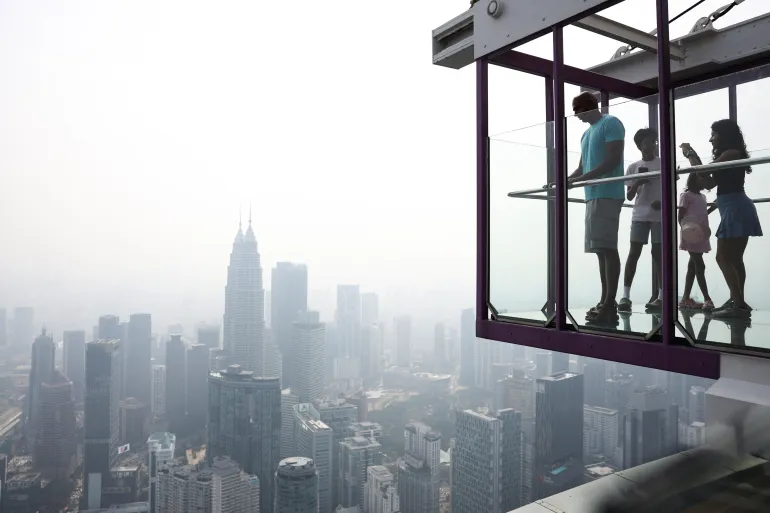
Forest and peatland fires burning across Indonesia have blanketed parts of Malaysian Borneo in thick, toxic smoke, creating the region’s most severe haze crisis since 2015. The hazardous air has triggered a sharp rise in respiratory ailments, forced the closure of hundreds of schools, and led to the cancellation of Independence Day festivities in Sarawak.
The smoke, originating from fires in the Indonesian regions of Kalimantan and Sumatra, has persisted throughout August, affecting not only Sarawak but also peninsular Malaysia, Singapore, and Brunei. This episode mirrors the 2015 crisis, which exposed millions to toxic pollutants and caused over 500,000 people to suffer respiratory issues.
Air quality reached critical levels on Tuesday, with six areas in Sarawak recording readings above 300 on Malaysia’s Air Pollutant Index—far exceeding the 100-point threshold for unhealthy air. In the state capital of Kuching, the index hit 407, while the town of Serian, located near the Kalimantan border, recorded a reading of 408.
For residents like Mia Emylia Hassan, a 33-year-old mother of two in Kuching, the situation is dire. “The air here is very thick,” she described, noting that the smoke is inescapable and visibility has dropped to roughly one kilometer. She reported that her 10-month-old daughter, who recently recovered from a lung infection, has been struggling to breathe, requiring multiple emergency room visits throughout the month.
National health data reflects this widespread distress. Malaysia’s Ministry of Health reported that asthma cases surged to 1,811 during the week of August 23–29, up from 219 the previous week. Conjunctivitis cases also saw a significant increase, rising from 146 to 720 in the same period. Patients like 52-year-old Karen-Michaela Tan in Kuala Lumpur have reported severe wheezing and breathlessness, requiring intensive nebulizer treatments and steroids to manage the effects of the haze.
The Association of Southeast Asian Nations (ASEAN) has activated a Level 3 transboundary haze alert, the highest tier, citing an increase in fire hotspots and the influence of an intensifying El Nino weather pattern. This climate phenomenon is expected to bring hotter, drier conditions, which experts warn will likely prolong the fire season and exacerbate the regional impact.
In response to the deteriorating conditions, Sarawak officials canceled outdoor Independence Day celebrations. Deputy Premier Douglas Uggah Embas warned that if air quality readings exceed 500, the region will declare a local emergency, shuttering all non-essential public and private offices. Educational institutions have also faced major disruptions, with nearly 600 schools in the Kuching area closing in late August, impacting approximately 200,000 students.
Athletic activities have similarly stalled. Coaches, such as Yap Kai Jinn of the Square One Football academy in Kuala Lumpur, have suspended all training sessions, citing the health risks to players. The club is currently seeking indoor alternatives while waiting for the weather to improve.
The impact has been even more severe in Indonesia, where officials report that approximately 5.5 million people on Borneo and Sumatra have been directly exposed to smoke. Deputy Health Minister Dante Saksono Harbuwono stated that 13,500 people sought treatment for respiratory infections during July and August alone. Government records indicate that over 200,000 hectares of land burned between January and July, with nearly half of that occurring in July.
Despite ongoing efforts to contain the blazes, hotspots continue to surge. In West Kalimantan, hotspots nearly doubled to 7,377 on Monday, while air quality in cities like Palangkaraya reached hazardous levels of 780 on the IQAir index. Indonesian authorities have arrested 72 individuals suspected of illegally clearing land for palm oil and pulp production through fire.
Atmospheric scientist Jayaprakash Muralitharan warned that the situation is likely to worsen before it improves. Because the hot weather began earlier than in previous years and peat fires are notoriously difficult to extinguish, he noted that there is little to be done until the rains arrive. With El Nino expected to reach “super” strength, experts emphasize that the region must prepare for a long and difficult fire season. The report also notes that anything above 100 is considered unhealthy. The report also notes that shortly after her 10-month-old daughter came home from the hospital after a lung infection, the haze arrived in early August. The report also notes that “She’s been on medication this whole month, and she has been coughing and vomiting.”. The report also notes that “It’s a mini heart attack for us every time,” Hassan said. The report also notes that along with a heavy dose of steroids, the 52-year-old said she needed two nebuliser treatments back to back to stop the wheezing. The report also notes that “Doctors are erring on the side of caution when it comes to asthma patients, choosing to up dosages rather than risk a patient being hospitalised for shortness of breath,” she said. The report also notes that and two purifiers run continuously, her house is sealed. The report also notes that still, “I battle throat scratchiness and nasal dryness even with these measures”, she said.