

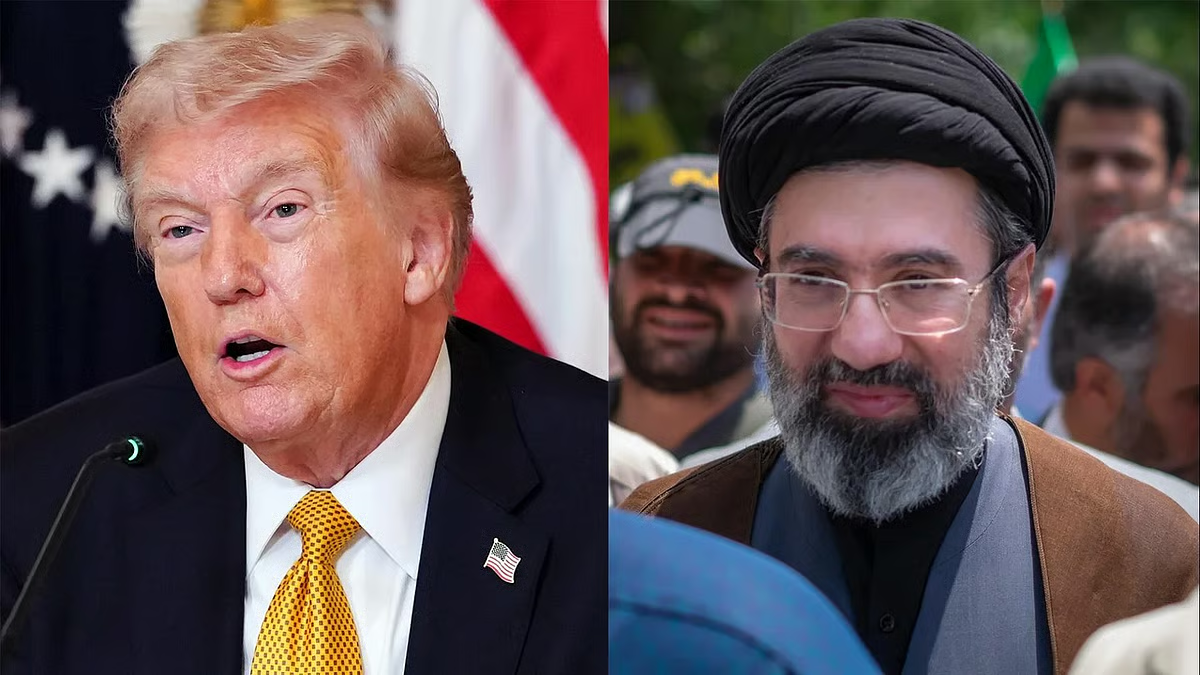
President Donald Trump has pledged a forceful response following a series of ballistic missile attacks launched by Iran against American military positions in Jordan. This development marks a sharp end to a month-long period of relative calm, reigniting direct hostilities and heightening concerns regarding a broader regional conflict.
The Iranian offensive followed a US military operation on Sunday that targeted two rocket launchers on Larak Island, situated near the strategic Strait of Hormuz. According to the US Central Command, these launchers were being prepared by the Islamic Revolutionary Guard Corps to deploy rockets equipped with sea mines into the vital maritime corridor. Iran reported that the strike resulted in several casualties and vowed to retaliate.
In response to the Larak operation, Iran’s Revolutionary Guard launched ballistic missiles at the King Hussein and Al-Azraq air bases in Jordan. While Iran claimed the strikes caused significant damage, the Jordanian armed forces stated that eight missiles entering their airspace were intercepted, with no injuries reported at the facilities. Iran also alleged attacks against US positions in the United Arab Emirates, though the UAE has denied any damage to its infrastructure.
Addressing the situation on Fox News, President Trump stated that the United States would “hit Iran hard” in retaliation for the strikes. He further escalated his rhetoric on Truth Social, labeling Iran a “Failed Nation” and claiming, without independent verification, that the country’s economy has collapsed, its military is ineffective, and that over 100,000 protesters have been killed by authorities. Additionally, Trump shared an AI-generated video depicting the destruction of Kharg Island, a critical hub for Iranian oil exports, though there is no evidence such an attack occurred.
The confrontation has placed the Strait of Hormuz at the center of the ongoing six-month conflict. While the US maintains that its operations are necessary to protect commercial shipping, Iran continues to challenge American control over the waterway. Treasury Secretary Scott Bessent indicated that the administration is preparing further sanctions against financial institutions linked to Iranian transactions as part of a broader effort to exert economic pressure.
Military analysts at the Institute for the Study of War and the Critical Threats Project noted in an August 26 update that Iran has adopted a new, more aggressive military doctrine. This shift, described by Iranian Artesh spokesman Brig. Gen. Mohammad Akraminia, emphasizes “rapid retaliation,” multiple strikes in response to individual provocations, and pre-emptive actions against US assets. The think-tank suggests this posture is intended to re-establish deterrence against the United States and Israel.
The renewed exchange of fire continues to disrupt maritime traffic and exert upward pressure on global energy markets. With the Strait of Hormuz serving as a primary artery for oil and gas trade, ongoing security concerns are impacting insurance, freight costs, and supply chain stability. As Washington weighs its next steps, the primary uncertainty remains whether the promised retaliation will manifest as a limited strike or signal the beginning of a sustained escalation targeting Iran’s military infrastructure and oil export capabilities. The report also notes that there was no independent confirmation of those claims. The report also notes that that its currency had collapsed, soldiers and police were not being paid and that inflation had reached 300%, he claimed Iran had no effective navy or air force. The report also notes that that claimed death toll is not independently verified. The report also notes that making it a potential target if Washington decides to escalate its campaign against Tehran, kharg Island is strategically important because it handles the majority of Iran’s seaborne oil exports. The report also notes that the post nevertheless sent a clear political message: Kharg could become the next major target if the confrontation escalates. The report also notes that uS Central Command said the IRGC units posed an imminent threat to commercial shipping and that US forces had recently completed mine-clearing operations in the Strait. The report also notes that iranian President Masoud Pezeshkian subsequently said Tehran was not seeking war but would not remain “passive” in the face of aggression.