

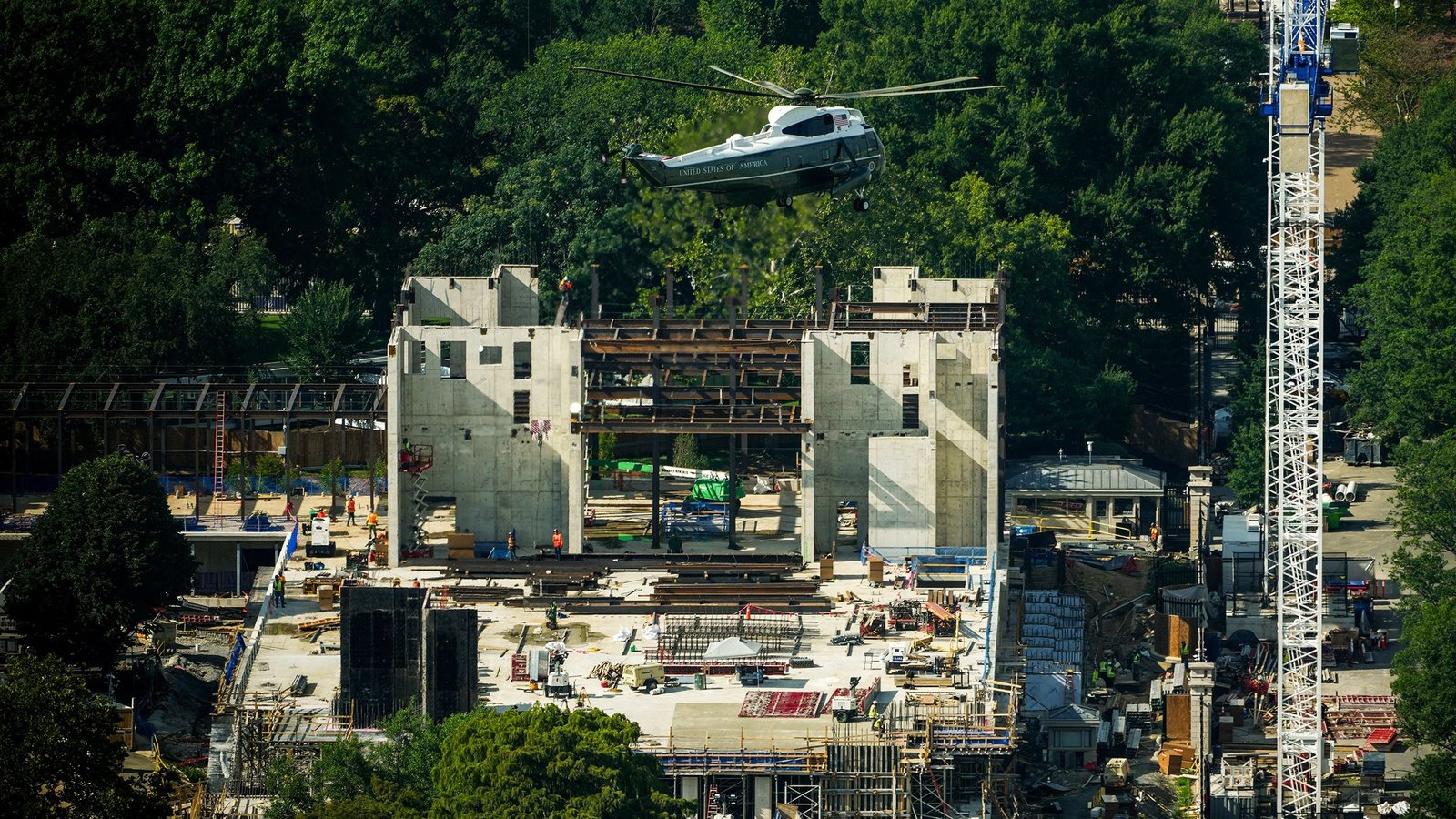
The Supreme Court issued a 5-4 ruling on Monday that permits President Donald Trump to continue the construction of a sprawling new ballroom at the White House. The decision effectively blocks a legal challenge from the National Trust for Historic Preservation, which had sought to permanently halt the controversial project. In an unsigned, eight-page opinion, the court’s conservative majority determined that the preservation group likely lacked the legal standing required to challenge the development, though the justices stopped short of declaring the project itself lawful.
This ruling serves as a significant victory for the administration, providing the necessary time to advance the nearly 90,000-square-foot structure, which the president considers a cornerstone of his legacy. Trump has defended the ballroom as a national security necessity, citing the inclusion of advanced protective features designed to shield the White House from potential attacks. The administration has been working at an aggressive pace, with court filings indicating that hundreds of laborers are operating 20 hours a day, seven days a week, to keep the project ahead of schedule and under budget. The site is already more than halfway complete, utilizing specialized concrete similar to that found in nuclear power plants, which makes the structure nearly impossible to dismantle.
The decision marks another notable success for the president on the high court’s emergency docket, a venue where he has frequently sought relief for his initiatives. Critics often refer to this process as the “shadow docket,” noting that it has allowed the administration to bypass lower court rulings on various controversial policies, including immigration enforcement and federal restructuring. Earlier this month, Chief Justice John Roberts had issued a temporary order allowing construction to continue while the court reviewed the president’s appeal, preventing an immediate work stoppage mandated by a lower court.
Chief Justice Roberts, however, joined the court’s three liberal justices in dissent, offering a sharp critique of the project. He characterized the construction as “likely unlawful,” arguing that the majority failed to recognize the unique status of the White House. Citing Winston Churchill, Roberts noted that while people shape buildings, buildings subsequently shape their inhabitants. He warned that the court’s decision allows the executive branch to potentially infringe upon the legislature’s authority over federal property and the power of the purse, emphasizing the need for strict adherence to rules regarding the People’s House.
The preservation group had argued that its member, architectural historian Alison Hoagland, suffered concrete injury due to the project’s impact on her enjoyment of the site. The majority rejected this claim, stating that mere disagreement or distaste does not constitute the specific injury required for federal standing. Conversely, the DC US Court of Appeals had previously ruled 2-1 against the administration, asserting that the decision to build such a massive addition should rest with Congress rather than being a matter of executive self-help.
Following the ruling, the president celebrated the outcome on social media, declaring he was pleased that the legal matter was resolved without further contingency or doubt. He dismissed the preservationists’ lawsuit as baseless and predicted the ballroom would become one of the greatest structures ever built in Washington, D.C. The administration has maintained a hands-on approach to various capital projects, including the Lincoln Memorial reflecting pool, a triumphal arch, and planned renovations for the Kennedy Center, all of which have faced similar legal scrutiny regarding their impact on the historic character of the city. The report also notes that that, Roberts wrote, was “all the more reason to ensure that those responsible follow the rules in deciding what to tear down and what to build up at the People’s House.”. The report also notes that critics argue Trump violated the law in tearing down the East Wing and pursuing the gilded site without congressional approval. The report also notes that they said, isn’t owned by the president who occupies it at any given time, the White House. The report also notes that “We conclude only that, based on the submissions before us, the government is likely to prevail in showing that the Trust lacks Article III standing to challenge the project in federal court.”. The report also notes that the Trump administration revealed how much construction had progressed in recent months, as part of the litigation. The report also notes that hundreds of workers are spending “20 hours a day, 7 days a week to keep the project ahead of schedule and under budget,” it said in court filings, and the project is already more than halfway done. The report also notes that they said the administration was trying to “outrun judicial review” by speeding ahead with a project that the administration is claiming may already be irreversible.