

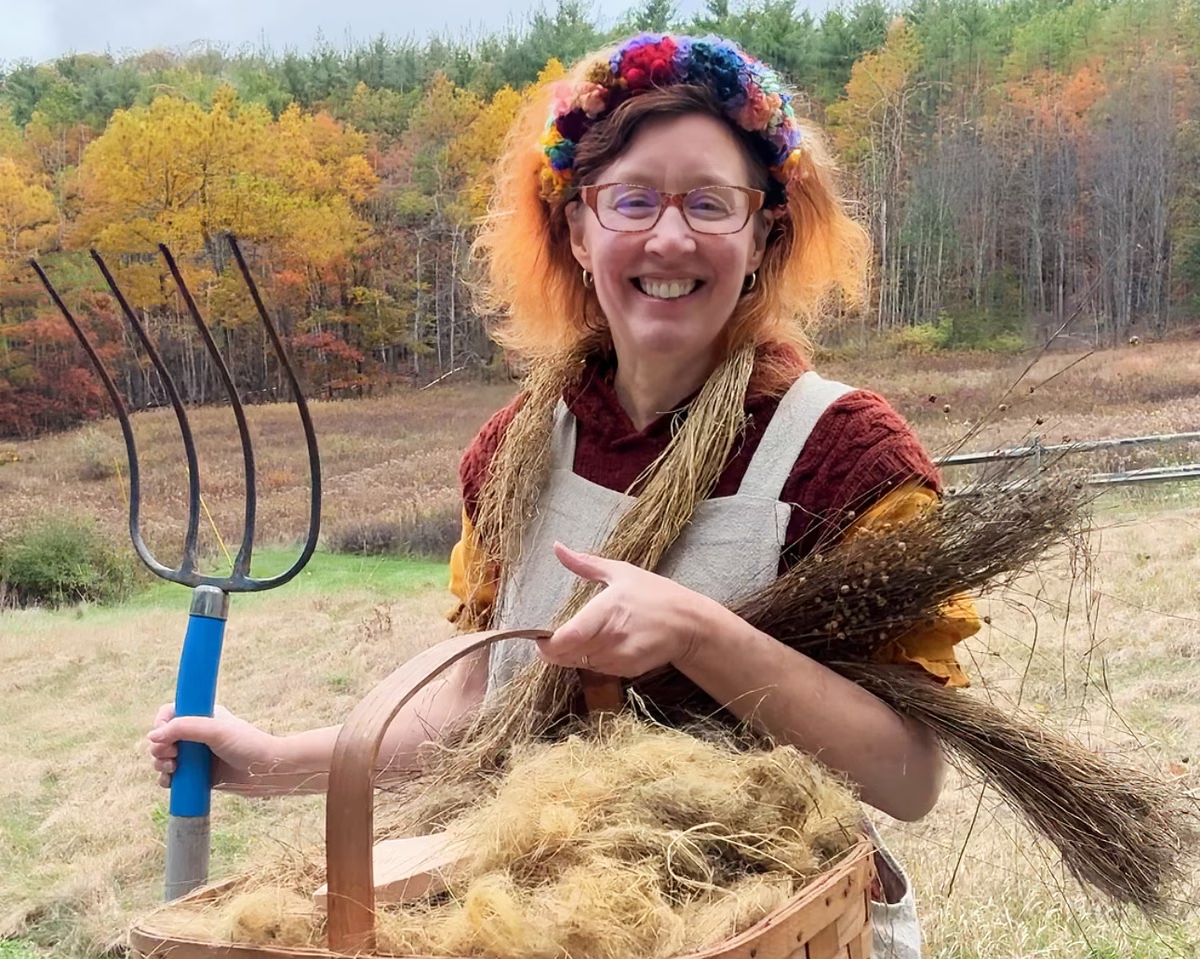
In an era defined by the rapid production and consumption of inexpensive clothing, one woman is turning to a radical, historic alternative. Eve Ogden Schaub has embarked on a project to create a linen dress from scratch, starting with flax seeds planted in her own backyard. Her endeavor, which she describes as an attempt to find the “slowest fashion imaginable,” serves as a direct critique of the modern garment industry.
The project began in April 2025, when Schaub converted a 600-square-foot vegetable garden in Vermont into a dedicated flax plot. Having successfully harvested two crops, she is now navigating the labor-intensive stages of processing the fiber. Her methodology involves traditional techniques that evoke a bygone era, including retting—a decomposition process—followed by breaking, scutching, and hackling. She has also begun growing indigo plants to eventually dye the linen yarn once it has been spun.
Schaub, a self-described “fibre-person and maker,” is no stranger to ambitious lifestyle experiments. She has previously authored books detailing her family’s efforts to eliminate sugar for a year and to live for 12 months without generating any waste. This latest project, she notes, is deeply connected to her environmental concerns regarding synthetic materials. “Unfortunately, we’re all walking around wearing plastic bags most of the time, and we don’t even realise it,” she observes.
The motivation behind this undertaking is a desire to challenge the systemic issues inherent in the global fashion industry. Schaub points to the environmental and health catastrophes linked to fast fashion, citing the massive textile waste dumps in Ghana and the prevalence of lung disease among workers in India’s recycling factories. She argues that our current culture prioritizes speed and low costs at the expense of human and environmental well-being, asking, “The whole system, I want to question and say, is this what we want?”
As she works toward weaving the linen on a large loom, Schaub has been documenting the process on social media. She finds the learning curve both challenging and humorous, noting that mistakes are an inevitable part of the process. “There’s something inherently funny in the learning process, because you screw up and you screw up, and you know you’re going to screw up,” she says. Her followers have responded with newfound appreciation for the labor required to produce clothing, often commenting on how the project clarifies why textiles were historically treated as such valuable commodities.
While her previous sewing experience was limited to crafting Halloween costumes, Schaub plans to collaborate with an experienced friend to design the final garment using historical patterns. She acknowledges that she cannot predict exactly when the project will conclude, but remains committed to the outcome. “I cannot predict when this project will end, but I promise I’m going to wear something at the end of this,” she says. For Schaub, the value lies in the meaning behind the creation: “Because of that, I hope it will be beautiful. I know it will be beautiful to me.” The report also notes that many of today’s clothes are the result of fast fashion, f rom crop tops to shorts and brightly patterned dresses. The report also notes that and that’s when I had the idea I could grow a dress from seed in my back yard,” she says. The report also notes that she is also learning to process the material in steps that would not sound amiss in a Grimms’ fairytale – sometimes enlisting family and friends to help. The report also notes that “So it’s an enormous undertaking, but something that not all that long ago was completely commonplace, and I found that a very attractive, interesting facet of the project,” she says. The report also notes that it has never been easier to get a cheap, convenient garment delivered to your door, as Schaub says. The report also notes that that bring us something that we can’t get from this fast-paced commercial world?”, what might we stand to gain if we were to slow down and try to find things that are more meaningful to us.