

Iran’s leadership has officially acknowledged the severe economic toll of the ongoing six-month conflict with the United States. President Masoud Pezeshkian confirmed that the combination of international sanctions and a US-led naval blockade has caused a nearly 35 percent decline in national exports and imports.
Despite these pressures, the government is prioritizing economic stabilization. Key objectives include curbing annual inflation—which reached 66 percent last month—creating new employment opportunities, and gradually reducing the nation’s reliance on the US dollar. During a brief window in June when a Memorandum of Understanding with Washington permitted oil sales, Iran successfully moved approximately 90 million barrels of crude.
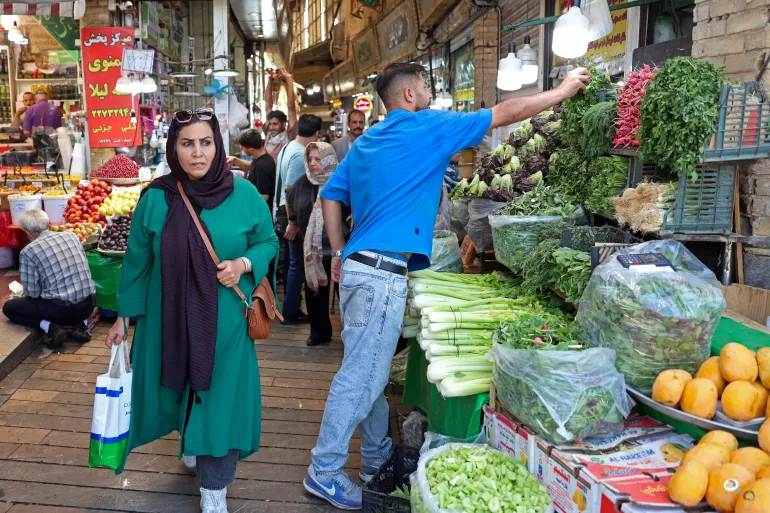
The human impact of the war remains acute for ordinary citizens. Residents in Tehran report that the conflict has fundamentally altered daily life. “Before the war, I didn’t work. Since the war, I’ve had to find a job to help support my household,” said one resident named Maryam, noting that the cost of living has surged. Small business owners, such as food vendor Omid, have also struggled to maintain operations as rising rents and stagnant trade make it difficult to pay staff.
Supreme Leader Ayatollah Mojtaba Khamenei, who has remained out of the public eye since the February 28 start of the war and the death of his father, Ayatollah Ali Khamenei, has issued a directive for the government to address these hardships. In a written statement, he emphasized the urgent need to manage market prices, inflation, and unemployment to preserve social cohesion.
To navigate the crisis, Tehran is framing its strategy around a dual approach of diplomacy and defense. Government officials described these as “two complementary, coordinated and inseparable wings” for protecting national sovereignty. Pezeshkian has advocated for a less confrontational stance toward neighboring nations, while Qatari Prime Minister Sheikh Mohammed bin Abdulrahman bin Jassim Al Thani visited Tehran on Thursday to discuss restoring open shipping through the Strait of Hormuz. Foreign Minister Abbas Araghchi characterized these diplomatic exchanges as “creative.”
Simultaneously, the military maintains a posture of defiance. Army commander-in-chief Amir Hatami stated that despite enemy efforts to dismantle Iran’s missile and drone capabilities, the country’s stockpiles were utilized with “utmost intensity.” On Friday, Acting Defence Minister Majid Ibn Reza issued a warning to adversaries, stating that Iran has “surprises” in store that will be revealed in due time. The report also notes that pledging to withstand US pressure, pursue diplomacy and maintain what it says is control over the Strait of Hormuz, the admissions came on Saturday as Tehran signalled it would not back down. The report also notes that president Masoud Pezeshkian told state media that exports and imports had slumped nearly 35 percent because of sanctions and the blockade of Iranian ports. The report also notes that he said Iran had nonetheless managed to sell about 90 million barrels of oil during the short-lived Memorandum of Understanding (MoU) signed with Washington in June, when oil sales were briefly permitted. The report also notes that omid, who runs a food business, said trade had dried up as rents rose: “We can barely afford to pay our workers.”. The report also notes that reporting from Tehran, said the government was promoting a message of unity, sinem Koseoglu.