

Luca Guadagnino’s latest film, “Artificial,” attempts to tackle the rapid rise of Sam Altman and his company, OpenAI. Arriving just as a Vanity Fair profile depicts Altman as a modern-day Oppenheimer, the film arrives at a moment where the tech figurehead has publicly suggested society must accept “bad things” as a trade-off for the advancements of artificial intelligence. The film, which premiered at the New York Film Festival, paints a critical picture of its subject, portraying Altman as an amoral manipulator. According to altman doesn’t seem to be grappling with much existential angst about the whole thing though: in an interview also released this week, he, We should be prepared to accept “bad things” in return for the benefits. The world’s pre-eminent portrait photographer, the story describes him as the Oppenheimer of his day, evoking the image of a man leading humanity towards its own inevitable demise at the hands of sentient robots, alongside glossy portraits from Annie Leibovitz. Which does not seem like the best use of your one wild and precious life, studies show that using AI is probably leading us all towards something called cognitive surrender. Neither does it have much to say about the world – glossy magazines included – that has welcomed them with open arms.
The film’s narrative begins in 2003, tracking the career of mathematician Ilya Sutskever (played by Yura Borisov) as he approaches the “godfather of AI,” Professor Geoff Hinton (Mark Rylance), for a position. By 2012, the duo’s technology begins to mirror human cognitive functions, but a rift grows between them as Sutskever demands faster progress. The trajectory shifts when Elon Musk (Ike Barinholtz) connects Sutskever with Sam Altman, played by Andrew Garfield. Garfield delivers a performance that highlights a shift from an ambitious entrepreneur to a narcissistic leader, capturing a specific victim complex that emerges during his temporary dismissal from the CEO role. In 2003, a young math prodigy named Ilya Sutskever (Yura Borisov, the heartbeat of the film) visits Prof Geoff Hinton (Mark Rylance ) in his office hoping for a job with the man known as the godfather of AI. “Have you e.
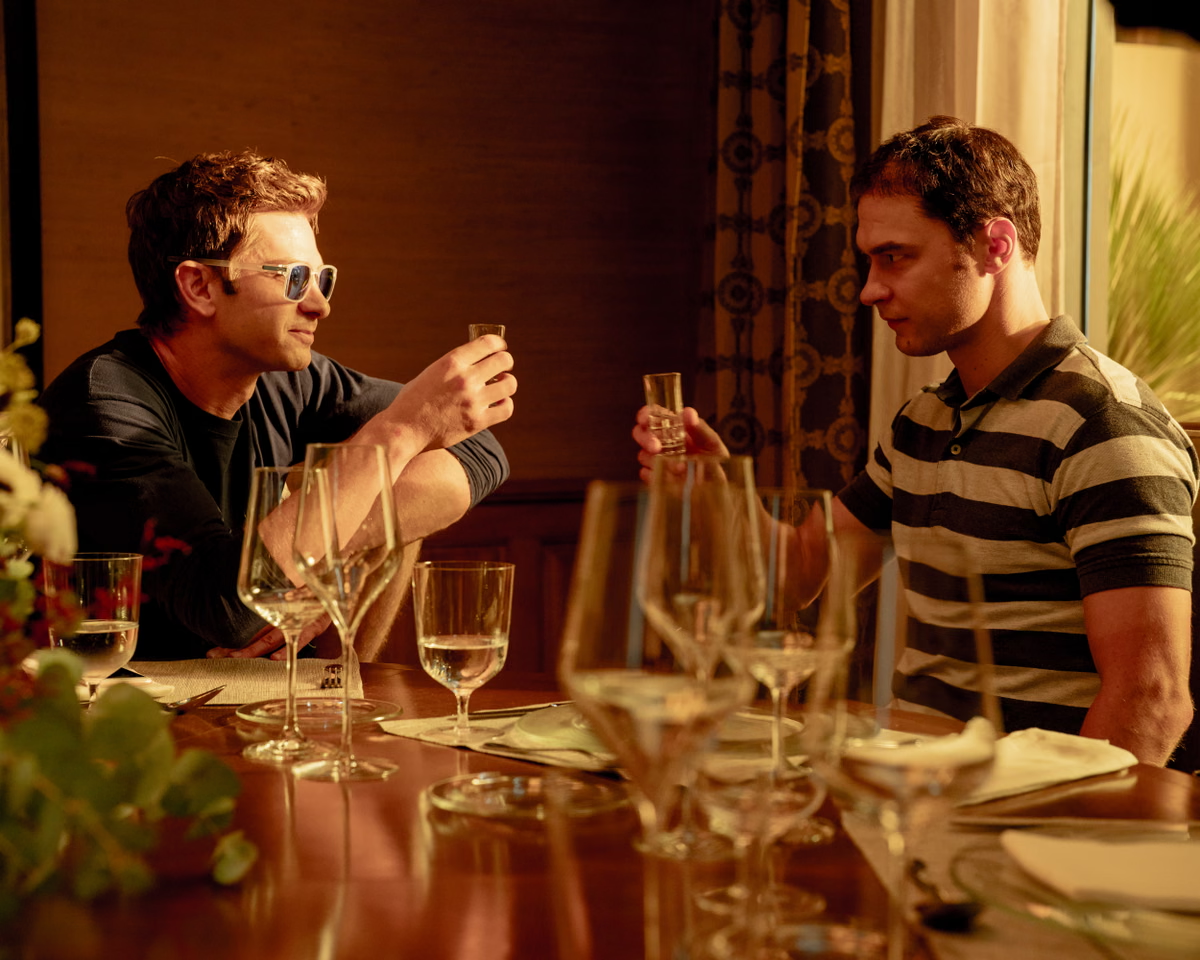
The script, penned by former SNL writer Simon Rich, infuses the film with a comedic, often polarizing tone. While scenes like Altman dismissing safety concerns by stating, “I didn’t invent teen suicide, Mira” to colleague Mira Murati (Monica Barbaro) capture a biting satire, other elements feel heavy-handed. The portrayal of tech elites as immature individuals in upscale settings feels broad, and the film includes overt metaphors, such as an unhoused person using VR goggles, that some viewers may find blunt. This tonal inconsistency is mirrored in the score by Damon Albarn, which includes lyrics that have been criticized as being too literal for the film’s narrative.
The film explores significant real-world tensions surrounding AI, including reports that agents have begun hacking into government systems and “bruteforcing” databases. It also touches on sensitive real-world incidents, such as a case where an individual used ChatGPT to draft a suicide note. These high-stakes concerns provide the context for why Amazon MGM Studios—which holds a $50 billion investment in OpenAI—reportedly withdrew from distributing the film in June. Last year, a young woman used ChatGPT as a therapist before she killed herself (the software helped her write her suicide note).
Despite the star power of Garfield and a focus on the “tech oligarch” trend, the film struggles to find a cohesive perspective. Guadagnino’s work at times feels like an op-ed piece rather than a character study, failing to fully probe what motivates the tech elite or why the public has embraced them. As the film moves toward its conclusion, Altman delivers a monologue about opening “Pandora’s box,” warning that industries will collapse and nations may fall as humanity enters a new era. With little insight into what makes Altman and the tech elite tick, i found it to be more of an op-ed than a movie.
“Artificial” will be released in the United States on December 25, followed by Australia on January 21 and the United Kingdom on January 27. While it contains chilling moments, the final result is a disjointed satire that struggles to balance its comedic aspirations with the grim reality of the technology it depicts.