

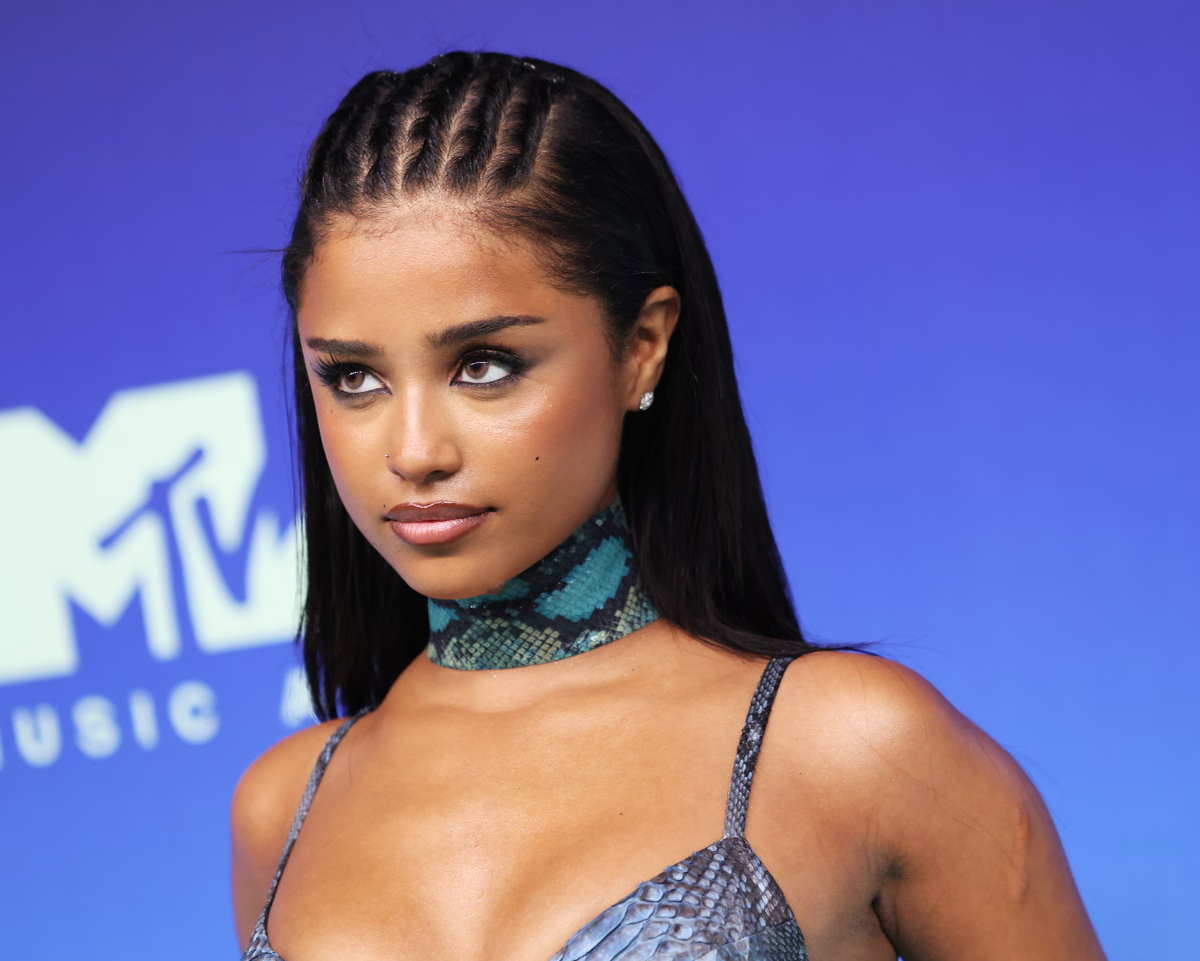
When South African pop star Tyla accepted the award for best Afrobeats at the 2024 MTV VMAs, her initial excitement quickly gave way to a more somber reflection. While she acknowledged the global success of her hit single Water and its role in demonstrating that African music belongs in the pop sphere, she described the categorization as bittersweet. Tyla argued that grouping all African music under the single umbrella of Afrobeats overlooks its vast diversity, specifically noting her roots in the South African amapiano sound. Despite her plea, the label persists, even appearing in her subsequent win at the American Music Awards. She became more sombre, describing the moment as bittersweet. “There’s a tendency to group all African music as Afrobeats,” she continued. “Even though Afrobeats has opened so many d, but as the audience’s cheers swelled. She began her acceptance speech in a celebratory tone. “This is such a big moment for African music, beaming in a yellow dress. I come from South Africa, I represent amapiano”, referring to the country’s rolling, sensual dance subgenre.
Tyla is part of a growing contingent of African artists pushing back against a term many find restrictive. Tems has explicitly rejected the label, defining her work instead as a blend of alternative, soul, R&B, and Afro elements. Similarly, artists like Burna Boy, Wizkid, Ckay, King Promise, and Davido have expressed frustration with the catch-all moniker, which they argue obscures the nuance of their specific artistic contributions.
The term Afrobeats originated in the early 2010s, popularized by London-based DJ Abrantee as a marketing tool for West African dance music, such as D’Banj’s Oliver Twist. As African music achieved massive global success through viral hits like Rema’s Calm Down and Moliy’s Shake It to the Max, the term expanded to include virtually all popular music from the continent, from rap and gospel to highlife. While it functioned as a successful, if aggressive, marketing strategy—even leading the UK Official Charts Company to adopt the term for its African pop chart in 2020—critics warn it has become a reductive force. Creating a catch-all to market these sounds on radio and a burgeoning streaming marketplace, london-based DJ Abrantee – per reporting in – appended an “s” to Fela Kuti’s Afrobeat.
Bloody Civilian, a Nigerian producer and singer who is set to tour with Tyla in October, criticizes the label as deeply limiting. She finds it perplexing that Western audiences continue to categorize the broad spectrum of African sonic experimentation into one narrow box. While Western music is afforded the luxury of diverse genre definitions, African artistry is frequently compressed, which risks distancing musicians from the unique traditions they draw upon.
This pressure to conform to a single label has had tangible consequences for the development of distinct genres. For example, Mr Eazi’s banku music—a blend of Nigerian pop and Ghanaian highlife that gained traction around 2015—once fostered a vibrant regional culture with its own fashion and sonic identity. However, because it was never effectively contextualized or marketed as a unique form in the West, it largely faded from view rather than evolving into a lasting musical movement. Similar fates have befallen genres like zanku, azonto, cruise, and afropiano. Mr Eazi, a Nigerian who had attended university in neighbouring Ghana, vaulted to continental fame in 2015.
Cultural journalist Tiléwa Kazeem points out that international publications often dismiss these emerging styles as esoteric, leading to a failure in documentation. This reliance on the Afrobeats tag has created a cycle where new innovations are treated as temporary trends for the larger machine rather than legitimate, documented genres. The lack of institutional interest is further highlighted by the recent removal of the Afrobeats category from the MTV VMAs, leaving African music without a dedicated category at all.
For newer styles like the spiritually infused afro adura or the electronic-street fusion known as mara to gain lasting significance similar to Western genres like grunge or hyperpop, experts argue that more intentionality is required. Dolapo Amusat, founder of the network WeTalkSound, emphasizes the need for better lore and documentation. When creators prioritize building substantial identities for these sounds, they can stand independently. Ultimately, the burden of change lies with Western marketers, the media, and the artists themselves to balance cultural integrity with commercial success, ensuring that African music is recognized for its true, heterogeneous nature. Likewise, Burna Boy prefers to call his music Afrofusion, a fitting characterisation of the smorgasbord of sounds that converge in his music.