

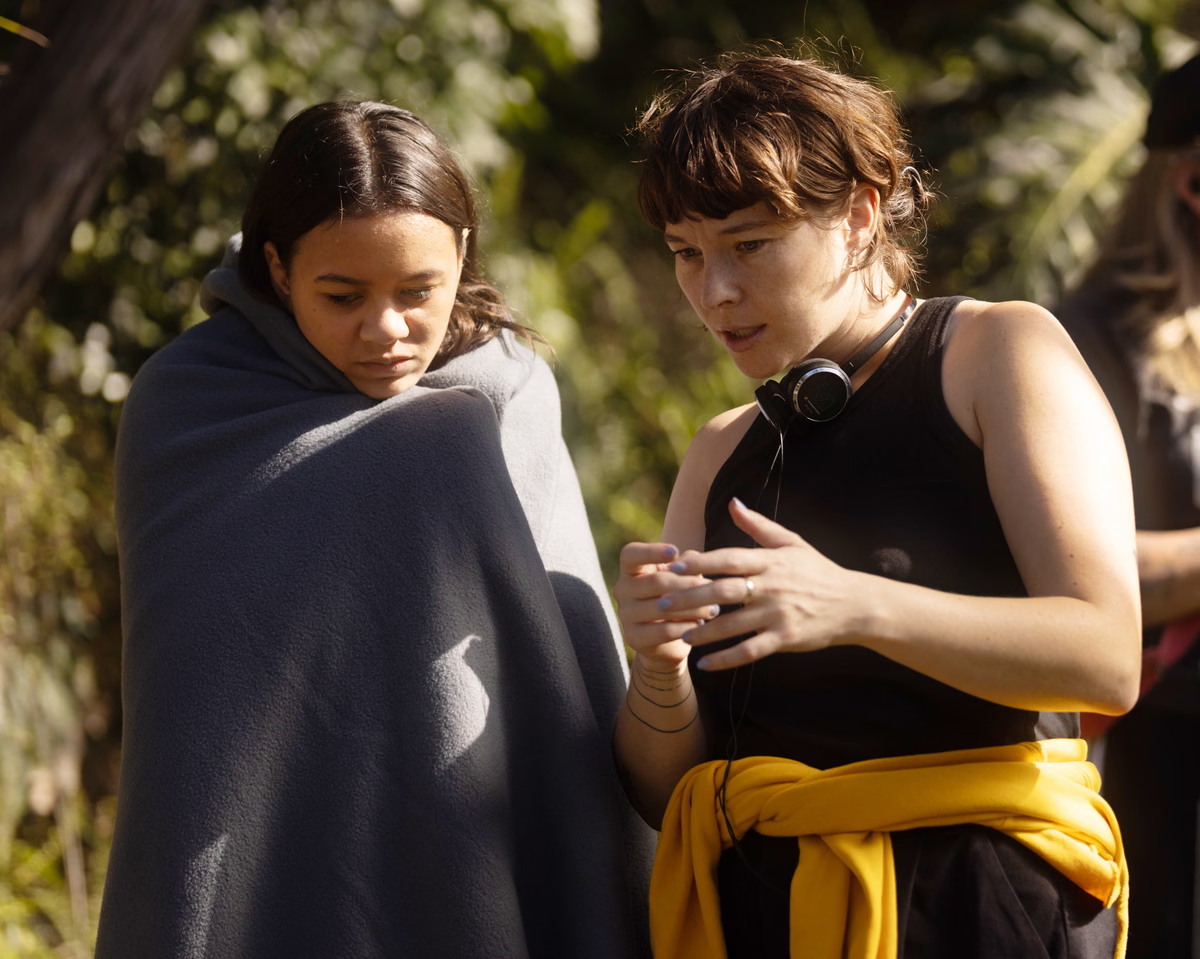
In the quiet yet emotionally resonant film Big Girls Don’t Cry, director Paloma Schneideman offers a piercing look at the awkward and often painful transition into adulthood. Centered on 14-year-old protagonist Sid, portrayed by Ani Palmer, the narrative captures the unsettling experiences of a teenager navigating desire and queerness in early 2000s New Zealand. Against a backdrop of dial-up internet and clandestine TV viewing, the film documents the difficulty of self-discovery during a time when safety for queer youth was far from guaranteed. Deeply uncomfortable watch; reliving the teenage negotiation – or not – of consent feels unsettling and validating, it is a deeply relatable. Which also explores desire, queerness and finding your way – in this case, through small-town New Zealand in the early millennium – suggests the need to feel empathy for our teenage selves is universally felt, the global response to Shneideman’s debut film. The film’s protagonist, 14-year-old Sid, negotiates adolescence at a time of fledgling dial-up internet and brick phones, where options for connecting with like-minded people or exploring sexuality included booting up MSN messenger or flicking through satellite TV to covertly watch Red Shoe Diaries.
Schneideman, 34, notes that the project aims to inhabit the difficult space between consent and non-consent, highlighting the internal pressures teenagers feel to comply with societal expectations. The film’s raw honesty has prompted deep reflection from younger viewers, with one 18-year-old attendee telling the director that the work felt both “seen and exposed.” This dual reaction—capturing the cathartic alongside the confronting—is precisely what the director aimed to achieve in her debut feature. “Yeah, an 18-year-old at the screening last night said, ‘I feel so seen and exposed,” director and writer Paloma Schneideman, 34, says. “I was like, whoa, that’s quite an astute way to think about it. “It’s such a tricky space, and I don’t think we see it a lot.
Developed within the inaugural 10-person cohort at Wave in the Ocean—a film school established by Oscar-winning director Jane Campion—the script began its evolution in 2019. The film, which was shot over 25 days in Ōmaha and Auckland early last year, features notable performances from Palmer, Noah Taylor, and Rain Spencer. As an executive producer, Campion encouraged Schneideman to trust her intuition and establish a creative foundation that prioritizes an authentic directorial voice. It features the main character, Sid, played by Ani Palmer, and one of the cool older city boys who has come to the small, golden-sand town of Ōmaha for the summer.
The production process was rigorous; Schneideman utilized a “body gauge” to instinctively determine whether a scene’s performance felt genuine. She admits to enduring many sleepless nights during the process, constantly questioning how to refine sequences until they felt seamless. Her primary ambition as a filmmaker is to make the mechanics of production invisible, noting that she feels physically ill when a scene fails to capture an honest human moment.
Since its world premiere at the Sundance Film Festival in February, the film has received significant international acclaim. It secured the Grand Prix at the Nouvelle Vagues Film Festival, where juror Kristen Stewart praised its “astounding touch” in handling themes of pain, strength, and past transgressions. Variety has lauded it as a “gentle, rigorous, queer coming of age story,” while the Hollywood Reporter highlighted its intense atmosphere and evocative sense of location.
As the film prepares for general releases in New Zealand and the United States on October 8 and 9, respectively, Schneideman remains focused on the future. She is already conceptualizing her next project, which she envisions as an “anti-romance” that examines the lingering scars of lost love. For the director, the creative process is an ongoing cycle of opening up emotional wounds and healing them, a deliberate approach she believes is necessary to avoid the pitfalls of overly simplistic or saccharine storytelling. Ahead of its general release in New Zealand and the US on 8 and 9 October, Shneideman is feeling grateful for the way it’s connected with audiences. “The most amazing part is seeing how many people take such ownership over the film, they think it’s for them.