

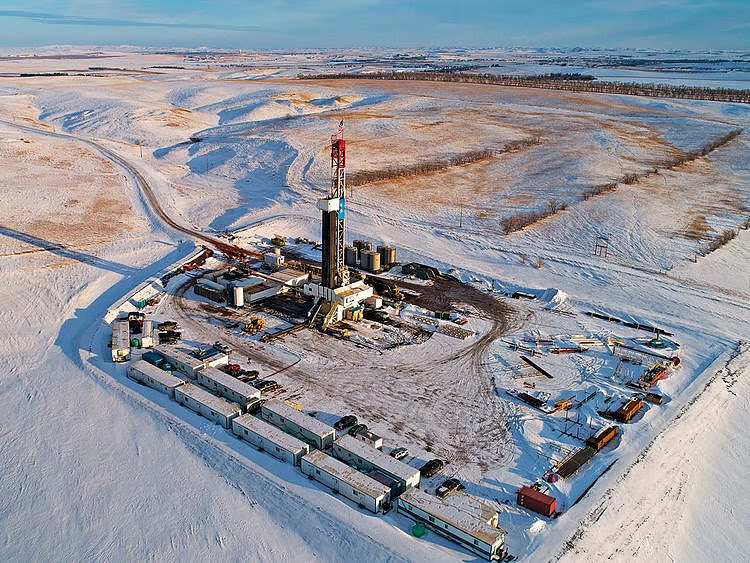
U.S. natural gas production is on track to hit a new annual record in 2026, with output forecast to average 122.5 billion cubic feet per day (Bcf/d), according to the latest Short-Term Energy Outlook (STEO) from the U.S. Energy Information Administration (EIA). This would eclipse the previous annual record of 118.5 Bcf/d set in 2025, marking an increase of about 4 Bcf/d, or 3.4%, in just one year.
The new forecast underscores the United States’ growing importance in global gas markets as producers expand supply to meet rising domestic demand and record LNG exports. The EIA notes that this role has become particularly significant amid disruptions to global gas trade, which have widened the price gap between U.S. Henry Hub gas and international markets, creating stronger incentives for American exports.
A major driver of this growth is the Permian Basin, where the EIA forecasts gas production will average 29.2 Bcf/d in 2026, a 6% increase over 2025. In this region, natural gas production is driven primarily by associated gas produced during crude oil extraction and is supported by crude oil prices. Even when gas prices are relatively modest, oil drilling can generate additional associated gas, increasing overall U.S. output.
The increase is being driven largely by continued production growth in major shale-producing regions, particularly the Permian Basin, Appalachia, and the Haynesville shale. Earlier EIA forecasts identified these three regions as accounting for roughly 69% of U.S. production over the 2026–27 period. Haynesville production is also benefiting from its proximity to major LNG export terminals and industrial consumers along the Gulf Coast.
The production boom is occurring as the United States continues to expand its position as a major LNG supplier. The EIA previously forecast U.S. LNG exports at about 17.4 Bcf/d in 2026, up from 15.1 Bcf/d in 2025, with exports rising to roughly 18.6 Bcf/d in 2027. This growth is supported by the ramp-up of new and expanded facilities, including Plaquemines LNG, Corpus Christi Stage 3, and Golden Pass LNG.
This makes the U.S. gas market increasingly connected to global energy markets, as more American production feeds LNG terminals for shipment to Europe and Asia. Despite record production, the outlook does not necessarily point to a sustained collapse in U.S. natural gas prices. The EIA’s recent forecasts put the Henry Hub benchmark around the mid-$3-per-million-Btu range for 2026, with production growth helping to moderate prices while stronger LNG exports and domestic consumption provide additional demand.
However, the balance could become tighter in 2027. The EIA has previously warned that demand growth could begin to outpace supply growth as LNG exports expand, potentially putting renewed upward pressure on prices and drawing down storage levels during that period.
The 2026 production record is not simply a shale-oil story. It reflects the convergence of Permian associated gas, shale productivity, expanding LNG capacity, rising electricity demand, and strong overseas demand—all of which are reshaping the U.S. and global gas markets. The U.S. is producing more gas at precisely the time global buyers are looking for reliable supplies, reinforcing America’s position as a key swing supplier.
While energy markets remain volatile, the broader context includes various global and domestic developments. Recent reports have noted that global LNG trade continued to grow in 2023, while other nations like Qatar are accelerating LNG expansion. Domestically, the energy sector continues to navigate complex dynamics, ranging from historical price fluctuations—such as when U.S. natural gas futures hit $10 for the first time since ’08—to broader geopolitical and national events, including military helicopter crashes in Texas and political transitions involving figures like Trump press secretary Karoline Leavitt.
US military helicopter crash kills 2 in Texas
Trump says US will ‘keep’ Hormuz strait control
Iran knew Trump’s hotel floor as missile threat emerges