

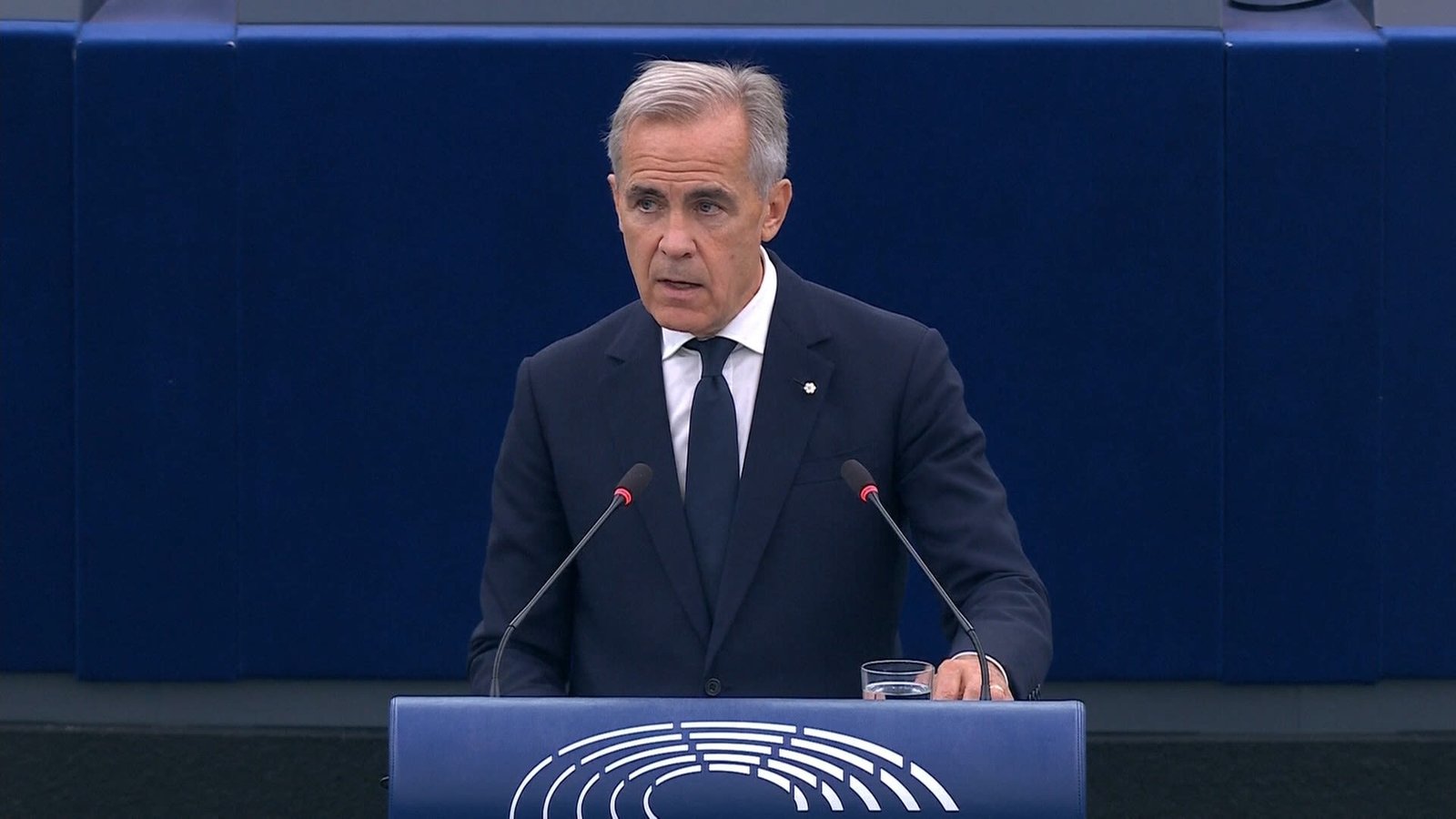
Canadian Prime Minister Mark Carney has pushed back against characterizations of his proposed closer alliance with the European Union as an attempt to establish a third global power bloc. Addressing lawmakers in France on Thursday, Carney clarified that the initiative is intended to build economic and political resilience rather than create a competitor to the United States “with better manners.” He emphasized that the goal is not to challenge any nation, but to ensure that Canada’s open markets, sovereignty, and democratic institutions remain protected against external threats.
This push for deeper integration follows a proposal from European Commission President Ursula von der Leyen that Canada should become the bloc’s first “associate member.” While this specific designation does not currently exist in the EU legal framework, the prospect has already drawn sharp warnings from US President Donald Trump. Trump indicated on Wednesday that the United States could impose heavy tariffs on European goods if he interprets a potential EU-Canada agreement as a “hostile act” against American interests.
Carney maintained that the partnership is an opportunity for Canada to improve its prosperity, sustainability, and independence. He stressed that while Canadian lawmakers will have the final say on the structure of any new alliance, the country is neither seeking nor positioned to become a full member of the European Union. He identified energy security, critical minerals, defense production, and AI safety protocols as key areas for bilateral collaboration. Furthermore, he proposed that Canada join the EU’s Horizon and Erasmus+ programs to foster greater educational and scientific exchange across the Atlantic.
The current legal and political landscape presents significant challenges for this ambition. Analysts at the Center for European Policy Studies noted that while countries like Ukraine and Georgia have association agreements, those require alignment with EU laws, a condition Canada is unlikely to accept. Additionally, the existing Comprehensive Economic and Trade Agreement (CETA), signed in 2017, remains unratified by ten member states, including Poland, Italy, and France, potentially complicating further expansion of ties.
Despite the hurdles, the initiative has found some high-profile support. Spanish Prime Minister Pedro Sanchez signaled his backing by sharing an image on social media featuring a Canadian maple leaf alongside the European stars. Within the EU, however, some officials have reacted with caution. German government spokesperson Stefan Kornelius noted that while Berlin welcomes a stronger partnership, the term “associate member” requires careful reconsideration to define a model that reflects the unique nature of the relationship.
Carney suggested that the precise terminology is a matter for European leaders to resolve, focusing instead on the practical substance of the deal. The two parties are expected to further discuss the mechanics of this cooperation at an investment summit scheduled for Montreal next month. The economic stakes are substantial; bilateral trade in goods and services between Canada and the EU reached €130.8 billion ($151 billion) last year, reflecting an increase of over 80% during the previous decade.
As Canada navigates ongoing trade disputes with the United States, Carney framed the EU-Canada collaboration as a necessary step to address “new storms,” including climate change, the weaponization of global trade, and the erosion of democratic norms. He argued that the alliance could serve as a model for other democracies seeking similar resilience, noting that the framework would remain open to other nations interested in joining such a cooperative effort. The report also notes that “This is an opportunity to make Canada stronger, more sovereign, more independent, more prosperous, more sustainable,” he said. The report also notes that we’ll put very heavy tariffs on Europe, which is a possibility,” he told reporters, if it’s a bad intention. The report also notes that touting Canada’s ability to provide Europe with liquefied natural gas and hydrogen, he said Canada and Europe should cooperate on critical minerals and energy security. The report also notes that even with allies, spurring them to seek new alliances to shore up their economies, canada and the European Union have both been on the sharp end of Trump’s combative approach to trade. The report also notes that we are pursuing resilience so no one can control our open markets, impair our sovereignty, threaten territorial integrity or undermine our freedoms, our democracies, our rule of law.”, on the contrary. The report also notes that its largest trading partner, lending urgency to efforts to get closer to the EU, which has itself battled numerous trade spats with America, canada is locked in a trade war with the United States.