

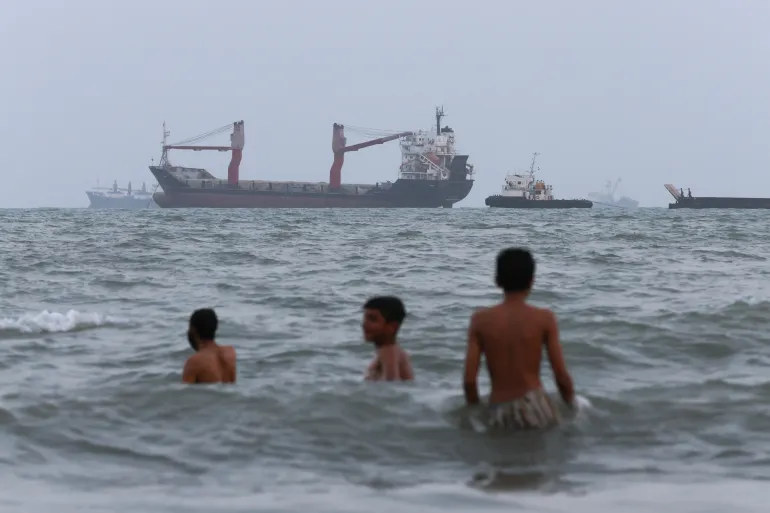
The United States and Iran have exchanged new, competing demands during negotiations for the reopening of the Strait of Hormuz, raising significant doubts about the prospects for a wider deal to end their five-month war. While the US claims it is involved directly in the talks, Iran maintains that it is communicating only with Oman, proposing a shared future management of the critical waterway. This passage, through which one-fifth of the world’s oil and liquefied natural gas supplies were shipped before the conflict began in late February, remains a central point of contention.
On Monday, US President Donald Trump announced he would demand compensation from Iran for deaths and injuries linked to conflicts and attacks spanning several decades. This escalation followed Iran’s issuance of new demands for reparations last week, alongside a declaration that it would not reopen the strait until Washington meets specific political and economic conditions. Experts note that broader peace negotiations between the two nations are unlikely to restart until the status of the Strait of Hormuz is definitively resolved.
“The two sides are further apart,” Al Jazeera’s Tohid Asadi reported from Tehran. “They are getting more and more distant when it comes to the possibility of any diplomatic settlement.” These developments threaten to further complicate the ongoing discussions between Tehran and Oman regarding the future management of the strait, despite previous indications from both Iran and the US that they desired an agreement to end the fighting.
“We’re going to ask for money for the damage they’ve done over a 50-year period,” Trump told reporters at the White House. “So if there’s damages to be paid, I think Iran should pay those damages.” Trump later specified on his Truth Social platform that Iran should compensate the families of the 17 US sailors killed in the October 2000 attack on the USS Cole in Yemen, an incident historically blamed on al-Qaeda. He also demanded compensation for the families of Iranian protesters killed during antigovernment unrest in January, adding that Iran should be held responsible for damages and deaths caused in Lebanon, Syria, Yemen, and Gaza.
These demands were issued in direct response to Iran’s own call for the US to provide compensation for damage caused by US and Israeli attacks during the current conflict. Tehran specifically requested compensation for what it termed two “imposed wars,” referring to the conflict that began on February 28 and the 12-day war with Israel in June 2025, which the US also joined. This cycle of retaliatory demands has created a diplomatic deadlock that analysts fear will be difficult to break.
The rhetoric from the US president appeared to conflict with comments made by Vice President JD Vance, who stated on Saturday that he was confident about reaching a deal with Iran that would benefit the American public. Vance also noted that Iran had assured the US it had “no plans” to impose tolls on the Strait of Hormuz, a key point of friction. Despite these assurances, oil prices jumped more than 5 percent on Monday following Trump’s new demands and continued to rise on Tuesday as hopes for a deal faded.
Iran maintains that the reopening of the strait, which it effectively closed to shipping shortly after the war began, depends on Washington meeting six specific conditions announced by the Supreme National Security Council on Saturday. These conditions include an end to US threats and insults, a permanent cessation of attacks against Iran and its allies in Lebanon, Palestine, Yemen, and Iraq, and the lifting of the US naval blockade on Iranian ports. Furthermore, Iran demands the withdrawal of US naval and air forces from the region and the unconditional release of all frozen Iranian assets.
At the same time, Tehran reports that negotiations with Oman regarding a new shipping arrangement, which involves defining new shipping lanes, have reached their “final stages,” according to Foreign Minister Abbas Araghchi. On Sunday, Araghchi reiterated that there are no direct talks with the US, though messages are being exchanged through intermediaries. Analysts suggest that the hardening of these positions reflects a strategy of maximalism intended to strengthen leverage before any potential final agreement.
“Both sides appear to be putting forward maximalist demands ahead of serious negotiations,” noted Mortazavi, a senior fellow at the Centre for International Policy. Mortazavi emphasized that the latest US stance is particularly sensitive, while Tehran is simultaneously seeking significant guarantees to ensure the conflict does not restart, alongside necessary economic relief.
Tehran-based political analyst Hossein Royvaran suggested that the resolution of the Strait of Hormuz standoff will ultimately depend on which party possesses the greatest endurance. “But the question is, who cries out first?” he told Al Jazeera. Royvaran also noted that there is deep, underlying discontent within the United States regarding the war and its broader consequences for American society.
Experts remain skeptical that a larger agreement can be reached while the fundamental issue of the Strait of Hormuz remains unsettled. The complexity of managing such a vital global artery, combined with the deep-seated mistrust between Washington and Tehran, suggests that the current impasse may persist for some time. As the war continues into its sixth month, the economic and political costs for both sides continue to mount, yet neither appears willing to concede on their core demands.
Ultimately, the diplomatic landscape remains fragile. With both nations entrenched in their respective positions and the global economy sensitive to any disruption in the Persian Gulf, the international community is watching closely to see if the back-channel communications with Oman can yield a breakthrough or if the standoff will lead to further regional instability.