

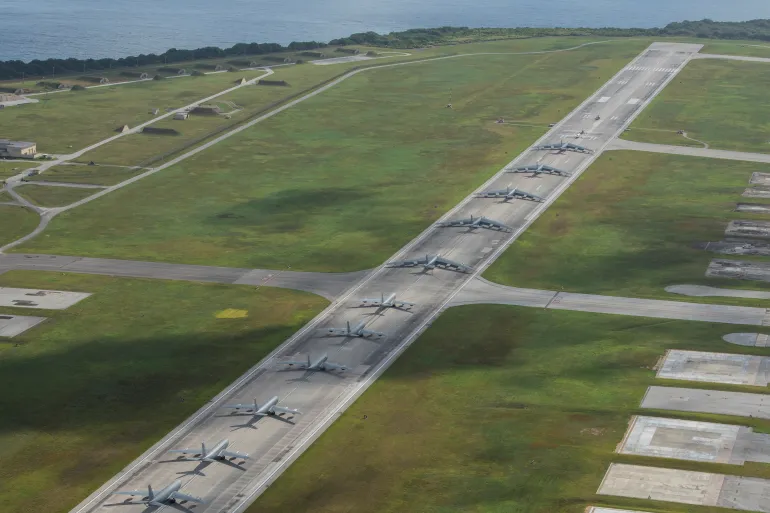
The United States Supreme Court has begun hearing oral arguments in a legal battle concerning the US Air Force’s ongoing detonation of unexploded ordnance at a beach in Guam. At the center of the dispute is Tarague Beach, a site utilized by the military for disposing of hazardous munitions—including missiles, bombs, and landmines—since 1982. The outcome could set a significant precedent regarding how environmental laws apply to federal activities within US territories. Hosting both Andersen Air Force Base and US Naval Base Guam, it has also served as a key US military hub in the western Pacific.
The litigation was brought by the local conservation group Prutehi Guahan, which translates to “Protect Guam” in the Chamorro language. The group argues that these disposal activities jeopardize the island’s ecosystem, threaten critical water resources, and degrade a site of immense cultural and historical value. Specifically, the group contends the detonation site sits atop an aquifer that supplies drinking water to more than 80 percent of the island’s approximately 170,000 residents. The island has an estimated population of about 170,000. Here’s what to know about the case.
A core aspect of the legal challenge involves the interpretation of federal environmental mandates. When the Air Force applied for a new permit in 2021 to continue its operations, Guam’s Environmental Protection Agency notably declined to “deny or approve” the application, allowing detonations to proceed. Prutehi Guahan asserts that the military failed to conduct required environmental impact assessments under the 1969 National Environmental Policy Act, which would necessitate community involvement.
Government attorneys argue that compliance with the 1976 Resource Conservation and Recovery Act fulfills the military’s obligations, asserting that this regulation supersedes the requirements of the National Environmental Policy Act in this context. Furthermore, the government contends that because local regulators have not issued a final decision on the 2021 permit, the conservation group’s lawsuit is premature.
The legal history of the site underscores deeper grievances. Prutehi Guahan notes the detonation range is situated “on ancestral land that the military seized from local families after World War II.” The area remains culturally significant, containing traditional medicinal plant harvesting zones and nearby fishing grounds essential for local sustenance. Archaeological records indicate the region is among the oldest continuously occupied sites in the area, with human activity dating back to the 2nd millennium BC.
Studies cited in court filings indicate that the destruction of munitions at the beach introduces toxic chemical residues and shrapnel into the surrounding reef and ocean environment. These concerns are compounded by a historical record of environmental contamination in Guam, including two Superfund sites linked to past hazardous waste dumping by the Navy and Air Force.
The procedural history of the case reflects the broader tension between territorial residents and the federal government. A district court initially dismissed the complaint in 2022, but the Ninth Circuit Court of Appeals—the largest federal circuit in the country—later reinstated the challenge. The Air Force subsequently appealed to the Supreme Court.
Observers such as Neil Weare and Adi Martinez Roman, co-founders of Right to Democracy, noted that this case highlights the “unbalanced political relationship” between those living in US territories and federal authorities. Guam has been a territory since 1898, yet residents lack presidential voting rights and possess limited legislative representation. In the wake of the Spanish-American Civil War, guam became a US territory in 1898.
In their analysis, Weare and Roman emphasized that for the people of Guam, who often have minimal agency over federal decisions impacting their environment, strict adherence to federal laws requiring community consultation is vital. As the Supreme Court reviews these arguments, the decision will weigh whether historical military land use policies can proceed without the modern oversight mandated by federal environmental protection standards. “Decisions the military made nearly a century ago caused damage that still requires extensive and expensive cleanup,” the filing said. “And military decisions made more recently compound the damage Guam already bears”.