

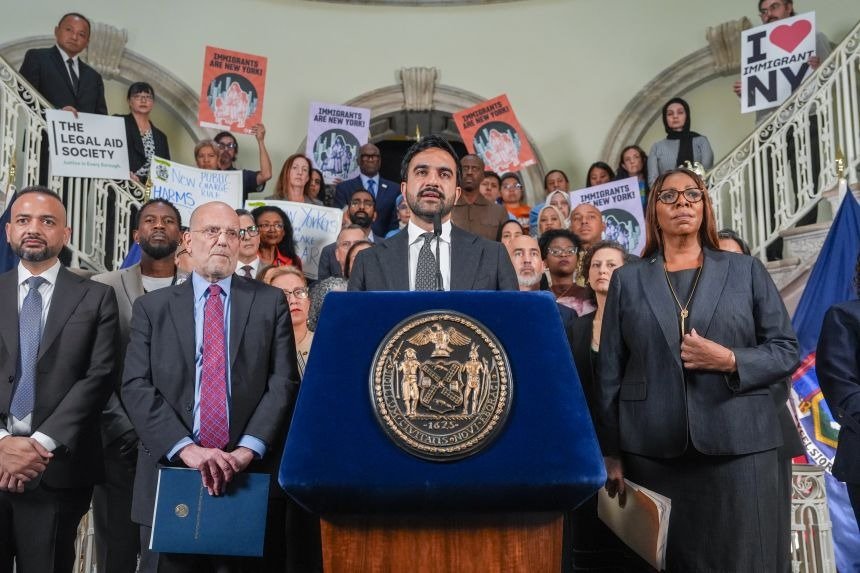
A coalition of 22 states, led by New York, has filed a lawsuit to halt a controversial new Department of Homeland Security (DHS) rule that gives immigration officials expanded discretion to reject applications for green cards, visas, or entry into the United States. Filed in the Southern District of New York on Monday, the legal action seeks to have the policy declared unlawful and prevented from taking effect. The regulation is scheduled to be implemented this Friday and is expected to impact approximately 588,000 applicants who undergo public charge reviews annually.
The policy change centers on the federal “public charge” rule, which dictates that the government can deny residency or entry to individuals deemed likely to become dependent on state assistance. While previous standards historically focused on cash benefits—such as Supplemental Security Income or Temporary Assistance for Needy Families—the new mandate is significantly broader. It does not specify which safety nets are included, asserting only that officials will weigh the receipt of any means-tested benefits. According to advocates, this allows officers to scrutinize critical services including Medicaid, the Supplemental Nutrition Assistance Program (SNAP), and even participation in school meal initiatives.
New York Attorney General Letitia James, during a joint news conference at Manhattan City Hall, condemned the move as an attempt to foster a hostile environment for immigrants. “Cruelty is the point,” James remarked. “Having a chilling effect on immigrants is the point. Letting individuals know that they are not welcome here is the point.” She noted that the rule could even allow authorities to consider benefits accessed by an applicant’s family members, including their U.S. citizen children.
Representing a separate coalition of local governments, New York City Mayor Zohran Mamdani argued that the administration is manufacturing a “climate of fear.” He cited evidence that many residents are already unenrolling from essential benefits for which they remain legally eligible, driven by confusion and concern over potential immigration consequences. “We’re talking about something that we know categorically does not apply to certain sets of New Yorkers, and yet we’re already seeing evidence of those kinds of New Yorkers unenrolling from life-saving benefits,” Mamdani stated.
The plaintiffs, which include cities such as Chicago, San Francisco, and Seattle, alongside Washington’s King County and California’s Santa Clara County, argue that the rule is “arbitrary and capricious.” They contend that the DHS failed to properly justify the change or account for the severe socioeconomic fallout. Furthermore, the states claim they face a combined loss of roughly $4.05 billion in annual federal transfer payments for Medicaid and the Children’s Health Insurance Program (CHIP) as families withdraw from these services.
This initiative builds upon broader efforts by the administration to tighten access to public resources. In July 2025, President Trump signed legislation often referred to as the “big beautiful bill,” which curtailed legal immigrants’ eligibility for food stamps and Medicaid. While the Biden administration had largely reverted to a narrower definition of public charge in 2022 by excluding non-cash benefits, the current DHS stance emphasizes a return to self-reliance. On July 16, the department posted to X that it is “reaffirming the requirement of self-reliance, protecting public resources, and ensuring that those who seek to enter and remain in our country are able to support themselves.”
As the legal challenge moves forward, the primary focus remains on the interpretation of executive authority. Attorney General James argues that the DHS is overstepping its mandate, as Congress never authorized such a sweeping interpretation of public charge status. With no judge yet assigned to the case, the plaintiffs are pressing for an immediate injunction to prevent the government from enforcing the rule while the litigation proceeds. The report also notes that new York and 21 other states are suing the Trump administration to block a new Department of Homeland Security rule that would give immigration officials wider discretion to deny green cards, visas or entry into the Unit. The report also notes that set to take effect Friday, would expand the list of possible government aid that immigration officials could cite as part of a reason to disqualify an applicant, the rule change. The report also notes that both ask the court to declare the rule unlawful and prevent DHS from using it. The report also notes that will accepting food assistance when I fall on hard times be held against me?’”. The report also notes that refugees, asylees and victims of domestic abuse and sex trafficking no longer qualify for the programs. The report also notes that “The fact that you’re going to deny individuals who are sick and hungry and homeless benefits just is beyond the pale.