

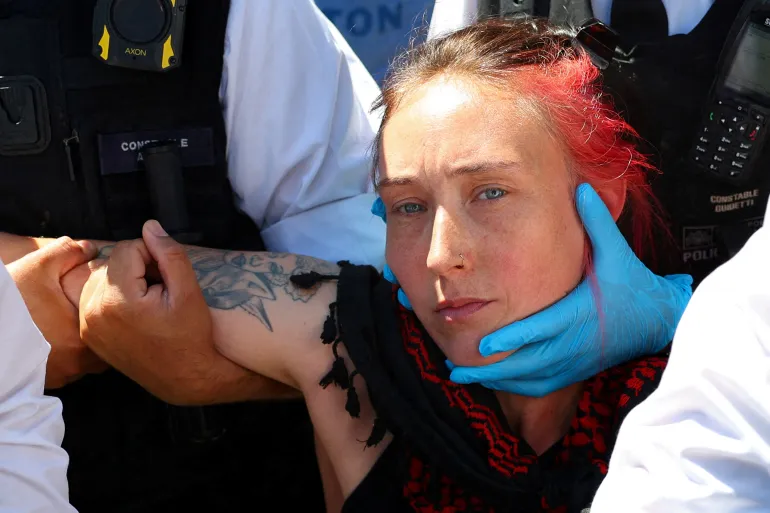
Across the United Kingdom, individuals with no prior history of political activism are finding themselves caught in a mounting legal struggle as they voice opposition to the ongoing conflict in Gaza. Claire, a 52-year-old administrative worker from the Scottish countryside near Edinburgh, represents the shifting tide among ordinary citizens. Once living a quiet, non-political life, she now faces a potential 14-year prison sentence due to her alleged support for the group Palestine Action.
Claire’s path to activism began in the summer of 2023 after she read the bookI Shall Not Hateby Dr. Izzeldin Abuelaish, a Palestinian physician who lost three daughters to Israeli tank fire in 2009. Witnessing the aftermath of the October 7, 2023, attacks online galvanized her. She recalled that for her, there was no delay between hearing the narrative that Israel had a right to defend itself and recognizing the subsequent misinformation. Her frustration grew when she attended an Armistice Day rally and heard government officials label peaceful protests as hate marches. She describes her work as “low-level administration” and does not use social media. She did not consider herself political, until three years ago. Writing letters to lawmakers and fundraising for various Palestinian aid programmes, she continued to march.
The legal pressure is significant. Earlier this year, police detained Claire under Sections 11 and 12 of the Terrorism Act, accusing her of being a member of and encouraging others to join a proscribed organization. She is among more than 3,000 individuals arrested for demonstrating support for the advocacy group since its 2025 ban. Despite the threat of imprisonment, Claire remains steadfast, asserting that she is not backing down against what she views as a government complicit in genocide. She began publicly protesting against the proscription of Palestine Action with Defend Our Juries, the group behind a campaign of civil disobedience aimed at lifting the ban, in August 2025.
A similar trajectory is shared by 70-year-old Marji from Colchester, a former financial services professional. Marji, who had never participated in a protest before the 2023 Armistice Day march, was spurred to action by the government’s rhetoric. Her background is rooted in a family history of fighting fascism, including her father’s service in the British Army and her father-in-law’s time as a prisoner-of-war during World War II. In July, she and her husband were arrested in Westminster under Section 12 of the Terrorism Act for alleged ties to Palestine Action. Marji, 70, lives in Colchester and had a similar feeling after hearing Braverman’s words.
The scale of the movement is vast, spanning various professional sectors from the arts to the railway industry. Trade unions and organizations like Artists for Free Palestine and Workers for Free Palestine have emerged to challenge the UK government’s diplomatic and trade ties with Israel. Protesters argue that the government’s refusal to halt arms sales while the death toll in Gaza exceeds 74,000—and while violence persists in the West Bank—has further alienated the public. “We’ve had to decide … is it safe to have grandchildren here.
Metropolitan Police activity remains intense, with recent arrests reported outside the Board of Deputies of British Jews in north London. Authorities have warned against rallies held on the three-year anniversary of the October 7 conflict, which began when Hamas-led attacks killed approximately 1,200 people and resulted in the capture of over 240 hostages. Since that date, the devastation in Gaza has reached a point where the territory now holds the largest population of child amputees in modern history.
For participants like Marji and Claire, the moral imperative outweighs the risk of professional or personal consequences. Marji, who has Jewish ancestry, rejects the notion that calling for an end to the conflict is synonymous with antisemitism. She emphasizes the ability to distinguish between the Jewish community and those who support an illegal occupation. Both women express that the government’s perceived gaslighting and complicity only harden their resolve to continue advocating for civil liberties and Palestinian rights.
As these activists await their legal outcomes, many echo the sentiment that standing by is no longer an option. A spokesperson for Workers for Free Palestine noted that many individuals feel anger and powerlessness regarding how their labor contributes to what they describe as an apartheid state. Despite the ongoing legal scrutiny, these Britons remain committed to their cause, hoping their actions will force a change in the national discourse regarding the UK’s role in the conflict.