

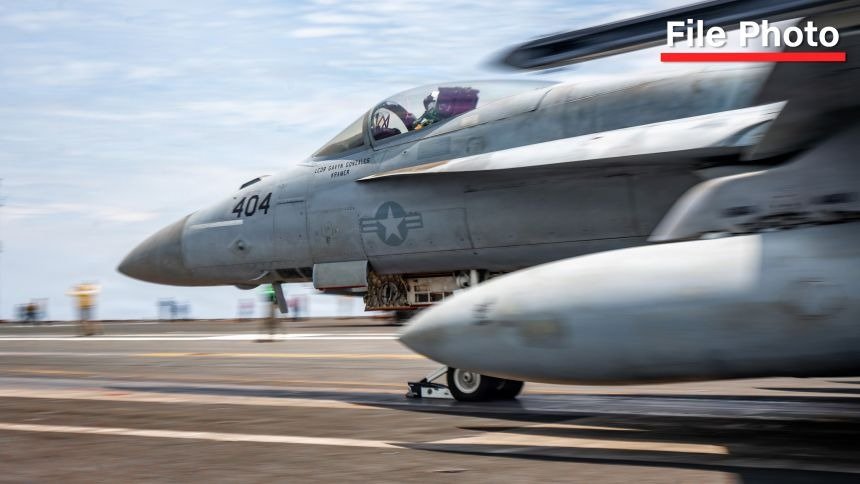
The United States military launched a fresh series of strikes against Islamic Revolutionary Guard Corps (IRGC) targets within Iran on Tuesday. According to US Central Command, the operation, which commenced at 12 p.m. ET, serves as a direct response to recent hostile actions, including attempted attacks on commercial vessels navigating the Strait of Hormuz and threats against American service members deployed in the region.
These military actions follow a volatile period of direct engagement between the two nations that began late Sunday and continued into Monday. During that initial exchange, Iran claimed to have fired missiles at US military installations in Jordan and the United Arab Emirates, characterizing the move as retaliation for a prior American strike on Iranian rocket launchers located on Larak Island. Conversely, US officials stated that the Iranian maneuvers were an attempt to deploy sea mines into the Strait of Hormuz, a critical global energy-shipping chokepoint.
President Donald Trump addressed the situation on Tuesday, labeling the US military response a “very justified attack.” He warned that Iran would face even more severe consequences should they choose to retaliate, while noting that the administration is currently holding back on what he described as “the biggest attack of them all.” In a post on Truth Social, the President claimed that the strikes were large and powerful, specifically targeting Iranian efforts to mine the strait and the earlier missile launches directed at the US base in Jordan.
Tehran has responded with vows of retaliation. The Armed Forces Central Headquarters in Iran issued a statement, carried by state broadcaster IRIB, promising to deliver “crushing and devastating blows” against the “American enemy.” The statement further warned that continued US aggression would result in heavier losses for American forces.
Local reports indicate that the impact of the strikes was felt across several regions. Iranian authorities confirmed that four projectiles struck the port cities of Chabahar and Konarak in the southeast. Meanwhile, IRIB reported multiple explosions occurring east of Bandar Abbas and in the vicinity of Qeshm Island. These locations are strategically significant, as Bandar Abbas and Qeshm Island overlook the Strait of Hormuz, while Chabahar and Konarak host vital maritime and military infrastructure on the Gulf of Oman.
Regarding the leadership in Tehran, President Trump expressed uncertainty, stating, “In my opinion, they don’t know who the leader is.” He suggested that the Iranian military has been significantly degraded, adding, “You have the radicals, but they’ve been wiped out from the standpoint of the military because the military is just a fraction of what it was.” Despite his assertion that the Strait of Hormuz remains in “extremely good shape” for transit, current tracking data indicates that maritime traffic through the region remains notably lower than levels recorded before the conflict began.
The escalation has had immediate economic repercussions. Following the announcement of the new strikes by US Central Command, oil futures climbed above $94 a barrel. This follows a trend from Monday, when an earlier exchange of fire caused global oil prices to rise by nearly 3% and contributed to a decline in US stock indexes. The current military posture marks a notable shift for Washington, moving away from a primary focus on economic pressure toward direct military intervention. The report also notes that “It’s very limited,” Trump said in the Oval Office, going on to list what he said were significant US military accomplishments over the course of the six-month war. The report also notes that their surveillance equipment is almost entirely gone,” he said. The report also notes that asked who was in charge in Tehran, Trump said it remained an open question. The report also notes that “That doesn’t mean we won’t smack ‘em. The report also notes that alejandra Jaramillo, Matt Egan, Aida Karimi and Hira Humayun contributed reporting.