

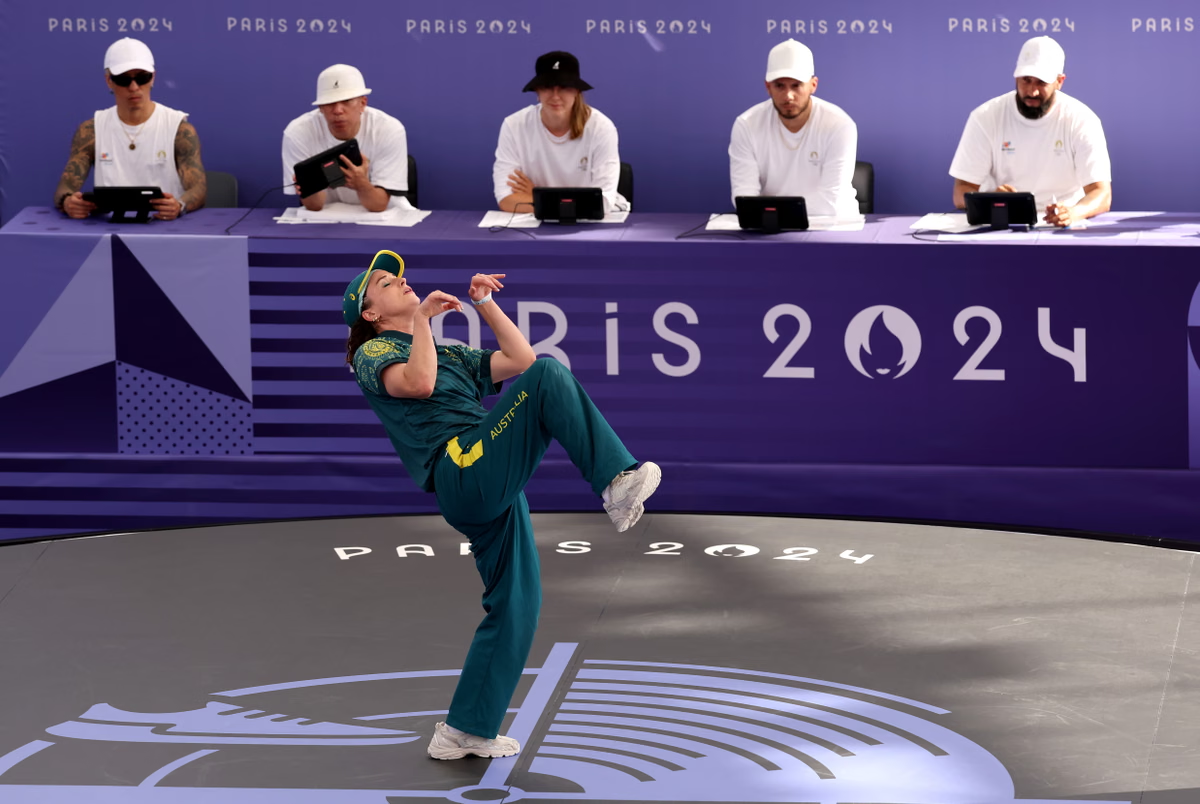
Netflix’s latest installment in its sports seriesUntold Raygun: Breaking Badlyprovides an intimate look at the 2024 Paris Olympics through the eyes of Australian B-girl Rachael Gunn. Early in the film, Gunn reflects on a pre-Games session with her sports psychologist, where she voiced a deep-seated fear: “Right before the Olympics, I went to my therapist, panicked,” she recalls. When she admitted her terror that the world might laugh at her, her therapist asked if that was a reasonable concern—a question that prompted hysterical laughter from Gunn. While most people’s worst-case scenarios remain hypothetical, Gunn’s fear manifested in a global viral moment, marked by her unconventional moves like the sprinkler and kangaroo hops.
Despite failing to secure a single vote from the nine judges across six rounds, Gunn became an overnight sensation. The documentary, which premieres globally on Tuesday, portrays her as a relatable, self-aware individual. Her parents appear in the film, laughing at the irony of their “quirky” daughter becoming an Olympian, while her husband, Sammy Free, is depicted as a devoted supporter. However, the film avoids a critical examination of what it means for breaking—a discipline rooted in the Black and Brown youth culture of the South Bronx—to have its Olympic debut defined by a white academic performing unorthodox routines rather than the dynamic athleticism typically associated with the art form.
The film benefits from the perspectives of other Australian B-girls, such as Flix and Tinylocks, who provide necessary context regarding the gender dynamics and the “no easy props” ethos of the breaking scene. This hip-hop philosophy, often linked to American B-girl Asia One, emphasizes that respect must be earned through demonstrated skill. Tinylocks, reflecting on Gunn’s rise within the small Australian scene, notes that while there were occasional moments of freshness, the quality of her performances was inconsistent. This sentiment reflects a broader concern among dancers who prioritize breaking as an art form over the competitive trajectory set by the World DanceSport Federation (WDSF) and the International Olympic Committee (IOC).
Addressing her performance, the documentary explains that Gunn adjusted her set composition after realizing she lagged behind the top-tier competitors she would face in Paris. Following poor showings at European battles in the months leading up to the Games, she and her husband shifted their strategy. Yet, the film suggests that even with a different approach, the fundamental requirements of the sport—clean footwork and precise, unhurried movement—remained a hurdle. While other athletes like pommel horse specialist Stephen Nedoroscik also became memes during the Paris Games, the discourse surrounding them lacked the intense mockery directed at Gunn, who notes that women often face disproportionate and harsh criticism for their public actions.
Gunn is certainly not the first athlete to compete at the Olympics with skills considered subpar by elite standards, joining the ranks of figures like Eddie the Eagle or Eric Moussambani. However, the documentary misses an opportunity to fully reckon with the impact of her notoriety on the future of breaking. While the WDSF has submitted breaking for consideration for the 2032 Brisbane Games, the sport will not appear at the 2028 Los Angeles Olympics—a fact unrelated to Gunn’s performance that the film leaves unaddressed. Ultimately, the documentary serves as a personal portrait, concluding with Gunn’s own acceptance of her identity as a “dorky white woman” who is an academic, leaving the viewer with a sense of her resilience rather than a deep dive into the cultural fallout of her Olympic appearance. The report also notes that anyone who has ever gone to a therapist will be amused at this anecdote. The report also notes that the therapist would have been right, nine and a half times out 10. The report also notes that no, they’d say, the worst outcome you can imagine probably won’t come to pass. The report also notes that the kangaroo hops – in the cypher made her go viral almost as soon as she was done with her sets, her shenanigans – the sprinkler. The report also notes that (Perhaps if Gunn had been explicit about what she was planning to do in her sets, her therapist would have reacted differently.) Gunn’s performance launched a thousand memes, more than a couple of late-night TV segments, several conspiracy theories, and even a musical at the Edinburgh Fringe Festival. The report also notes that it’s mostly focused on Gunn herself with little time spent on the greater context of the art form and how it ended up in the Olympics. The report also notes that through them, we get a coming of almost middle-age story about an academic who meets a B-boy working at a call center, falls in love with him and the art form he’s passionate about, and somehow ends up centerstage at the Olympics. The report also notes that sammy Free seems like a sweet fellow who is completely besotted with his wife.