

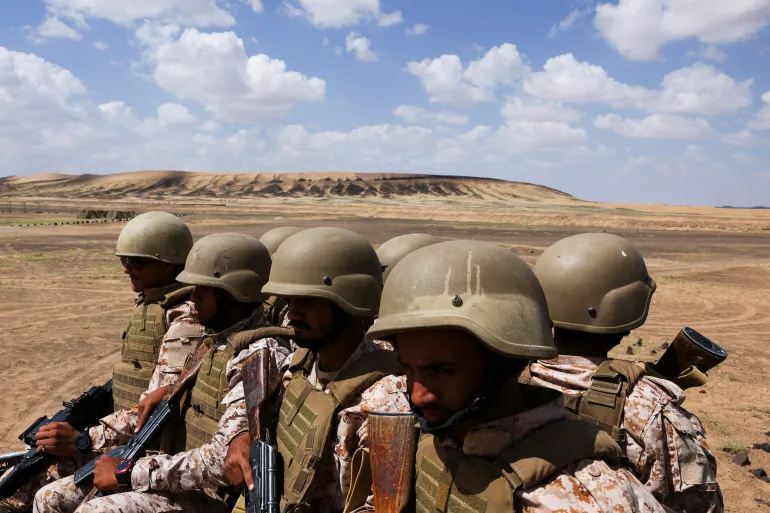
Yemen is currently facing its most significant risk of returning to full-scale war since the 2022 truce was established, according to a warning issued by a United Nations envoy. Hans Grundberg, the UN Special Envoy for Yemen, informed the UN Security Council on Thursday that military activity has surged across previously frozen front lines, resulting in both civilian and military casualties.
Clashes have been reported between Iran-aligned Houthi fighters and government forces in areas including Marib, Hadramout, and al-Makha. The internationally recognized government, based in Aden, stated it successfully repelled a Houthi offensive in Taiz and has launched its own artillery and drone strikes against Houthi positions across several governorates. In response to the escalating situation, the head of Yemen’s Presidential Leadership Council declared on Wednesday that any Houthi actions would be met with “a comprehensive response or deterrence.”
Grundberg urged all parties to prioritize immediate de-escalation and work toward a stable ceasefire. He cautioned that renewed Houthi attacks on Red Sea shipping threaten to pull Yemen into the broader regional confrontation between the United States and Iran. Furthermore, he emphasized the urgent need for “economic de-escalation” to stabilize a nation devastated by a decade of civil war. He encouraged the warring factions to cooperate on reopening commercial flight routes to Sanaa, resuming oil exports, and ensuring that merchant vessels can safely reach Yemeni ports.
The conflict, which began when the Houthis seized Sanaa in 2014 and triggered a Saudi-led military intervention in 2015, has seen progress toward a lasting peace stall since 2023. As regional tensions have risen, the humanitarian situation has worsened significantly. UN humanitarian chief Tom Fletcher reported to the Security Council that over half of the Yemeni population lacks reliable access to food, with six million people currently facing “emergency” levels of deprivation that approach famine conditions.
Fletcher also highlighted the disproportionate impact of the conflict on women, noting that three women die daily due to preventable complications related to pregnancy. The British government has placed the blame for this humanitarian crisis on the Houthis, citing their attacks on international shipping and Saudi territory. Sarah MacIntosh, the UK’s permanent representative to the UN, condemned “reckless Houthi actions” for fueling regional violence and urged the group to focus on peace rather than regional entanglement.
The cycle of violence continues to escalate, with the Houthis claiming responsibility for a drone strike on an oil refinery in Saudi Arabia’s Jazan province on Thursday. A Houthi military source informed Reuters that the strike was a retaliatory measure against alleged Saudi violations of Yemeni sovereignty and airspace in the Hajjah and Saada provinces. This incident marks the latest in an ongoing series of missile and drone exchanges that have intensified since the Houthis announced a blockade on Saudi shipping in the Red Sea on July 20.
On these issues, both sides in the conflict “have more to gain from cooperation than confrontation”, he said.
Yemen has been mired in conflict since the Houthis seized the capital Sanaa in 2014, prompting a Saudi-led military intervention the following year that spiralled into a years-long war.
The Houthis and the internationally recognised government struck a truce in 2022 that has, until now, largely held.
Progress towards a lasting agreement to end the war stalled in 2023 as tensions in the wider region escalated, Grundberg said.
The intensification of fighting in Yemen is worsening the country’s humanitarian crisis.