

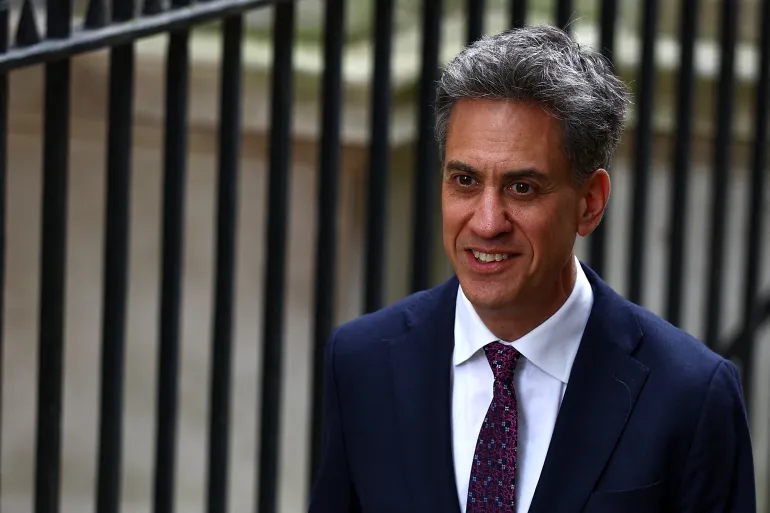
The United Kingdom has officially implemented a ban on the import of all goods produced within illegal Israeli settlements located in the occupied West Bank. In a significant address to Parliament, Foreign Secretary Ed Miliband characterized this move as part of a “comprehensive reset” of the nation’s policy toward Israel, asserting that the government must act against injustices in Palestine rather than merely criticizing them.
Miliband explicitly accused Israel of engaging in “ethnic cleansing” within the Palestinian territories. He stated that the British public does not wish to support the occupation by allowing products manufactured in these settlements to be sold in local shops. The Foreign Secretary emphasized that while the new sanctions regime targets illegal settlement expansion, it is not directed at the state of Israel itself.
The government’s new measures include a total prohibition on advertising the sale of properties located in illegal West Bank settlements and the imposition of sanctions on any organization, business, or individual involved in providing infrastructure, financing, or construction services for these areas. Furthermore, the UK will refuse all new export licenses for weapons or materials that “materially contribute to the occupation.”
Beyond the trade restrictions, Miliband announced that the UK is extending its global human rights regime to enable faster action against settlement expansion, specifically targeting the development of the E1 area. He also confirmed that the government would impose new sanctions on Al-Qard al-Hasan, the financing arm of the Lebanese group Hezbollah, and would reinstate sanctions on Iran in alignment with European Union and United States policies.
The Foreign Secretary, who is Jewish, reiterated the UK’s commitment to a two-state solution and condemned the rhetoric of Israeli officials like Finance Minister Bezalel Smotrich, who have publicly opposed the concept of a Palestinian state. Miliband also addressed rising anti-Semitism in the UK, promising a more rigorous government approach to combat prejudice, while clarifying that targeting Jewish people for the actions of the Israeli government is “anti-Semitism, pure and simple.”
Despite these changes, Miliband maintained that the UK continues to recognize Israel’s right to exist and live without fear. He condemned the October 7, 2023, Hamas-led attacks and insisted that Hamas must dismantle its infrastructure and decommission its weapons, stating that the group has no place in the future of Gaza.
The impact of the settlement import ban is expected to be limited, as such goods represent less than 1 percent of total UK-Israel trade. In 2025, total trade between the two nations reached 6 billion pounds ($8.1bn). Critics, including Zena Agha of the British Palestinian Committee, described the move as a “bare minimum,” while Chris Doyle of the Council for Arab-British Understanding argued that the UK must be prepared to escalate measures if Israel continues its settlement activities.
Following Miliband’s announcement, a coalition of 12 nations—including France, Canada, Denmark, Spain, Finland, Ireland, Iceland, Norway, Poland, Portugal, and Sweden—issued a joint statement supporting the two-state solution and signaling their own intent to restrict trade with illegal settlements. This collective international pressure aims to discourage further expansion in occupied territories.
The UK has historically attempted to differentiate between Israeli products and those from settlements, requiring importers to provide documentation to ensure goods are not mislabeled. Last May, the government suspended negotiations to modernize trade agreements regarding digital services, further signaling a cooling of economic ties related to the occupation.
Miliband concluded by framing the decision as a reflection of British values, stating that the country is committed to fighting oppression and standing up for what is right globally. He emphasized that the government’s dispute is strictly with the conduct of the current Israeli administration, not with the Israeli people. The report also notes that the ban comes amid an intensifying wave of Israeli settler pogroms on Palestinian communities in the occupied West Bank and controversial settlement expansions that have prompted a UK-led debate on Europe-wide trade restrictions. The report also notes that he accused the Israeli government of turning a blind eye to the violence and intimidation of Palestinians. The report also notes that a Britain that fights against oppression and suffering wherever it occurs, a Britain that stands up for what is right”, he said, britain is a country “that upholds its values at home and around the world. The report also notes that he added, the UK has already suspended more than 30 arms licences used by the Israeli army in Gaza. The report also notes that the UK is an important trading partner for Israel as a whole. The report also notes that however, it is difficult to estimate exactly how much of this is from goods produced by settlements, but an estimated 38 million pounds ($51.4m) worth of goods was imported from the occupied territory in 2025, parliament records show.