

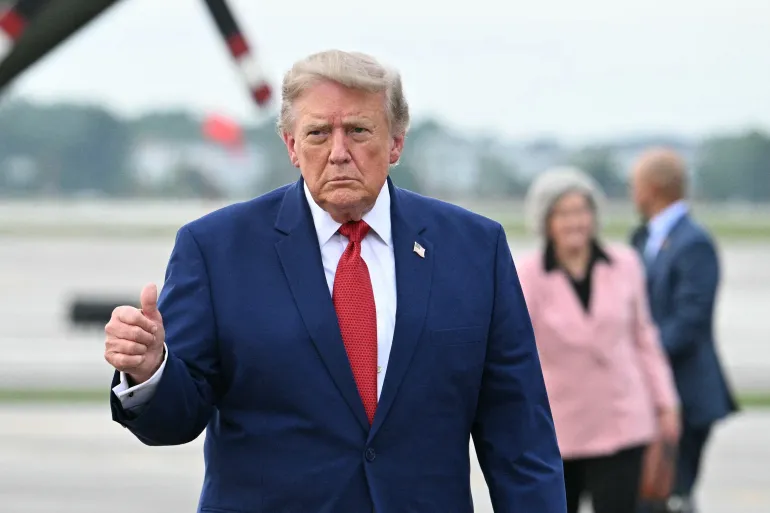
United States President Donald Trump has reaffirmed his assertion that the U.S. maintains “total control” over the Strait of Hormuz. This declaration comes as transit through the vital waterway dropped to a one-week low, a development occurring against the backdrop of the ongoing US-Israel conflict with Iran.
Trump shared these remarks via a Truth Social post on Wednesday, echoing sentiments he expressed to reporters the previous day. His comments arrive as diplomatic initiatives intended to resolve the hostilities and restore full access to the strait remain stalled. “The U.S.A. has total control over the Strait of Hormuz. I THINK WE WILL KEEP IT!” the president stated.
In his message, Trump characterized the current US blockade of Iranian ports as “A WALL OF STEEL,” asserting that Tehran is powerless to counter it. He further described Iran as “the Bully of the Middle East No Longer,” concluding his post with the phrase, “Praise be to Allah!”
Despite these claims, Iran continues to exert influence over the region, recently engaging in independent discussions with Oman regarding the future management of the strait. Broader peace negotiations involving Washington have largely stagnated, and Tehran maintains that full maritime traffic will not resume until the US naval blockade is lifted, sanctions are removed, and frozen Iranian assets are released.
The impact of the conflict on shipping has been severe. Reuters reported that only eight vessels transited the strait on Tuesday, a sharp decline from the pre-war average of 130 to 140 ships. Data from the analytics firm Kpler indicates this figure is also a drop from the previous ten-day average of approximately 12 ships per day.
The conflict, which began on February 28, saw a brief period of hope in June when the US and Iran signed a Memorandum of Understanding; however, that agreement collapsed in mid-July, leading to renewed hostilities. Recent days have seen sporadic incidents, including a US Navy helicopter strike on a Panama-flagged cargo ship on Tuesday. Additionally, the Yemen-based Houthis have expanded the theater of operations, with a Tuesday attack on an Egyptian-owned vessel resulting in six deaths.
International diplomatic efforts continue, with Pakistan’s Foreign Ministry spokesperson, Tahir Andrabi, noting on Wednesday that Islamabad is working to facilitate negotiations between the warring parties. Pakistan’s leadership has held recent talks with officials from Iran, Saudi Arabia, and Kuwait, and Interior Minister Mohsin Naqvi is currently visiting Tehran to support these efforts.
While the Trump administration has signaled a desire for a diplomatic exit—partly due to the war’s unpopularity ahead of the November midterms—analysts suggest the president’s rhetoric is aimed at framing the conflict as a success. Dennis Citrinowicz of the Institute for National Security Studies argued that such claims create a “virtual reality” that ignores the situation on the ground, noting that Iran still possesses the capability to disrupt maritime traffic.
Disputes have also emerged regarding official US data. US Energy Secretary Chris Wright claimed on Tuesday that the seven-day average for oil exports through the strait had reached nearly 9 million barrels per day (Mbpd), citing infrastructure upgrades. However, industry analyst Brett Erickson of Obsidian Risk Advisors challenged this, stating there is “zero evidence” to support the 9Mbpd figure, emphasizing that the claim is neither potential nor probable.
Reuters news agency reported that just eight ships transited through the Strait of Hormuz on Tuesday, far below the 130 to 140 ships pre-war rate.
That was down from the previous ten-day average of about 12 ships, according to trade analytics platform Kpler data.
He added that Pakistan’s deputy prime minister and deputy foreign minister held talks with officials from Iran, Saudi Arabia and Kuwait on August 10, and that Pakistani Interior Minister Mohsin Naqvi is also visiting Teh
While ships can still transit through the strait, they face several obstacles and heightened threats.
That has caused the volume of traffic to drop dramatically.
He added that Pakistan’s deputy prime minister and deputy foreign minister held talks with officials from Iran, Saudi Arabia and Kuwait on August 10, and that Pakistani Interior Minister Mohsin Naqvi is also visiting Tehran.
Despite the lack of progress, the Trump administration has continually signalled its desire for an off-ramp in the war, which remains politically unpopular in the US ahead of midterm elections in November.
Wright said that, when combined with upgraded land delivery infrastructure, fossil fuel deliveries from the region were close to pre-war levels.