

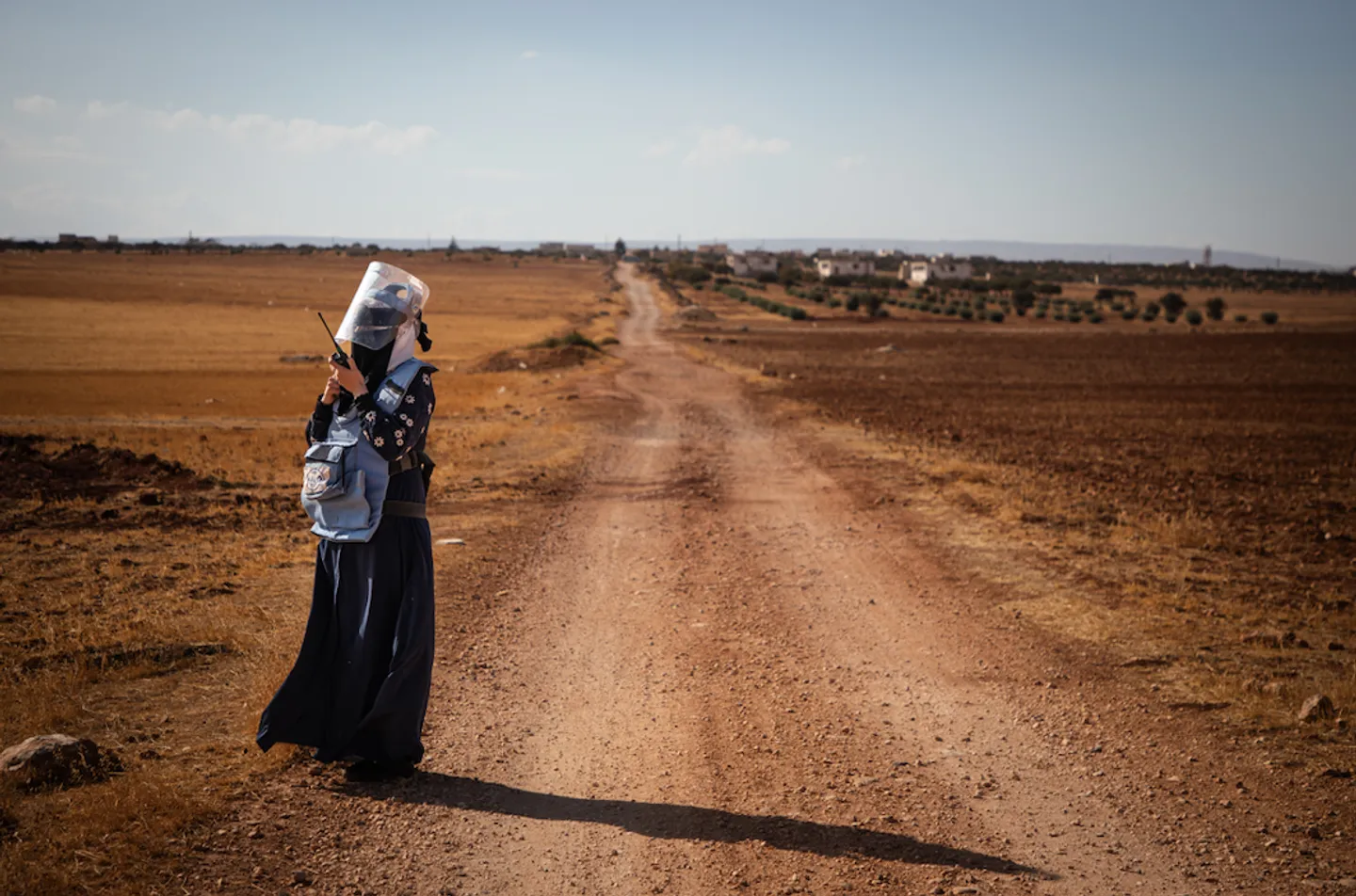
In the Idlib countryside, Lama Haj Kaddour stands in a dry field, carefully holding a detonator. She is part of an all-female team that spends hours locating and neutralizing buried landmines. When a blast occurs, a plume of smoke marks the spot where a deadly threat once lay hidden. Kaddour, a 33-year-old mother of three who relocated from the Hama countryside to Idlib in 2019, is one of 31 women currently working in operational demining roles for The HALO Trust in the region.
The legacy of fourteen years of civil war has left Syria heavily contaminated with landmines and explosive remnants of war (ERW). This danger persists even after the cessation of major conflict, threatening the millions of displaced people returning to damaged homes. According to The HALO Trust, women are increasingly taking on roles as manual deminers, team supervisors, paramedics, and community educators as the organization expands its national staff beyond 250 personnel.
The fall of the Assad regime in December 2024 proved to be a turning point for these efforts. The change in government removed significant operational restrictions, allowing the organization to broaden its training and clearance operations into areas like Daraa and the northwest. In these new hubs, women now account for approximately 20 percent of trainees—a notable figure given that a 2019 survey by the Journal of Conventional Weapons Destruction previously identified women as only 20 percent of the global mine action workforce, with clearance roles being predominantly male.
For women in conservative regions, their gender offers a distinct operational advantage. They are often able to enter local households to communicate directly with other women and children, providing essential safety education that male colleagues might not be able to deliver. Kaddour, who began her career supporting landmine survivors before training for fieldwork in 2022, views the work as a personal mission. She explains that she could never live with the thought that a single wrong step by her children could trigger a landmine, resulting in death or the loss of a limb.
The scale of the crisis remains severe. Raed al-Hassoun, director of clearance operations at Syria’s National Mine Action Centre, reported that 49 landmine incidents occurred between the start of 2026 and the end of August, resulting in 24 deaths and 61 injuries. The Syrian Network for Human Rights (SNHR) estimates that at least 3,799 civilians, including 1,000 children and 377 women, have been killed by landmines across the country. The highest death tolls have been documented in Aleppo, Raqqa, and Deir Ezzor.
The threat is dynamic, as environmental factors like flooding can shift buried explosives into new areas. Siba Abdul Karim, a 36-year-old mother of two who leads the non-technical survey department at The HALO Trust, notes that the danger is not fixed to where the war originally left it. She and her colleagues work to mitigate these risks, often balancing the dangers of the field with their responsibilities as parents. For many, like 26-year-old Mariam al Asaad—a volunteer with the White Helmets—the work is deeply personal. Al Asaad’s own brother was injured when he stepped on a landmine in their family’s olive grove in 2017, an event that forced the family to abandon their land.
National efforts to address the crisis are ongoing. Al-Hassoun notes that the National Mine Action Centre is developing standards to govern the field and building a national information management system to better track risks. Military engineering teams from the Ministry of Defence and units from the Ministry of Emergency and Disaster Management are also involved in clearance operations. The center has established an operations room in Damascus, coordinating efforts between international NGOs like The HALO Trust, the International Committee of the Red Cross, and the Red Crescent to prioritize the reconstruction of infrastructure, such as in the Jobar district.
Despite the risks, these women remain committed to their work. Whether they are calming a child who has discovered an explosive device or clearing fields to allow families to return to their livelihoods, they see their contribution as vital to the country’s recovery. As al Asaad notes, while she worries about the balance between her duties and her daughter, the necessity of clearing the land remains the primary driver for her daily work. The report also notes that the rest of the team waits, still and silent, a short distance away. The report also notes that kaddour wears a protective vest over her clothes. The report also notes that she dresses fully in black with only her eyes visible, in line with social norms in Idlib, like her colleagues. The report also notes that she first worked with relief organisations before joining The HALO Trust. The report also notes that women now make up about 20 percent of new demining trainees — eight out of a recent class of 40, according to Pomfret, in training hubs such as Daraa. The report also notes that but the roads leading to them contaminated, many find their homes still standing. The report also notes that on August 31, an unexploded object detonated in the village of Faydat Ibn Muwaina in the Deir Ezzor countryside as children were handling it.