

Pakistan has intensified its diplomatic efforts across the Middle East, with Prime Minister Shehbaz Sharif embarking on a three-day official visit to Saudi Arabia from August 6 to 8. The trip, initiated at the invitation of Saudi Crown Prince and Prime Minister Mohammed bin Salman bin Abdulaziz Al Saud, occurs amid heightened regional tensions and a push by Islamabad to foster de-escalation in the Gulf.
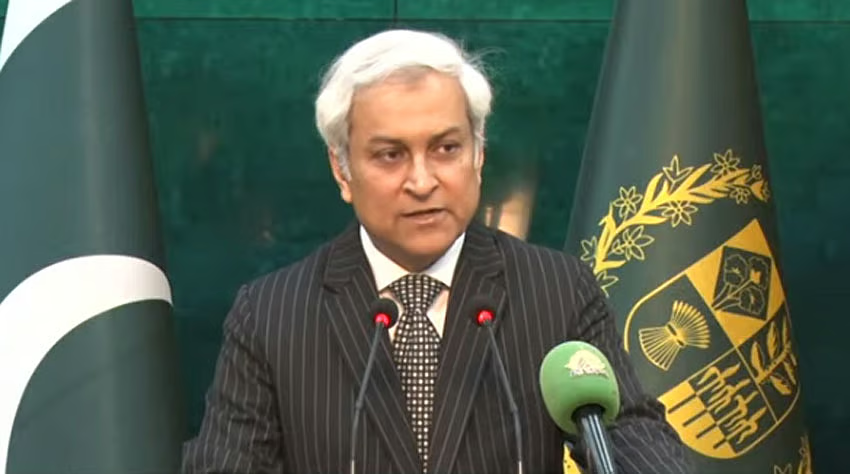
Foreign Office spokesperson Tahir Andrabi stated during an August 6 briefing in Islamabad that the visit underscores the enduring strategic partnership between the two nations. The delegation accompanying the Prime Minister includes Deputy Prime Minister and Foreign Minister Ishaq Dar, along with Chief of Army Staff and Chief of Defence Forces Field Marshal Syed Asim Munir. The leadership is set to discuss economic and defense cooperation, as well as coordinated responses to pressing international developments.
Andrabi emphasized that Pakistan remains committed to promoting regional stability through active engagement. This includes efforts to ease tensions around the Strait of Hormuz, a critical artery for global energy supplies. Islamabad has expressed support for Oman’s role in regional mediation and continues to back diplomatic initiatives aimed at achieving a lasting resolution to ongoing crises.
Diplomatic efforts are also focused on facilitating dialogue between Washington and Tehran. Deputy Prime Minister Ishaq Dar has held recent discussions with his Saudi and Iranian counterparts, Prince Faisal bin Farhan and Seyyed Abbas Araghchi, covering the situations in Palestine, the Red Sea, and the Strait of Hormuz. Dar has also extended an invitation for the Iranian foreign minister to visit Pakistan.
Regarding the Palestinian cause, Pakistan reaffirmed its stance during the August 5 Ministerial Meeting on Jerusalem in Amman. The government reiterated its support for a sovereign Palestinian state based on pre-1967 borders, with Al-Quds Al-Sharif as its capital, aligning with the consensus of Arab League and Islamic nations.
On the security front, Pakistan is strengthening its counterterrorism cooperation with the United States. Following the fourth round of the Pakistan-US Counterterrorism Dialogue in Washington, both nations committed to disrupting terrorist facilitation networks. The dialogue specifically identified threats from ISIS-Khorasan, Al-Qaeda, the Tehreek-e-Taliban Pakistan (TTP), and the Balochistan Liberation Army (BLA).
Intelligence collaboration between Islamabad and Washington remains robust, with plans for further expansion. Discussions have focused on cross-border militant networks operating from Afghanistan, with Pakistan continuing to urge the Kabul administration to dismantle infrastructure used for attacks against Pakistani territory. While characterizing recent border clashes as internal Afghan matters, Andrabi noted that support for the TTP remains the primary barrier to normalized relations with Kabul.
Pakistan has also expressed interest in Saudi Arabia’s evolving maritime security initiative, though discussions regarding its operational framework are ongoing. Islamabad continues to condemn attacks on commercial vessels in the Red Sea and Bab al-Mandeb, labeling such actions as violations of international law that jeopardize global trade.
Looking ahead, the government plans to continue utilizing multilateral platforms and bilateral diplomacy to reduce Gulf tensions. These efforts are part of a broader strategy to secure economic stability and reinforce strategic partnerships. The administration is also pursuing domestic policy initiatives, including the establishment of a special protection unit for Chinese nationals, the introduction of a national esports policy, and addressing its status as the world’s fifth most populous nation as of 2026.
The Foreign Office also addressed various regional and global concerns, including the condemnation of Israeli actions by several Arab and Muslim nations, the launch of new digital services for the Prophet’s Mosque, and the UAE’s stance on drone attacks against Saudi oil facilities. Additionally, the government has officially denied allegations regarding the participation of Pakistani nationals in the conflict in Ukraine.
The meeting brought together Arab League member states and selected Islamic countries to coordinate their response to the deteriorating situation in occupied Jerusalem.
Pakistan enters 2026 as 5th most populous country
While some countries have taken the lead in specific areas of the peace process, he described Pakistan’s contribution as part of a coordinated regional effort aimed at preventing further escalation and creating conditions for sustained negotiations.
He expressed hope that progress on the Strait of Hormuz would pave the way for the resumption of technical-level talks envisaged under the Islamabad Memorandum of Understanding and the Pakistan-Qatar Joint Statement.
Canada, Pakistan reset ties with landmark visit