

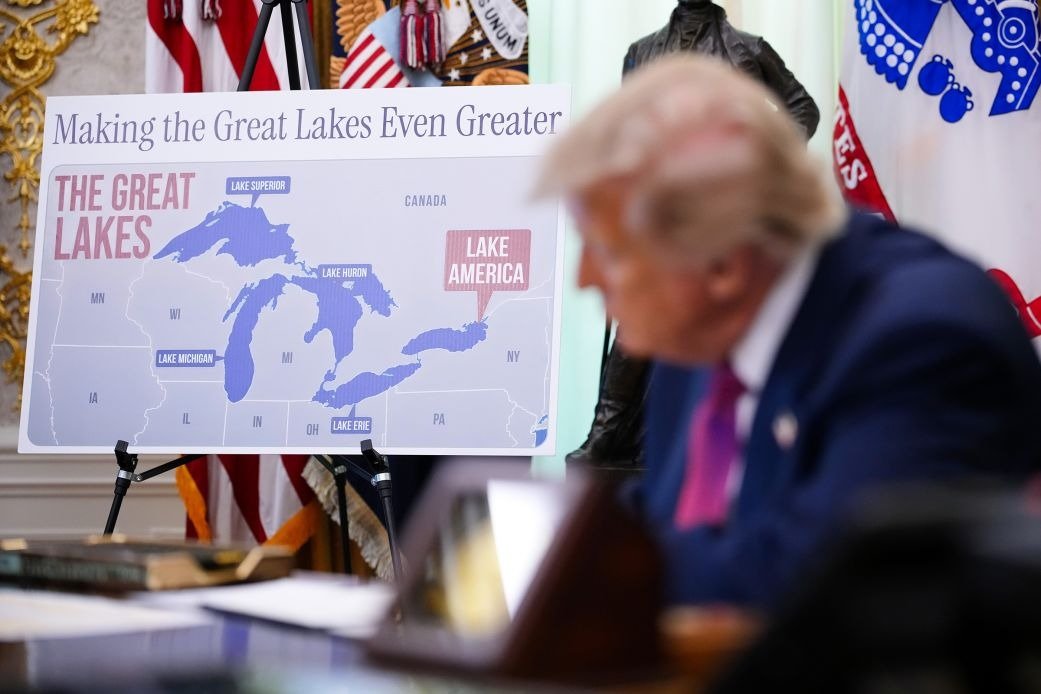
President Donald Trump formalized a directive on Thursday to rename Lake Ontario as “Lake America,” a move that further strains diplomatic relations during an ongoing trade dispute with Canada. Standing in the Oval Office beside maps labeled “Making the Great Lakes Even Greater,” the president declared the change effective immediately. He noted that the concept of a “Lake of America” had been under consideration for some time, even suggesting that he might eventually seek to rename the Atlantic and Pacific Oceans.
The executive order mandates that Interior Secretary Doug Burgum and the Board on Geographic Names complete the transition within 30 days. This process includes updating the Geographic Names Information System and removing all references to the original name from federal documents, contracts, and agency communications. Trump justified the decision by citing the significant volume of the lake’s waters located within U.S. territory, describing the landmark as a vital component of the nation’s heritage.
This development follows a series of retaliatory economic measures between the two nations. Over the weekend, the administration imposed 50% tariffs on approximately $20 billion worth of Canadian goods, prompting Canada to respond with its own increased levies on U.S. products. Trump, who has characterized Canadian officials as “nasty people” and difficult to negotiate with, had previously hinted at the name change, stating he saw little reason to maintain business ties with Ontario.
Canadian Prime Minister Mark Carney swiftly rejected the renaming, emphasizing that the name Lake Ontario is derived from the Wendat word “Ontari’io,” meaning “the lake is beautiful, the lake is big.” In a statement on social media, Carney affirmed that the name has existed for over 400 years, predating both countries, and declared that Canada would continue to recognize it as Lake Ontario indefinitely. Nova Scotia Premier Tim Houston also dismissed the order, labeling the action as “foolishness.”
The administration has previously utilized similar tactics, such as renaming the Gulf of Mexico to the “Gulf of America” last year. That decision faced significant pushback from Mexican officials, who refused to adopt the new moniker. While Google adjusted its mapping services to reflect the change for U.S. users, it retained the original name for users in Mexico. Furthermore, the Associated Press refused to adopt the “Gulf of America” terminology, leading to a legal dispute after the White House restricted the news organization’s access to certain events.
Efforts to resolve the current trade conflict remain stalled. U.S. Trade Representative Jamieson Greer confirmed on Wednesday that there are no active negotiations with his Canadian counterpart, Dominic LeBlanc. Despite a personal rapport with LeBlanc, Greer noted that the Canadian side is currently evaluating its next steps. The impasse persists even as some lawmakers attempt to de-escalate; Senator Susan Collins of Maine recently urged the administration to return to the negotiating table after Canada offered to remove seafood and fish products from its retaliatory tariff list.
As the administration moves forward with the renaming, the broader impact of the trade war continues to be felt. Canada remains the United States’ second-largest trading partner, accounting for 12.6% of total U.S. trade. With the current executive order, the White House aims to solidify its stance, though the practical application of the name change remains limited to U.S. federal jurisdiction and does not force international compliance. The report also notes that pointing out in a post on X Thursday afternoon that the origin of Lake Ontario’s name is more than 400 years old, predating the founding of both the U, it didn’t take Canadian Prime Minister Mark Carney long to push back. The report also notes that he called the body of water — which borders Ontario, Canada and New York — “a tremendous asset to the United States and part of our Nation’s heritage.”. The report also notes that though he can’t force other countries to follow suit, trump has wide latitude over how the US government refers to geographic landmarks. The report also notes that on Tuesday, Trump said he was seriously considering renaming Lake Ontario “in that we don’t expect to be doing much business with Ontario any longer.” Canada is the United States’ second largest trading partner, behind Mexico, according to US Census data, making up 12.6% of its total trade. The report also notes that he concluded that his country would “forever” call it Lake Ontario. The report also notes that their foreign policy, their national monuments, their hydronyms, their trade relations.