

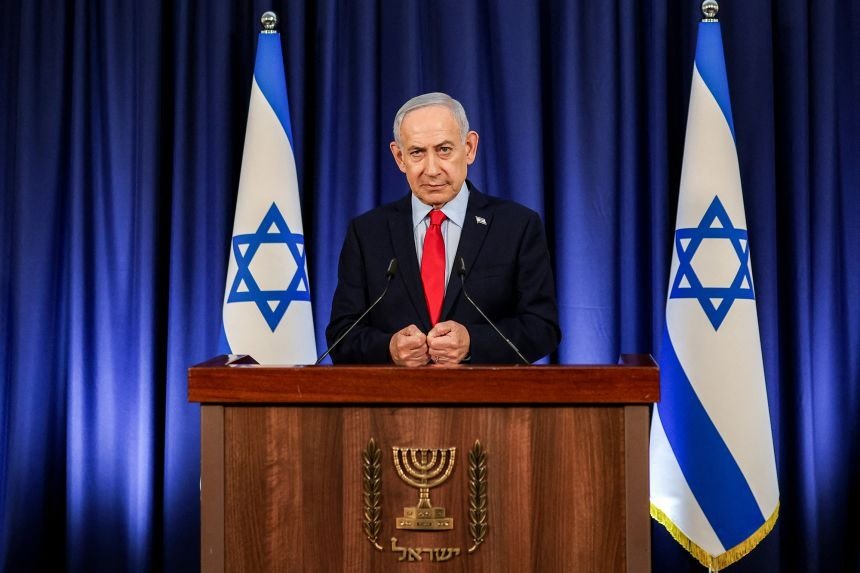
Israeli Prime Minister Benjamin Netanyahu is facing a significant political crisis following a report that UAE President Sheikh Mohammed bin Zayed warned him about an impending Hamas operation roughly 10 days before the October 7, 2023, attack. The report, published by the Haaretz newspaper and based on an upcoming book by authors Shlomi Eldar and Ruti Yuval, alleges that the two leaders held a 45-minute phone conversation. During this call, the UAE president reportedly cautioned that Hamas leader Yahya Sinwar was planning a major offensive that would likely cause significant bloodshed and regional instability. This warning was allegedly linked to a message Sinwar had sent to both the UAE and Israel via a Palestinian mediator in mid-September 2023, which spoke of an impending “earthquake.”
The Prime Minister’s Office has vehemently rejected these claims, labeling the report an “absolute lie” and asserting that no such conversation took place between the two leaders during that period. While the UAE Foreign Ministry declined to confirm or deny the specific call, it issued a statement noting that it does not comment on private discussions between leaders, adding that intelligence sharing between relevant entities remains ongoing. An Israeli source indicated that Netanyahu’s office had pressured the UAE to issue a more explicit denial, but the Emirati government limited its response to a general statement regarding intelligence cooperation.
With national elections approaching in less than two months, the report has become a focal point for opposition leaders who are framing it as further evidence of systemic failure. A coalition of four opposition figures—Gadi Eisenkot, Naftali Bennett, Avigdor Lieberman, and Yair Golan—issued a rare joint statement demanding an immediate and thorough investigation into the government’s conduct. They questioned what specific information the prime minister possessed, why he failed to inform the security establishment, and why no preventative measures were taken to protect civilians. Former Prime Minister Naftali Bennett characterized the alleged disregard for such warnings as “criminal negligence,” while Yair Lapid argued that the massacre could have been prevented had the prime minister fulfilled his responsibilities.
The political tension is further exacerbated by the ongoing debate over accountability for the October 7 attack, which resulted in the deaths of 1,200 people and the abduction of over 250 others. Netanyahu has consistently resisted calls from survivors and bereaved families to establish an independent state commission of inquiry. Instead, his administration has frequently pointed toward security officials, suggesting they failed to alert him to the imminent threat on the night before the attack. This narrative has led to heated public exchanges, including recent accusations by Sara Netanyahu against Yair Golan, whom she suggested had suspicious advance knowledge of the event—a claim Golan dismissed as a “vile conspiracy theory” and a distraction from the government’s own failures.
Golan, a retired major general and current leader of the Democrats party, has been particularly vocal, asserting that the prime minister’s narrative of being kept in the dark is no longer credible. Following the Haaretz report, he described the situation as a “conscious and criminal abandonment” of duty. The Democrats party has since escalated its campaign, placing a large billboard over a major Tel Aviv highway that labels the events of October 7 as the “1,200 murdered file” and accuses the government of causing death through negligence.
The controversy arrives at a time when Netanyahu has outlasted nearly all of the top security officials who were in power at the time of the attack. Since the events of October 7, the heads of the Mossad, Shin Bet, military intelligence, the military chief of staff, and the defense minister have all left their positions. Gadi Eisenkot, currently viewed as a primary challenger to the prime minister, has pledged that if elected, he will prioritize the formation of a state commission to investigate the security and intelligence failures that allowed the Hamas operation to succeed. The report also notes that and assured Bin Zayed that Israel was prepared for any scenario, haaretz reported that Netanyahu reacted “relatively calmly” to the information. The report also notes that she questioned how Golan was “already dressed and ready” at dawn that day to head south, “while others knew nothing, including the prime minister.”, in an interview with the pro-government Channel 14. The report also notes that calling the allegation part of Netanyahu’s attempt to “rewrite” the events of October 7 and deflect responsibility, golan demanded an apology for what he called a “vile conspiracy theory” and said he would pursue a defamation suit.