

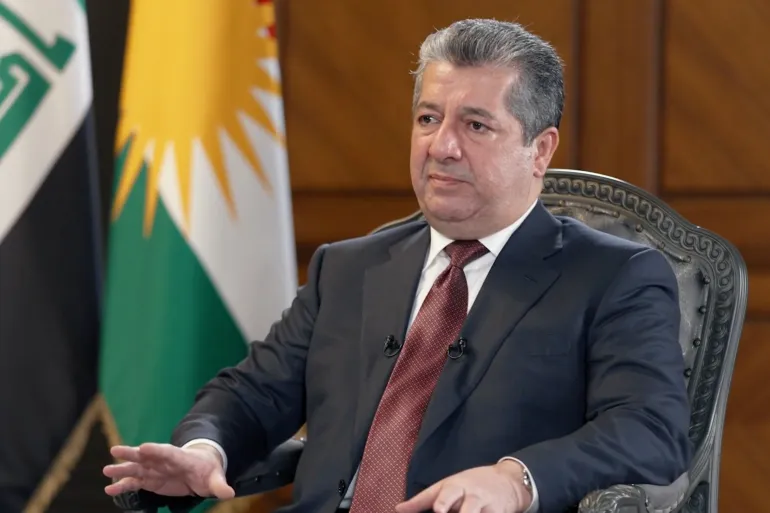
Masrour Barzani, Prime Minister of the Kurdistan Regional Government (KRG) in northern Iraq, has stated that his semi-autonomous region is determined to remain outside the ongoing regional conflict involving the United States, Israel, and Iran. In an exclusive interview with Al Jazeera on Saturday, Barzani emphasized that no external actors have pressured the KRG to join the hostilities, asserting, “No party has pressured us to get involved in the war and we do not want to be a party to any conflict in the region.”
Since the outbreak of the conflict on February 28, the region has faced significant instability, with Barzani reporting that over 1,000 missile and drone strikes—launched by Iran or regional militias—have caused extensive damage to local infrastructure. Describing these actions as “unjustified,” the Prime Minister advocated for peaceful resolutions through diplomatic dialogue rather than military escalation.
The security situation has been highlighted by specific incidents, such as the March missile strike by Iran’s Islamic Revolutionary Guard Corps (IRGC) against the al-Harir Air Base near Erbil. While the IRGC labeled the site a US military headquarters, Barzani clarified that the base has been vacant of American personnel for nearly a decade, following the defeat of ISIL. He noted that while US forces remain in Erbil to combat terrorism, their presence has frequently drawn hostile fire.
Regarding internal security, Barzani expressed support for the Iraqi government’s initiative to consolidate military power. Prime Minister Ali al-Zaidi has mandated that all paramilitary groups must surrender their weapons to state control by September 30, aiming to end the long-standing influence of armed factions that has persisted since the 2003 US-led invasion.
On the diplomatic front, Barzani confirmed that the KRG maintains no official relations with Israel, while simultaneously strengthening ties with Turkiye and Syria. This regional outreach was underscored by a recent visit from KRG President Nechirvan Barzani to Syria, where he met with President Ahmed al-Sharaa—the first such high-level meeting since the collapse of the Bashar al-Assad regime in December 2024.
The conflict has also drawn attention to Iranian Kurdish opposition groups residing in the region. With Kurds comprising approximately 10 percent of Iran’s population, both US President Donald Trump and Israeli officials have speculated that arming these factions could impact the internal balance of power within Iran. These groups remain on high alert as their positions in Iraq and Iran have become focal points in the broader regional struggle.
The prime minister said the region’s infrastructure has been severely damaged by more than 1,000 missile and drone attacks since the war began on February 28, either directly from Iran or from within Iraq via militias.
He added that US troops remained in Erbil to “fight terrorism” and that their presence had repeatedly come under attack.