

Tehran has indicated a strategic pivot toward a more aggressive military posture in its conflict with the United States, coinciding with the official expiration of a Memorandum of Understanding (MoU) on Monday. While the agreement had largely collapsed following a resurgence of hostilities last month, its formal end marks a new phase in the standoff.
Brigadier General Yadollah Javani, who leads the political bureau of the Islamic Revolutionary Guard Corps (IRGC), stated on Sunday that his forces are prepared to take any necessary action to defend the nation. He emphasized that while Iran’s efforts have remained defensive, they are now poised to adopt an offensive character, warning opponents to anticipate “strategic surprises.”
The shift in rhetoric follows the consolidation of power by Supreme Leader Mojtaba Khamenei, who recently appointed several IRGC loyalists to critical security roles. Khamenei has explicitly tasked the new IRGC commander-in-chief, Major General Ahmad Vahidi, with balancing “maximum deterrence” alongside a readiness for “powerful offensive operations.”
Vahidi claimed that Iranian forces have successfully challenged the most heavily armed military in history since the conflict began with US and Israeli strikes on February 28. Meanwhile, IRGC spokesperson Hossein Mohebbi has previously identified US energy networks, power grids, and digital infrastructure as potential targets should Washington strike Iranian civilian facilities.
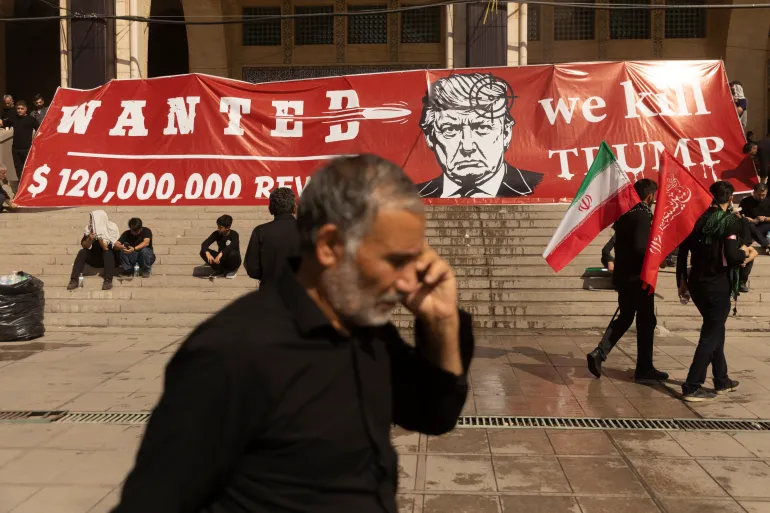
The prospect of ground operations remains a central point of contention. US President Donald Trump recently asserted that Iran had been defeated and suggested that the Strait of Hormuz would soon be declared US territory. Although the White House later characterized the remark as a joke, the response from Tehran was swift. Army chief Amir Hatami announced a bounty of $30,000 for the capture or killing of any US soldier involved in ground operations on Iranian soil, with double that amount offered for female captors.
Mohsen Rezaee, secretary of the Supreme National Security Council, suggested that the US had previously considered ground incursions but abandoned them due to flawed planning. He noted that US Central Command air raids in July targeted approximately 50 cities across 15 provinces, focusing on infrastructure like radar, maritime towers, and logistics routes to isolate the southern regions.
Rezaee argued that a successful ground invasion of the Strait of Hormuz would require a force of at least 100,000 troops, noting the logistical impossibility of crossing the Zagros Mountains and Fars province with smaller numbers. In anticipation of such threats, Iranian forces have reinforced islands and coastal areas, including the vital Kharg Island oil terminals.
Army spokesperson Mohammad-Reza Akraminia confirmed that rapid-response units are positioned to repel any foreign landings. He warned that any American attempt to seize Iranian islands would be met with direct retaliation, extending to targets on foreign soil if necessary.
Beyond the immediate US conflict, Iran is also preparing for potential instability near its borders with Iraq, Turkiye, Pakistan, and Afghanistan. The IRGC has reportedly intensified its defensive measures and continued targeted strikes against armed groups operating within Iraqi Kurdistan.
Despite the expiration of the MoU, Iran’s Ministry of Foreign Affairs maintained that the document’s end does not carry specific significance for the ongoing war or the status of negotiations with Oman regarding the Strait of Hormuz. Foreign Ministry spokesperson Baghaei stated that Iran does not formulate policy under the pressure of deadlines or ultimatums.
Baghaei added that ongoing discussions with Oman aimed at a partial reopening of the Strait have faced delays due to technical and legal complexities, as well as the interference of “ill-wishing parties.” He reiterated that Tehran’s decisions remain rooted in its own assessment of national security and interests.
Parliament speaker Mohammad Bagher Ghalibaf praised the now-expired MoU as a diplomatic victory, asserting that the Islamic Republic has emerged from the conflict with the US and Israel as a political and military victor. He dismissed the US and Zionist regime’s efforts as an “abject failure.” The report also notes that vahidi said Khamenei’s leadership and the Iranian armed forces had managed to “bring to its knees the most heavily-armed army in world history” after the US and Israel launched strikes in Iran on February 28, starting fi. The report also notes that “Our hands are open in terms of reaching the aggressors and they will become more open through our initiatives,” Hatami said, referencing recent Iranian attacks on US forces in Jordan. The report also notes that instead attacking about 50 cities in 15 provinces, rezaee said that the US Central Command had refrained from hitting Tehran or northern Iran during the two-week flareup in fighting in July. The report also notes that tensions between Iran and the US over control of the Strait of Hormuz have continued to rise despite a ceasefire being agreed between them in June. The report also notes that hardline Iranian politicians and media outlets have discussed the idea of mounting a ground incursion against US interests in Bahrain and Kuwait if Washington invades Iran. The report also notes that while there is no recent indication that the US is planning ground operations in Iran, analysts have raised questions over the feasibility of that and the risks involved. The report also notes that vahidi said Khamenei’s leadership and the Iranian armed forces had managed to “bring to its knees the most heavily-armed army in world history” after the US and Israel launched strikes in Iran on February 28, starting fierce fighting between the two sides. The report also notes that he added, women would be given twice the reward if they managed such a feat.