

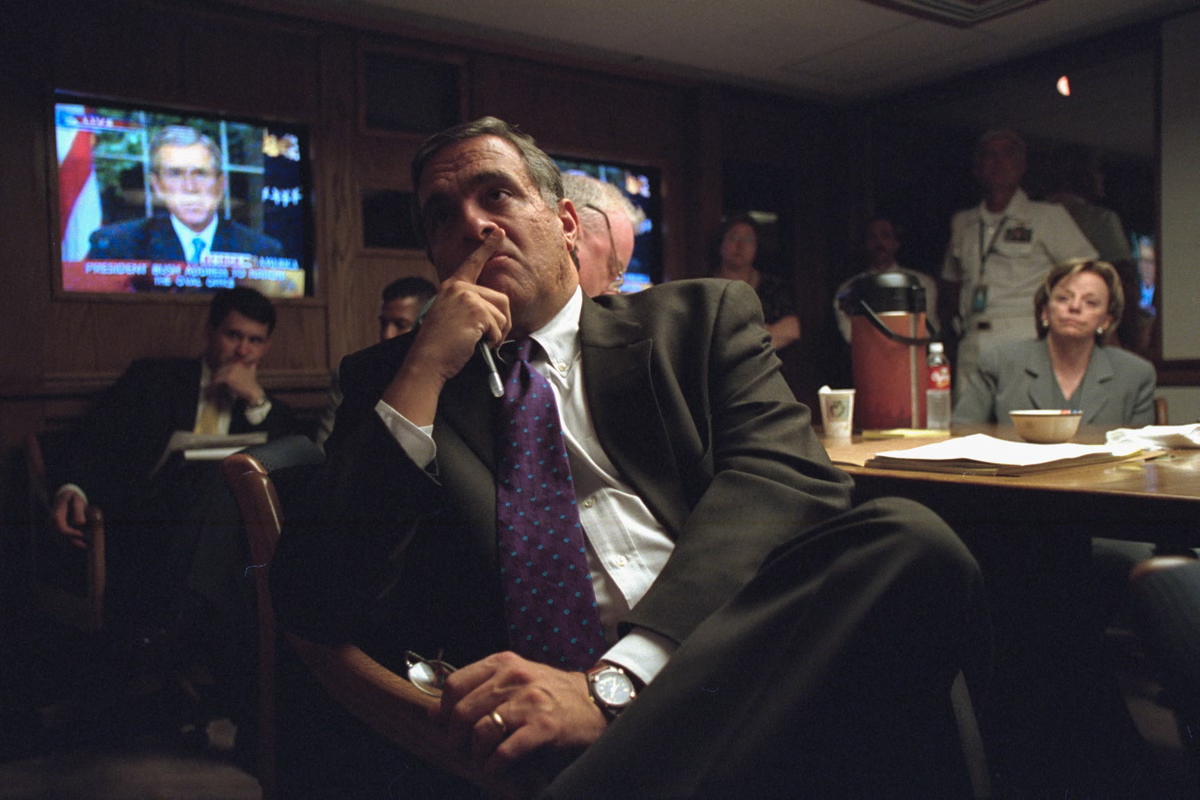
For a generation of intelligence officers, the end of the Cold War left the CIA searching for a new purpose. That search ended abruptly on September 11, 2001, when al-Qaida’s devastating strikes on New York and Washington signaled that the era of anti-communist operations had been replaced by a relentless, no-holds-barred war on terror. This shift would eventually leave the agency with a tarnished reputation, marked by the use of falsified intelligence to justify the invasion of Iraq and an extraordinary rendition program involving the use of enhanced interrogations.
The immediate aftermath of the attacks revealed an organization largely unprepared for the new reality. Margaret Henoch, then a counter-intelligence officer, remembers the atmosphere at the CIA’s Langley headquarters as one of profound confusion and a lack of clear leadership. She recalls an officer entering her office to report that a plane had struck the World Trade Center. About 40 minutes later, finding no guidance from the agency’s senior leadership, she ascended to the seventh floor, where the director, George Tenet, and other top officials were based, only to find the area largely deserted.
Bill Harlow, who served as the CIA’s public affairs director at the time, later noted that the agency had been aware of intelligence from 1995–96 regarding potential terrorist interest in using aircraft to attack the headquarters. He explained that Tenet and his senior team had relocated to a more secure, lower-profile building on the compound to ensure their survival. While the counter-terrorism center staff remained in the main building, thousands of other personnel were eventually ordered to evacuate. By that time, however, roads were gridlocked with commuters fleeing Washington, leaving many staff members trapped in the parking lots.
The initial dysfunction soon gave way to a period of intense focus. Henoch describes a flood of intelligence reports confirming al-Qaida’s involvement, forcing officers to rapidly educate themselves on the group’s structure and reach. Steven Cash, a former counter-terrorism officer who had moved to the Senate intelligence committee, recalls the scene at the Capitol as chaotic, with staff members witnessing the Pentagon strike from across the National Mall. Reflecting on the agency’s performance, Cash expressed a sense of survivor guilt, questioning whether the intelligence community had failed to prevent the tragedy.
The following day, September 12, senators visited Langley to determine what resources the agency required. This visit helped catalyze significant legislative changes, including the USA Patriot Act and the Homeland Security Act. These measures were designed to expand surveillance and law enforcement powers. Later, the creation of the Office of the Director of National Intelligence (DNI) aimed to break down silos between the 18 different intelligence agencies, ensuring better information sharing.
Susan Miller, a retired CIA officer, noted that the DNI was established specifically to prevent the hoarding of intelligence within the CIA, a problem that had hindered coordination before 9/11. While these structural changes improved intelligence capabilities, the agency also became increasingly vulnerable to political pressure. This was evident in the lead-up to the Iraq War, where officials like Donald Rumsfeld pushed narratives about links between Iraq and terrorists, such as the alleged meeting between Mohammed Atta and an Iraqi consul in Prague—claims that intelligence officers often found baseless.
Despite the controversies and the long, difficult conflicts in Iraq and Afghanistan that followed, some veterans believe the agency emerged more capable. Cash noted that the intelligence community significantly improved its ability to prevent repeat attacks on US soil. While acknowledging that the post-9/11 years were not a “great time” for the agency’s reputation, he emphasized that the fundamental approach to national security had been permanently transformed. The report also notes that a generation of spies had lost an enemy but not yet found a role. The report also notes that al-Qaida’s devastating attacks on New York and Washington on 11 September 2001 announced to the Central Intelligence Agency (CIA) that the long era of battling communism, for which it had been founded, was officially at an end, a decade after the dissolution of the Soviet Union. The report also notes that a third smashed into the Pentagon, and a fourth crashed in the Pennsylvania countryside after passengers overcame the hijackers, the US intelligence community was dramatically transformed after two planes flew into the World Trade Center. The report also notes that accounts of what unfolded inside the CIA’s headquarters in Langley, Virginia, suggests an organization unprepared for the drastically changed world the attacks ushered in, despite an awareness among some in the intelligence community that al-Qaida and its leader, Osama bin Laden, represented a clear and present danger. The report also notes that to this day, Henoch – who had previously been stationed in Vienna, where she focused on the International Atomic Energy Agency and nuclear threats – is haunted by the apparent vacuum that followed. The report also notes that the area was deserted, apart from three assistants, to her surprise. The report also notes that “It was reasonable that they would have moved those guys someplace else,” said Henoch. The report also notes that “What was unreasonable, in my humble opinion, was that no one thought about all those people sitting in that building.