

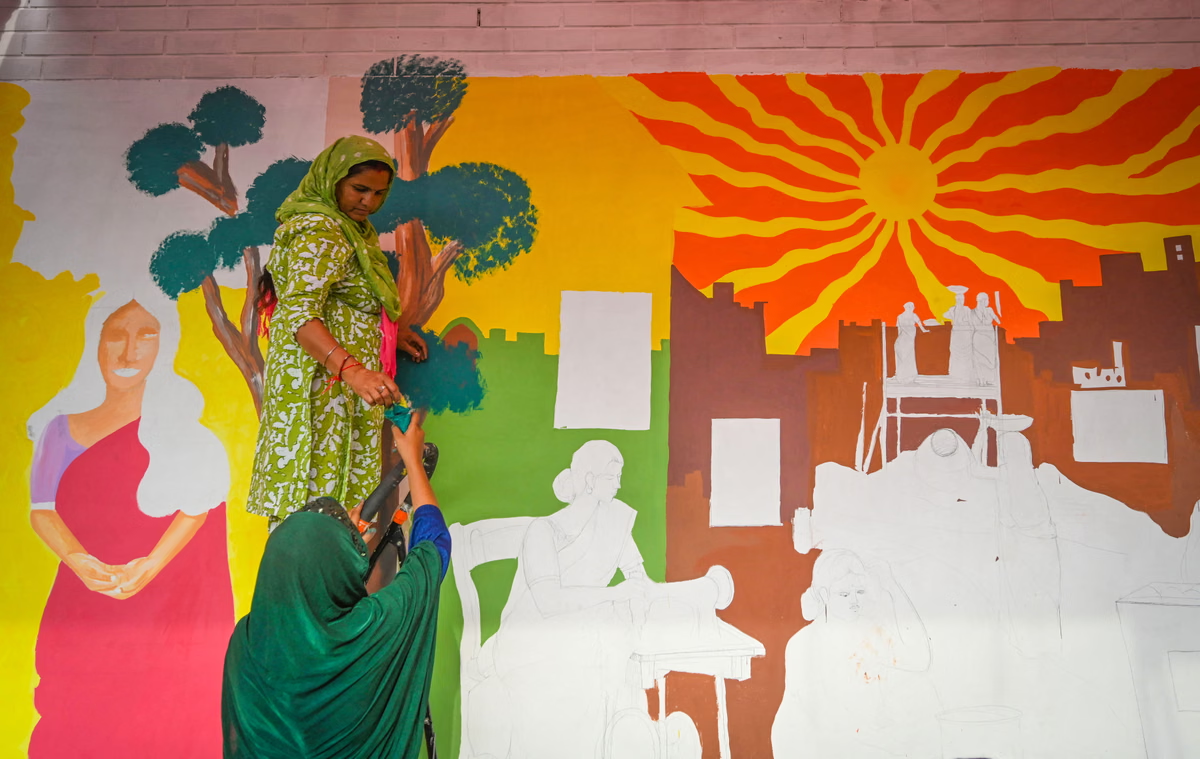
In the cramped Sunder Nagri slum of north-east Delhi, 40 households have begun keeping “garmi khata” or heat registries to document their grueling experiences with the city’s increasingly frequent and intense heatwaves. For 39-year-old Gulshan, the diary offers a sense of relief that her family’s struggle is being acknowledged. To keep her four children cool, she washes her floor every evening, yet the family still relies on a desert cooler and damp clothing to survive the night. This practice has led to skin infections and rashes for her and her children, highlighting the severe health toll of living in such conditions.
The initiative, supported by Greenpeace India, aims to move beyond simple meteorological data. Researcher Nibedita Saha notes that while satellite data identifies hotspots, it fails to capture the human experience. Senior campaigner Aakiz Farooq explains that the project empowers residents to become their own storytellers, creating written evidence of how heat impacts their daily lives, work, and mental well-being.
For 19-year-old student Arshi, who shares a single room with five family members, the heat is a constant barrier to her education and livelihood. She supplements her studies by making decorative tassels for trucks, often seeking refuge in her college library’s air-conditioned space before returning to the stifling humidity of her home. While the ambient temperature might read 29.3C (85F), the high humidity levels often push the “feels-like” temperature toward 36.3C (97F).
The economic impact is equally severe for workers like 21-year-old Raja, a street vendor. He regularly encounters ground temperatures exceeding 54C (129F) while working from his pushcart. The extreme heat causes his produce to spoil rapidly and discourages customers from venturing out, leading to a significant drop in his daily income. With no cooling beyond a ceiling fan, Raja has resorted to sleeping on his roof since May to escape the relentless indoor heat.
Urban planner Aravind Unni emphasizes that heat experiences are deeply stratified by income, occupation, and geography. Satellite analysis supports this, with India Today reporting a 7C difference in land-surface temperatures between the industrial-adjacent Mahipalpur district and the greener, affluent suburb of Vasant Kunj. Unni argues that while community mapping is a step forward, Indian cities currently lack the administrative infrastructure for decentralized climate action.
The collected diaries have been submitted to the National Human Rights Commission as part of a broader effort to classify extreme heat as a human rights issue. Furthermore, the team is working to transform these testimonies into legal evidence. This strategy aligns with the Supreme Court’s 2024 ruling, which established that protection from the most severe impacts of the climate crisis is a component of the right to life.
These efforts coincide with a significant policy shift: on August 4, the Indian government officially designated heatwaves as a nationally notified disaster. This classification allows states to access emergency relief funds. Activists like Unni and Farooq hope this development will facilitate community-led interventions, such as installing shade structures, improving water access, and increasing local greenery to mitigate the urban heat island effect. The report also notes that e very summer evening, Gulshan follows the same routine. The report also notes that last summer, the family saved enough to buy a desert cooler, which uses evaporation as a cheaper alternative to air conditioning. The report also notes that the family uses the appliance cautiously to save on energy costs. The report also notes that but even when it is on, Gulshan, who does not use a surname, has to dampen everyone’s clothes before sleeping. The report also notes that the 39-year-old and her children now have rashes and one has a skin infection from the wet cloth against their skin. The report also notes that this summer, Gulshan started jotting down these coping strategies in a garmi khata, or heat registry. The report also notes that cities across India have begun drawing up heat action plans – agreements formulated by a municipality or district administration on how to prepare for and respond to extreme heat, over the last few years. The report also notes that “While we have some meteorological data on heat, what’s absolutely missing is people, community – what they feel, what they experience.”.