

The morning of August 5, 2024, began in a tense, locked-down Dhaka. The city was gripped by an indefinite government-imposed curfew, while the Anti-Discrimination Student Movement had issued a decisive ‘March to Dhaka’ call, demanding the resignation of then-Prime Minister Sheikh Hasina. The preceding days had been marked by widespread violence, leaving the nation in a state of deep anxiety. Citizens faced a haunting uncertainty: would the leader, accused of crimes against humanity, finally relinquish power, or would the death toll continue to rise? This fear, coupled with the prospect of a prolonged struggle, left most of the population sleepless, waiting for a resolution to the national crisis.
By the morning of August 5, the capital was heavily fortified. Military, BGB, RAB, and police personnel were stationed at every major intersection, supported by barbed-wire barricades and constant loudspeaker announcements urging citizens to remain indoors. It felt like a city under siege, with security forces maintaining a rigid grip on all movement. The atmosphere was thick with the anticipation of a final confrontation between the state and the populace.
The momentum for this day had been set on the evening of August 4, when movement coordinator Asif Mahmud announced that the ‘March to Dhaka’ program, originally scheduled for August 6, would be brought forward to August 5. In a public statement, organizers urged citizens to join the final struggle, declaring that the time had come to leave a definitive mark on the student-citizen uprising. They called for a worker’s rally at Shahbag at 11:00 AM, a women’s rally at the Central Shaheed Minar at 5:00 PM, and nationwide mass sit-ins.
Coordinator Nahid Islam emphasized that even if the internet were shut down or the leadership arrested, the movement would continue until the one-point demand for the government’s resignation was met. Despite these declarations, the state’s security apparatus remained unyielding. From dawn, police and military units occupied key transit points, including Mohakhali, Banani, Gulshan, Karwan Bazar, Shahbag, Jatrabari, Mohammadpur, and Rampura, effectively isolating residential areas from the main thoroughfares.
Entry points to the capital, such as Jatrabari, Gabtoli, and Abdullahpur, were subjected to the strictest scrutiny, with multiple army and police checkpoints established. Even those holding curfew passes faced rigorous searches and questioning. By 10:00 AM, the streets remained largely empty, save for a few individuals moving for essential purposes. However, the situation began to shift rapidly after 10:00 AM as small groups of students began to emerge, soon joined by teachers, workers, parents, and citizens from all walks of life.
By 11:00 AM, mobile and broadband internet services were severed, yet the flow of people toward Shahbag continued unabated. Near the Bangabandhu Sheikh Mujib Medical University, protesters gathered with handheld megaphones, chanting slogans for the one-point demand. The Shahbag intersection itself remained under heavy military control, with armored vehicles and police personnel searching anyone attempting to pass, including medical staff and patients.
Tensions escalated after 11:30 AM when the sound of gunfire and explosions echoed from the direction of Chankharpul. Shortly after 12:00 PM, a procession of approximately 500 people, led by 50 women, marched from the Matsya Bhaban area toward Shahbag, chanting slogans. When military personnel attempted to block their path near the overpass, the protesters responded by offering flowers to the soldiers, a gesture that drew widespread attention.
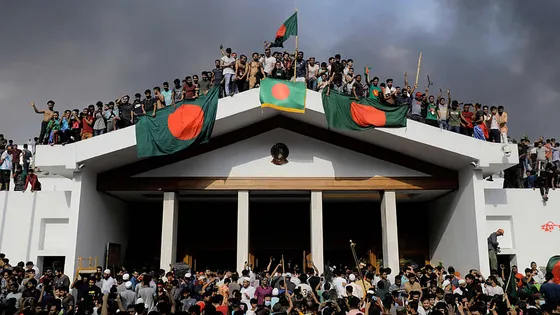
As the afternoon progressed, the crowd at Shahbag swelled with arrivals from Gazipur, Narayanganj, and other surrounding areas, turning the intersection into a massive sea of people. The atmosphere shifted from defiance to jubilation when news broke that the Army Chief would address the nation, followed quickly by reports that Sheikh Hasina had fled the country. The news triggered an outpouring of emotion, with protesters embracing, weeping, and celebrating the end of the regime.
The events of August 5, characterized by the mass defiance of the curfew and the subsequent political transition, represent a pivotal chapter in Bangladesh’s history. As internet connectivity was restored, the news of the victory spread nationwide, and thousands of citizens marched toward the Ganabhaban. Areas including Shahbag, Banglamotor, Kakrail, TSC, and Matsya Bhaban became centers of celebration, marking the successful culmination of the student-led movement.