

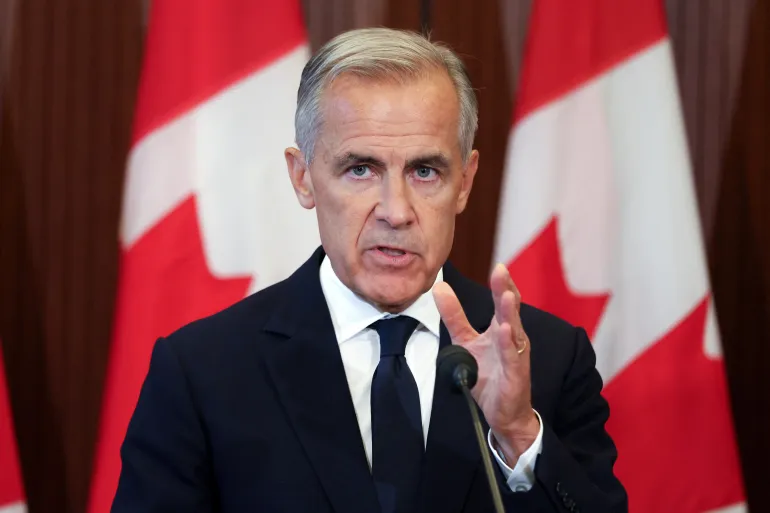
Canadian Prime Minister Mark Carney has announced that Canada will implement retaliatory, “dollar-for-dollar” tariffs on American imports beginning September 8. The decision follows the United States’ imposition of 50 percent tariffs on nearly $20 billion worth of Canadian goods, a move that has significantly escalated trade tensions between the two long-standing allies.
The planned Canadian response will target a variety of US imports, including steel, dairy products, household appliances, agricultural equipment, paper, and electronics. Carney described the move as a “focused response” taken with reluctance, emphasizing that his government had exhausted every effort to reach an agreement that would protect Canadian workers, strengthen the national economy, and uphold the country’s sovereignty.
The trade dispute intensified on July 20 when President Donald Trump announced the 50 percent tariffs, citing what he characterized as “discriminatory treatment” within Canadian trade policies. Although negotiators had successfully postponed a previous deadline on Wednesday, marathon discussions over the following three days failed to produce a deal. Carney stated that Canada ultimately walked away because the US “asked too much and offered too little,” specifically pointing to last-minute American demands regarding car imports and restrictions on Canada’s ability to pursue independent trade alliances.
“The US introduced in the last hours efforts to restrict our ability to have other trade deals,” Carney alleged. He noted that while Canada is a preferred partner for many nations, the American proposals sought to limit that reach, which he deemed unacceptable. Carney further remarked on the volatility of the current US administration, suggesting that under Trump, American commitments are often “written in pencil” and prone to abrupt shifts.
Despite optimism as late as Friday afternoon—when Trump suggested to reporters that a deal was “moving along”—the situation deteriorated rapidly. By Saturday, US Trade Representative Jamieson Greer confirmed that no further talks were scheduled with Ottawa. Greer indicated that the US would move forward with measures to counter Canada’s retaliation, asserting that Canada had rejected a superior trade arrangement.
Carney acknowledged the severity of the situation during his address, responding to a question about his somber tone by stating, “You’re at war when you get attacked. We got attacked.” He framed the conflict within the context of a broader transformation in US commercial relations, noting that the current administration has increasingly used economic integration as a weapon against its closest allies.
Since returning to the White House in 2025, Trump has frequently utilized wide-reaching tariffs as leverage to secure more favorable trade terms. Experts have noted that this aggressive foreign policy has strained relationships with traditional partners. In response, Carney has advocated for “middle powers” to collaborate as a counterbalance to the influence of superpowers like the US and China.
Looking ahead, the Prime Minister emphasized that Canada must focus on building domestic strength and diversifying its international trading relationships. “We can’t control the storm that blows in from Washington,” Carney said. “We can, however, chart a new course by building Canada strong and diversifying our trading relationships abroad.” The report also notes that carney’s remarks come after weeks of uncertainty over whether the tariffs would take effect. The report also notes that as part of an ongoing back-and-forth over trade between the two countries, the newest import taxes were first announced in July. The report also notes that since the start of his second term, Trump has sought to ratchet up pressure on Canada, as part of a push to increase US influence over the Western Hemisphere and advance US priorities. The report also notes that the two neighbours are longtime allies and have been among each other’s largest trading partners for decades. The report also notes that the revised tariff deadline expired at midnight Eastern US time (04:00 GMT). The report also notes that “In recent days, the United States proposed new terms that were uneconomic, unfair, and undermined the net benefits for Canada and called into question the reliability of any deal,” Carney said.