

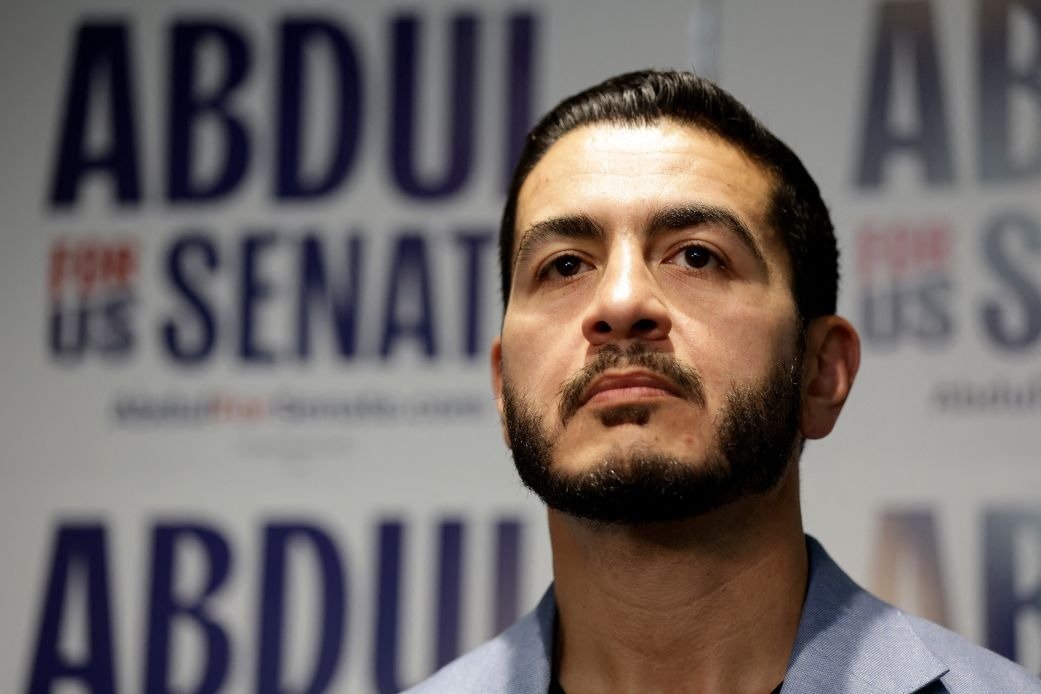
As former President Barack Obama prepares to join Michigan Democratic Senate candidate Abdul El-Sayed on the campaign trail later this month, historical records of the candidate’s pointed criticisms of the former president have resurfaced. These comments, spanning from 2012 through the 2020 Democratic primary, highlight a stark contrast between El-Sayed’s past legislative grievances and his current partnership with the party leader. El-Sayed’s criticism of Obama was often searing.
In a 2012 HuffPost essay written following Obama’s reelection, El-Sayed—who supported him in the election—argued that the president had failed to uphold the “hope and change” promise of his initial campaign. He characterized the president’s tenure as a perpetuation of war and an erosion of civil liberties, while faulting his administration for record deportations. El-Sayed went on to write that he viewed the support for Obama as choosing the “rock over the hard place” compared to Republican opponent Mitt Romney, lamenting that the victory felt like the “silly emotions of a naïve young man” rather than a triumph for progressives. According to in comments reviewed by KFile from Obama’s 2012 reelection through the 2020 Democratic presidential campaign, El-Sayed faulted him for perpetuating war, eroding civil liberties, overseeing record deportations and preserving economic and healthcare systems that he, Favored corporations over ordinary people. According to in a 2012 HuffPost essay written shortly after Obama won reelection, El-Sayed — who, He had voted for him — accused the president of failing to deliver the “hope and change” that defined his 2008 campaign. “This leader has perpetuated war, violated our civil liberties, deported more people from our shores than any other president before him, and the list of his failures goes on,” he wrote. “That memory will serve not as a reminder of the history we made that night – but of the silly emotions of a naïve young man who didn’t understand that hope and change required more than flowery prose and a winning smile,” El-Sayed wrote of Obama’s first election. “I have little hope because there has been less change.”.
El-Sayed’s critiques also targeted the Affordable Care Act, which he described as a “watered-down reform” that prioritized the needs of healthcare lobbyists over the public. Beyond domestic issues, he frequently voiced opposition to the administration’s foreign policy, specifically condemning the expansion of military operations into Yemen and Pakistan, alongside the regular deployment of drone strikes. He maintained that these systemic failures had contributed to increased economic inequality. He also dismissed the Affordable Care Act as insufficient and argued that Obama’s incremental approach helped create the conditions for Donald Trump’s rise. El-Sayed also took shots at the Affordable Care Act, Obama’s signature accomplishment and legacy across his two terms, calling it a “watered-down reform that kowtows to the interests of healthcare lobbies.”.
During a 2020 panel at the University of Chicago, El-Sayed cautioned that the Democratic Party faced the risk of returning to the political instability of 2016 if it did not pivot away from incrementalism. He famously remarked that the country was ultimately not “better off” eight years after Obama’s 2008 inauguration, emphasizing a need for sweeping structural changes to address deep-seated social and economic disparity.
El-Sayed’s campaign has pushed back against the implication that his past rhetoric signals inherent hostility. Representatives for the candidate provided examples where he praised Obama personally, noting that the 2008 victory was a foundational moment that inspired El-Sayed to believe a person with his specific background could successfully pursue public office. The campaign also pointed to a 2020 social media exchange where El-Sayed clarified that while he maintained fundamental disagreements with many of Obama’s policies, he still considered the former president to be “competent, coherent, and committed to Americans.”
Addressing these past statements in a recent campaign release, El-Sayed reflected on his trajectory from a 24-year-old observer of the 2008 election to a candidate today. He praised Obama for expanding the horizons of what was perceived as possible in politics, noting that he looks forward to standing alongside the former president. “We stand on the shoulders of giants,” El-Sayed stated, adding that despite the challenges Obama faced, his leadership remains a source of inspiration for the next generation of political candidates. With a name like mine, he changed what was possible for someone like me.
This political friction occurs as El-Sayed competes against Republican challenger Mike Rogers in a critical Michigan Senate race. With control of the Senate potentially resting on the outcome in Michigan, both the candidate’s past policy critiques and his current alignment with establishment figures remain central to the discourse surrounding his campaign.