

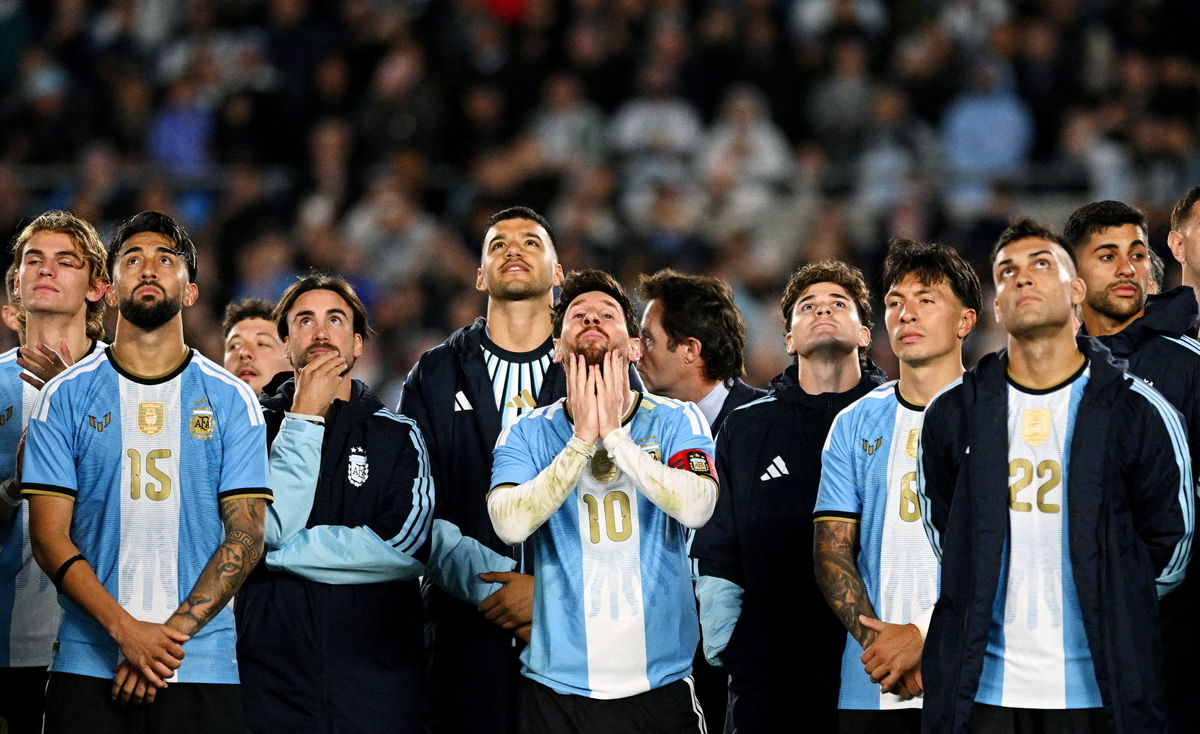
The international career of Lionel Messi, which reached its final chapter this week, has long polarized opinion, blending immense sporting success with broader societal questions. Brazilian writer Milly Lacombe captured the essence of this duality during the 2026 World Cup, describing Argentina’s performance as possessing a “sacred order.” She famously grappled with the contradiction of viewing Messi simultaneously as a divine talent on the pitch and a man whose public actions—such as shaking hands with Donald Trump—drew criticism during periods of heightened anti-Argentinian sentiment.
Critics often questioned Messi’s reticence on significant issues, including documented racist incidents involving the national team. Lacombe remarked on the pain of watching someone with such global influence choose to remain small, while others noted that Messi has historically struggled to articulate himself in public. Journalist John Carlin once observed the difficulty of extracting meaningful statements from the star, and even past teammates like Juan Sebastián Verón noted the visible anxiety Messi felt when assuming the captaincy in 2010. His most memorable public outburst remains his confrontation with a Dutch player during the 2022 World Cup. She asked. “That’s why it hurts so much to see someone with Messi’s power choosing to make himself small,” she wrote, how is it possible that Messi was not speaking out against the racist incidents we all saw around the Argentina team. Then again, much has been made of his visible discomfort with words throughout his epic career. According to journalist John Carlin once, Having interviewed Messi twice, he would decline a third opportunity, such was the challenge of getting the little giant to say anything of consequence. According to in 2010, Juan Sebastián Verón, He had never seen Messi as nervous as when he had to address his teammates for the first time as Argentina captain. Messi and Argentina were treated as darlings when they won the World Cup in 2022.
Despite his reluctance to engage in discourse, Messi’s impact on the field remained undeniable. Following their 2022 World Cup triumph, the team was widely celebrated, though by the 2026 final defeat to Spain, public sentiment had soured, and the squad was cast in a villainous light. Lacombe noted that when Messi manages to turn a losing game around after looking to the sky, it creates an inexplicable, mystical sensation that resonates deeply with fans, even when the team’s actions off the field provoke controversy. “That’s why it’s important to understand that when Messi, in the middle of a game that was lost, looks at the sky, and then after that he turns the game around and smashed it, there is something very mysterious there.
Messi’s path to the national team began early, as he was eligible for both Spain and Argentina. His debut in a youth match against Paraguay spurred a scramble to secure his allegiance before Spain could intervene. Over the years, he endured heavy criticism, including protests where pundits held a minute’s silence for his performances and attacks on his refusal to sing the national anthem. Journalist Alejandro Wall aptly noted that Messi was essentially “constituted in defeat,” having lost frequently throughout his international tenure, yet he persisted despite personal heartbreak.
The public’s relationship with Messi shifted significantly after 2016, when his brief retirement triggered a national outpouring of love that led him to reverse his decision. Following the death of Diego Maradona in 2020, a more confident version of Messi emerged. He assumed a stronger leadership role, evident during the 2021 Copa América victory, where he began delivering heartfelt pep talks to his teammates using his distinct Rosario accent.
His final farewell at the Monumental Stadium felt improvised, mirroring the rushed nature of his early career. Despite the Argentinian Football Association’s struggle to secure a high-profile opponent, the event drew significant crowds. The festivities featured tributes to the number 10, including a performance by Soledad Pastorutti and an appearance by a veteran of the Falklands/Malvinas War. Before the match, Messi received an honorary doctorate from the University of Buenos Aires in a modest ceremony.
The match against Benin served as a fittingly redemptive conclusion. The opponents provided a spirited challenge, presenting Messi with a statue of a Dahomey Agojie warrior. Messi influenced the game by setting up three of his side’s goals and successfully converting a penalty. His final post-match speech was uncharacteristically articulate, reflecting a man at peace with his journey. “We had the dream of fulfilling our dream,” he told the crowd, adding, “I don’t know, I’m talking more than ever. I don’t want to leave here. I love you.”