

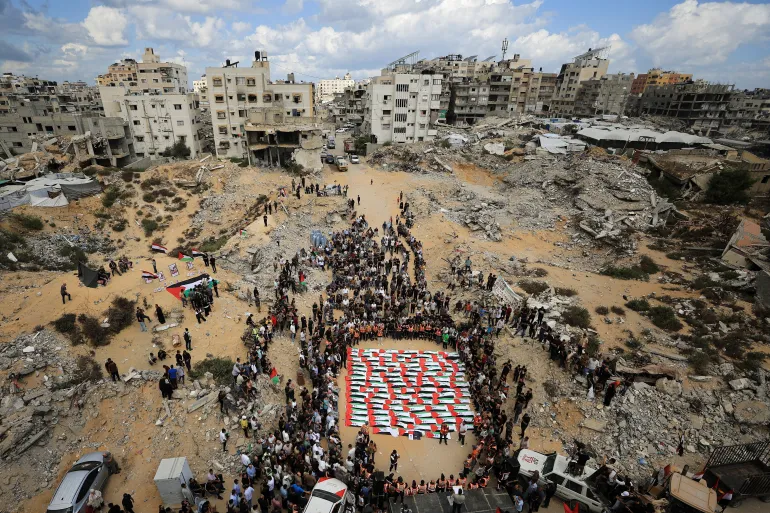
Three years after Israel initiated its military offensive in response to the October 7, 2023, attack, the Gaza Strip has undergone a profound and devastating transformation. The landscape is marked by the widespread destruction of residential neighborhoods and essential public infrastructure, effectively stripping away the basic foundations of daily life for approximately two million residents. Gaza City, Gaza Strip – Three years after Israel launched its genocidal war on Gaza following the Hamas-led October 7, 2023 attack on Israel, the Palestinian enclave has been transformed beyond recognition. Destroying homes and neighbourhoods and severely damaging its infrastructure and essential services, israel’s sustained aerial and ground assault has devastated vast parts of the Gaza Strip. The war has changed not only where they live, but how they carry out the most ordinary parts of daily life, for people in Gaza. A home, running water, electricity and a mode of transport – the basic infrastructure of everyday life – no longer exist for many Palestinians in Gaza. Water has become another daily challenge.
Despite the announcement of a ceasefire in October 2025, the humanitarian crisis remains severe. The Ministry of Health reports that 1,462 Palestinians have been killed since that date, bringing the total death toll to more than 74,245 since the conflict began. Ongoing military activity continues to disrupt life, forcing cycles of displacement that have left families struggling in volatile conditions. It has not brought an end to the suffering, although a “ceasefire” was announced in October 2025.
United Nations data from September indicates that 94 percent of the population requires urgent shelter and household support, with 65 percent of families forced to reside in tents or makeshift shelters. These temporary dwellings offer little protection from environmental elements and lack basic sanitary facilities. Additionally, water insecurity has worsened, with 91 percent of households reporting moderate-to-high stress in August, compared to 84 percent in June. Lighting, kitchen equipment and sanitation facilities, according to the United Nations, many families also lacked adequate bedding.
Gaza’s economy has effectively collapsed, with the UN Conference on Trade and Development estimating that 92 percent of economic establishments have been destroyed or damaged. Unemployment has surged to 78 percent, and the GDP per capita for 2025 plummeted to $212—merely 17 percent of its 2022 level. Industrial and agricultural outputs have slowed to just 6 percent of pre-war capacity, while the construction sector has ground to a near halt at 1 percent.
Economic researcher Rami al-Zaygh noted that the war has pushed society back several decades, forcing a reliance on informal work and the revival of obsolete tools to navigate a scarcity of resources. With prices for goods sitting 200 percent higher than pre-war levels, many families are entirely dependent on cash aid or digital transactions as physical currency becomes increasingly difficult to source.
The education sector remains in crisis, with UNICEF reporting that 98 percent of schools have been damaged or destroyed. By April 2026, approximately 700,000 children had missed nearly three consecutive years of formal schooling. While some utilize temporary learning spaces, around 200,000 children currently have no access to education, fueling concerns from the Palestinian Ministry of Education regarding a massive loss of core academic skills.
Healthcare delivery is equally precarious. Only 19 of Gaza’s 36 hospitals remain even partially functional, and none are operating at full capacity. Severe shortages of medical supplies, fuel, and diagnostic equipment hinder treatment for critical conditions, including cancer. While 12,400 patients have been medically evacuated since October 2023, the World Health Organization estimates that tens of thousands more remain in need of urgent care outside the enclave.
Furthermore, the breakdown of civil administration and repeated attacks on police and security personnel—with at least 12 incidents resulting in 53 deaths between January and May 2026—have created a security vacuum. Humanitarian organizations and the UN Human Rights Office have warned that this environment encourages looting and property crime, further complicating the delivery of aid. As Israel expands control over certain zones, groups like Euro-Med warn that forced displacement is becoming entrenched, denying families any clear path to return to their homes.