

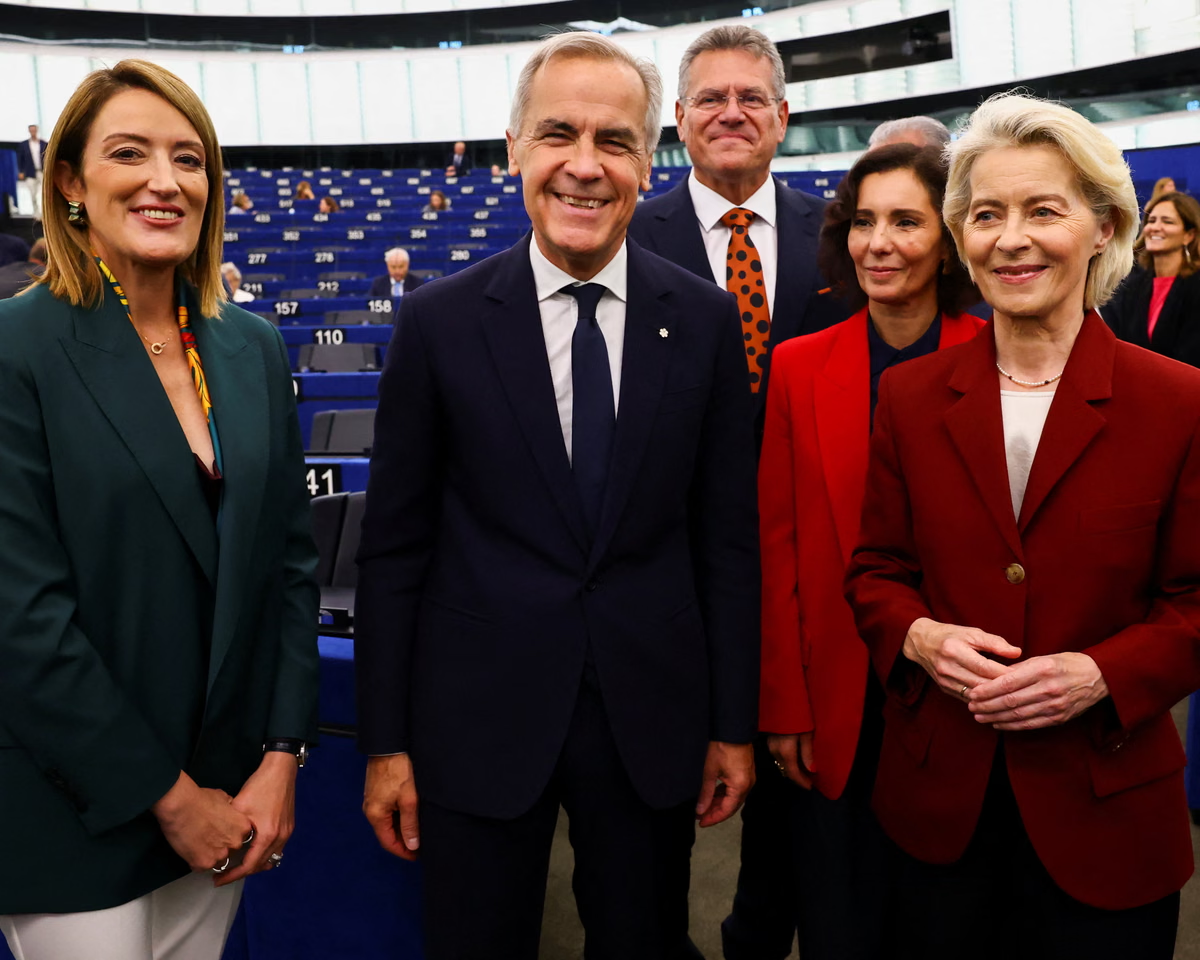
Mark Carney received a warm reception at the European Parliament on Thursday, where he addressed the assembly to welcome a landmark proposal for Canada to serve as the bloc’s first-ever associate member. The event featured strong displays of camaraderie, with German Green MEP Terry Reintke wearing a Canadian ice hockey jersey to mark the occasion. Reintke lauded the move, stating, “Europe has extended a hand, and Canada has taken it.”
The invitation was initially proposed by European Commission President Ursula von der Leyen just one day prior. The idea was immediately met with skepticism from Donald Trump, who publicly threatened to impose “heavy tariffs” on Europe should such a membership structure materialize. Despite the celebratory atmosphere in Strasbourg, significant ambiguity surrounds the initiative, primarily because the term “associate member” currently lacks a concrete legal definition within the European framework.
“I’m not quite sure why she used that term because there’s simply no legal definition,” a senior politician noted, adding that the vague language has sparked more debate over the meaning of the partnership rather than its future potential. German Chancellor Friedrich Merz’s office expressed interest in closer ties with Canada but explicitly urged for the “associate membership” label to be reconsidered. Merz has previously attempted to pitch similar status for Ukraine, though that suggestion was promptly rejected by other member states.
Diplomatic circles have voiced concerns that von der Leyen may have overreached with the announcement. One EU diplomat characterized the offer as an “empty phrase,” noting that it remains the responsibility of the 27 member states to define what such a relationship would entail in practice. Any formal cooperation agreement would ultimately require unanimous approval from all member states, a process that is often complex and fraught with legislative hurdles.
Existing trade frictions underscore these challenges. Although Carney praised the 2016 EU-Canada comprehensive economic and trade agreement as a global success, ten member states—including France, Poland, and Italy—have still not ratified it. Domestic political climates in these nations make imminent progress unlikely. Furthermore, both jurisdictions are currently moving toward protectionist policies; Canada has prioritized local suppliers for public contracts, while the EU is debating its Industrial Accelerator Act, which mandates “made in Europe” content for public spending on green technology and electric vehicles.
Questions also persist regarding how an associate member would interact with the EU’s integrated single market. Carney advocated for “seamless digital trade in non-agricultural goods and a wide range of services,” yet the EU has historically treated the four freedoms—the movement of capital, goods, services, and labor—as a non-negotiable package requiring strict regulatory alignment. While both sides share common interests in Arctic cooperation, AI, and quantum computing, the path toward a redefined alliance remains fraught with unresolved technical and political obstacles. The report also notes that politicians queued to shake his hand and take selfies. The report also notes that one EU diplomat said von der Leyen “seemed a bit far out in floating this” and that even before Wednesday’s speech member states had worried that she was overpromising on Canada. The report also notes that any new trading and cooperation relationship with a foreign country would need to be approved by the EU’s 27 member states. The report also notes that energy security, critical raw materials, quantum computing and work together in the Arctic – Carney noted that Canada shared an Arctic border with Denmark, referring to the maritime border with Greenland, there is a lot of common ground: both sides want to deepen cooperation on AI. The report also notes that but 10 EU member states have yet to ratify it, including France, Italy and Poland, carney described the 2016 EU-Canada comprehensive economic and trade agreement as “one of the world’s most successful trade agreements”.