

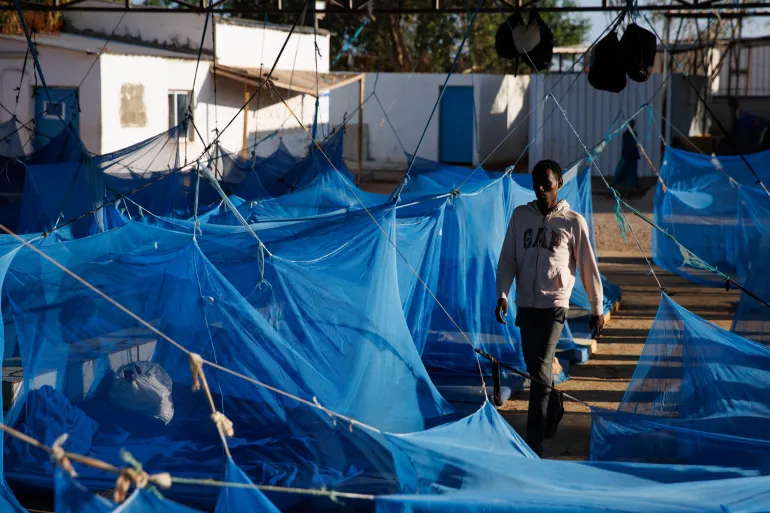
A surge of violence in Yemen has prompted a mass exodus, with more than 2,000 people fleeing across the water to Djibouti in recent days. The International Organization for Migration (IOM) reported on Sunday that the recent escalation of conflict between Houthi rebels and government forces has displaced 85,818 individuals to date, with 82,000 of those displacements occurring since the beginning of September alone.
Djibouti’s Economy and Finance Minister, Ilyas M. Dawaleh, noted that 1,400 refugees reached the country within a 24-hour period ending Saturday. Earlier on Friday, Dawaleh confirmed that 500 people, including many women and children, arrived in the coastal city of Obock after being rescued at sea when their vessels ran out of fuel while navigating the Bab al-Mandeb strait. Safiya Ibrahim, the IOM’s humanitarian response coordinator, highlighted the gravity of the situation, stating that “vulnerable groups such as women and children have reached the shores of Obock, with more expected in the coming days.”
Obock, located just 20 kilometers (12 miles) from the Yemeni coast, has long served as a critical entry point for those escaping the war. The region is currently experiencing a rapid Houthi offensive that began Thursday with the seizure of the port city of Mocha. Rebels have since secured the coastline and islands near the Bab al-Mandeb, leading to the reported evacuation of entire villages in the Maqbanah, Jabal Habashi, and al-Maafer districts.
Beyond its role as a sanctuary for those fleeing Yemen, the strait is frequently used in the opposite direction by migrants from the Horn of Africa traveling toward the Gulf. Djibouti currently hosts a substantial refugee population; data from the United Nations Refugee Agency as of March 2026 recorded over 36,000 registered individuals, the vast majority originating from Somalia, Ethiopia, and Yemen. The report also notes that that number has now exceeded 2,000 people, according to Sunday’s IOM figures.