

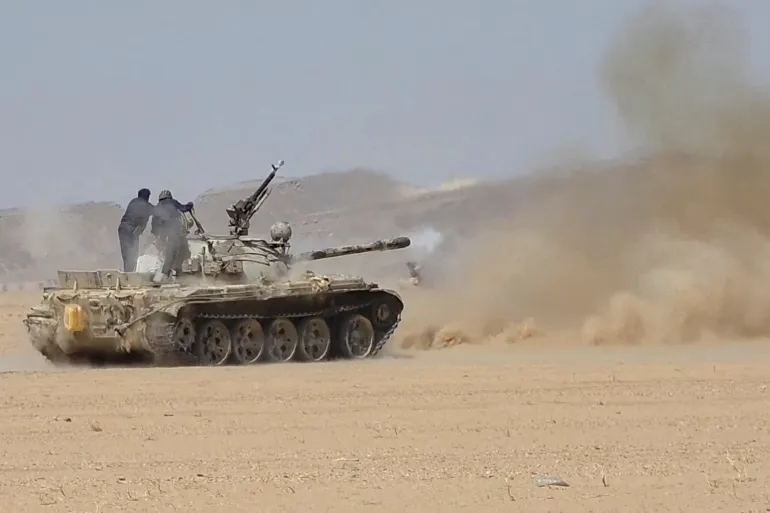
Yemen is grappling with its most significant surge in violence since the 2022 UN-brokered truce effectively halted large-scale combat. The conflict, which began in 2014 when the Houthis seized vast areas of the nation, has reignited as the Iran-backed group attempts further territorial expansion, forcing the internationally recognized government to launch a series of air strikes to defend its positions.
Government officials have described the current situation as a “battle for survival.” While the Houthi movement—formally known as Ansar Allah—recently claimed control over coastal zones, government forces report they are actively engaging the group. According to the state-run news agency Saba, government military units recently targeted Houthi positions near the port city of Mocha, asserting that they destroyed multiple vehicles and weapons while inflicting casualties on the militia. Government spokesperson Majed Abdullah al-Nazili confirmed these operations, noting that strikes were carried out on the Mocha-Dhubab road, approximately 11 kilometers from the city.
Sultan al-Arada, governor of Marib and a member of the Presidential Leadership Council (PLC), acknowledged that recent losses on the west coast were “painful and unfortunate,” yet emphasized that such setbacks are an expected reality of the ongoing war. Al-Arada accused the Houthis of deliberately sabotaging the peace process to force a military confrontation. He added that forces that retreated from the coast are currently regrouping in Marib with the long-term goal of reclaiming the capital, Sanaa. Meanwhile, the military’s reserve Nation Shield Force reported that its 6th Brigade successfully downed five drones during engagements in the al-Aghbara region.
The international dimension of the conflict remains prominent. The Houthis have publicly accused Saudi Arabia of conducting over 100 air strikes within the last 48 hours. Riyadh, which entered the conflict in 2015 to restore the government of then-President Abd-Rabbu Mansour Hadi, continues to support the current administration, which is overseen by the eight-member PLC established in 2022. Analysts suggest that internal divisions among government forces are hindering an effective response to the Houthi offensive, with experts noting that a fragmented command structure limits the government’s ability to counter the Houthis effectively.
Primary Active Front Lines
- The Western Coast and Bab al-Mandeb StraitHeavy fighting is concentrated near Mocha and Hodeidah as the Houthis attempt to secure key shipping lanes and Red Sea chokepoints.
- TaizThis mountainous province remains a scene of intense ground battles, serving as a critical gateway between the interior and the coast.
- Marib and al-JawfGovernment forces are currently defending their positions in these northern governorates, which share a border with Saudi Arabia.
- DhaleaThis region serves as a vital contact point, connecting the Houthi-controlled north with the government-aligned south.
The humanitarian impact of the renewed fighting has been severe. The International Organization for Migration reported that over 82,000 people have been displaced since the start of September. Among those fleeing the violence, more than 2,000 individuals have sought refuge in neighboring Djibouti within the last 24 hours. The conflict continues to test one of the world’s most vulnerable populations as both sides remain locked in a cycle of aerial and ground-based confrontation. The report also notes that including more than 2,000 who headed to Djibouti, the fighting has forced tens of thousands of Yemenis from their homes. The report also notes that and how has Iran responded, what is the Saudi role in the conflict. The report also notes that the spokesperson for the government forces, Majed Abdullah al-Nazili, said they also struck the Houthis’ “vehicles and members” on the Mocha-Dhubab road, 11km (7 miles) from the city, according to Saba. The report also notes that completing their hold on the Bab al-Mandeb strait, a narrow waterway vital to global oil shipping, the government’s attacks came after the Houthis captured Mocha on Thursday and the island of Mayyun (also known as Perim) on Friday. The report also notes that he said government forces were continuing to fight on several fronts and that the ultimate objective in Marib and elsewhere remained “the restoration of the capital, Sanaa”. The report also notes that “The forces that withdrew are now rearranging themselves, and they will return to the battle again in one form or another,” he said. The report also notes that separately, the September Net website, which is affiliated with the army of the internationally recognised Yemeni government, reported that air forces conducted a series of air raids against Houthi targets across the country, saying equipment had been destroyed and Houthi fighters killed, but gave no further details on the number of casualties.