

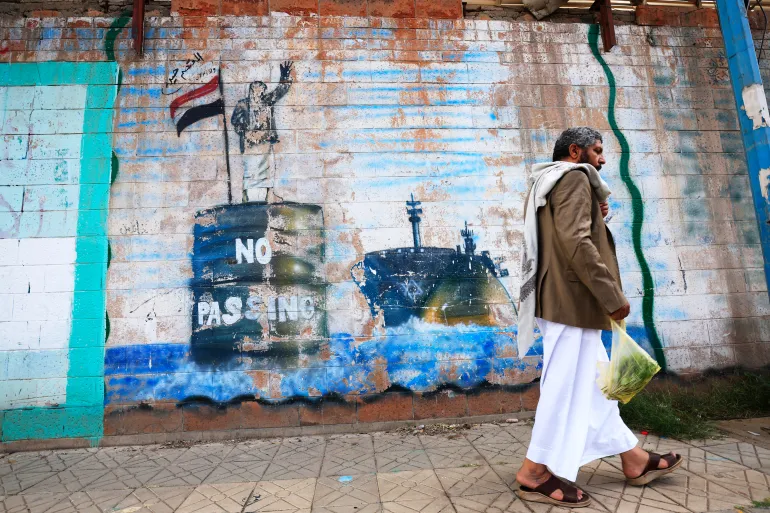
Tehran has expressed strong support for the Houthi movement following their recent capture of key Red Sea coastal cities and islands in Yemen. The advances, which effectively grant the group control over the strategic Bab al-Mandeb strait, are being framed by Iranian officials as a significant victory in the ongoing regional conflict.
The Houthis, a Zaidi Shia Muslim political and armed faction, have been engaged in a protracted struggle against the Western-backed Yemeni government since seizing the capital, Sanaa, in 2014. Their latest battlefield successes against fragmented Saudi-supported forces have been lauded by Iranian leadership as a “divine triumph” and a testament to years of resilience.
Hossein Mohebbi, a spokesperson for the Islamic Revolutionary Guard Corps (IRGC), described the takeover of the western coast as the “fruit of years of steadfastness in the most difficult of battlefields.” Similarly, Iranian parliament speaker Mohammad Bagher Ghalibaf invoked the words of the late Supreme Leader Ayatollah Ali Khamenei, asserting that the Houthis’ resistance would inevitably lead to success, stating, “The brave Yemeni people will certainly triumph, by permission of God Almighty.”
The strategic implications of these gains are significant. By securing the port city of Mocha and surrounding islands—including Mayun, located just 3km off the mainland—the Houthis have gained the ability to threaten maritime traffic in the Bab al-Mandeb strait using coastal artillery rather than relying solely on drones and missiles. While military spokesperson Yahya Saree noted that maritime navigation remains safe for all except Saudi vessels, the shift in control provides a new layer of leverage for Tehran in its broader confrontation with the United States, which has been ongoing since February 28.
Iranian First Vice President Mohammad Reza Aref praised the developments, urging regional leaders to pursue “rationality of liberation from dependency” on Western powers. Mohammad Mokhber, an adviser to Supreme Leader Mojtaba Khamenei, added that the victory proves security is not a commodity that can be purchased.
Despite the celebratory rhetoric, Iran’s Ministry of Foreign Affairs maintains that the Houthis operate independently. Spokesman Esmaeil Baghaei stated that the current situation in Yemen is the result of the Yemeni people “losing patience.” The ministry has called for an end to the Saudi-led blockade, a return to negotiations, and respect for Yemen’s sovereignty, while rejecting characterizations of the Houthis as mere proxies for Tehran.
The broader context involves a complex web of regional tensions. Since 2023, the Houthis have targeted vessels they claim are linked to Israel, prompting retaliatory strikes from the US, UK, and Israel. Meanwhile, Iran continues to leverage its partial control of the Strait of Hormuz. Officials in Tehran are currently preparing for talks with regional representatives regarding shipping through that waterway, though they emphasize that no dialogue with Washington will occur under current conditions.
Hardline media outlets within Iran have echoed the government’s stance. The newspaper Keyhan characterized the advances as the “miracle of resistance” that has placed the US and Israel in a difficult position, while the Quds newspaper labeled Iran and the Houthis as the “lord of the straits.”
As the situation evolves, the potential for further disruption in the Red Sea remains a point of concern for international shipping. While Iran has hinted that the Bab al-Mandeb could be further impacted if the conflict persists, its diplomatic apparatus has stopped short of explicitly linking the Houthi advances to its own ongoing dispute with the United States. The report also notes that and are viewed by some as part of Tehran’s wider war against the US, ongoing since February 28, the Iran-allied group’s recent victories have been praised in Iran. The report also notes that mohammad Bagher Ghalibaf, Iranian parliament speaker and chief negotiator with Washington, reposted a comment made by slain Supreme Leader Ayatollah Ali Khamenei in 2024, saying the “resistance” of the Houthis will inevitably lead to victory. The report also notes that as part of their stated aim to pressure Israel to end the genocidal war on Gaza, the Houthis began to attack several vessels in the Red Sea they claimed were linked to Israel in 2023. The report also notes that this prompted bombing campaigns by the US, United Kingdom and Israel against Houthi positions in Sanaa, Hodeidah and other areas. The report also notes that saudi Arabia, which joined the war against the Houthis in 2015, has largely stayed out of the current eruption in fighting in Yemen. The report also notes that also known as Perim, sitting about 3km (1.9 miles) off Yemen’s mainland – provides the group with close-range access to the Bab al-Mandeb strait, the Houthis’ control of Yemen’s Red Sea coastline and multiple islands – including the island of Mayun. The report also notes that a video published on Friday showed a Houthi commander telling soldiers they will no longer need missiles and drones to threaten shipping in the crucial waterway. The report also notes that the prospect of closing down the strait could potentially be used by Tehran in future negotiations over ending the war with the US.