

Six months after the launch of Operation Epic Fury, a military campaign initially intended to secure a swift victory has devolved into a protracted and unpredictable conflict. When US and Israeli forces began coordinated strikes on February 28, the strategic objective was to neutralize Iran’s leadership and military infrastructure to force a diplomatic resolution. Instead, the war has produced no clear winner, resulting in thousands of deaths, widespread displacement, and the closure of critical global oil corridors.
The intensity of the fighting has fluctuated through several distinct phases. The opening night of the war saw the death of Iranian Supreme Leader Ali Khamenei, which led to the installation of his son, Mojtaba Khamenei, as the new leader. Mojtaba has shown no political inclination toward de-escalation, further complicating prospects for a resolution. The conflict has since expanded to include hundreds of missile and drone strikes targeting Israel, US military bases, and various Gulf capitals.
Diplomatic efforts have struggled to gain traction. A ceasefire brokered by Pakistan in April facilitated the most significant high-level talks between Washington and Tehran since 1979, held in Islamabad. Although these discussions collapsed over nuclear disagreements, a subsequent agreement known as the Islamabad Memorandum was signed on June 17, establishing a 60-day framework for peace. However, the respite was brief; strikes ceased on June 28 only to resume on July 8 when Iran began targeting commercial shipping in the Strait of Hormuz.
Recent military activity highlights the ongoing volatility. Last week, US forces struck rocket launchers on Larak Island, citing concerns that Iran intended to seed the waterway with sea mines. Iran retaliated with strikes against US positions in Jordan. On Tuesday, American operations targeted a fishmeal factory on Qeshm Island and a ports authority tower in Sirik. Iranian officials reported that a strike on a home in the village of Kuhestak, where a wedding was taking place, resulted in two fatalities.
The Gulf states, despite their efforts to remain neutral, have faced significant security challenges. The UAE Ministry of Defence has characterized the ongoing attacks as a “dangerous escalation,” noting that it has intercepted 174 ballistic missiles and 689 drones since the conflict began. The vulnerability of regional waters was further underscored on August 31, when two supertankers were struck by unknown projectiles within a corridor previously designated as safe by the US Navy. Additionally, two vessels were hit near Oman’s Khasab, signaling rising risks for maritime transit.
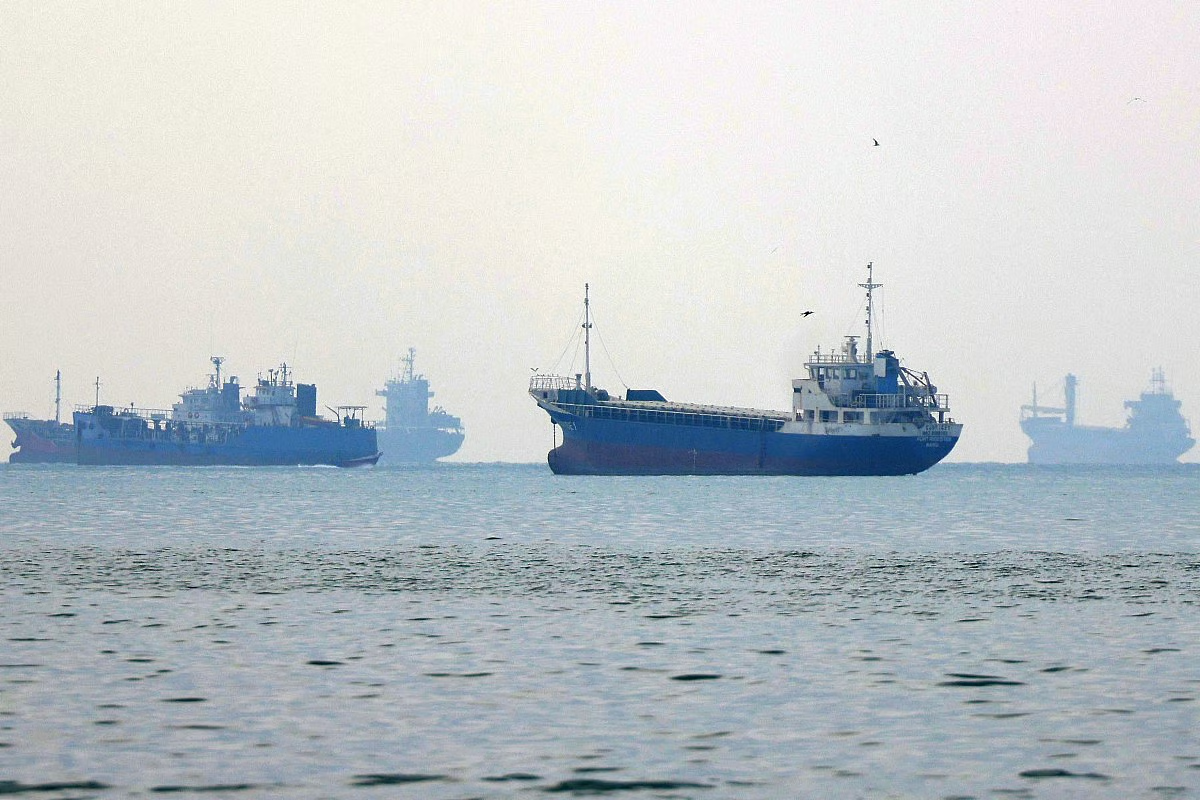
The economic impact remains severe, though regional states have utilized sovereign wealth reserves and fiscal buffers to mitigate the immediate shocks. In April, the International Maritime Organisation reported that approximately 20,000 mariners and 2,000 ships were stranded in the Arabian Gulf. While these figures have since declined, the human cost persists, affecting fishing communities and sailors caught in the crossfire.
The current deadlock is influenced by domestic political pressures, including midterm elections in the United States and internal crises within Iran. As neither side possesses a strategy to force a definitive resolution, the conflict remains a series of intermittent exchanges. Diplomatic focus has now shifted to the Oman channel, where quiet conversations continue in an attempt to find a de-escalation path that remains elusive for both parties.
This war has fundamentally altered the security landscape for Gulf nations, which previously relied on the assumption that hosting US bases and maintaining open diplomatic channels would guarantee stability. Moving forward, the region is prioritizing deeper, more reciprocal security partnerships and diversified economic strategies. The conflict has accelerated the necessity for alternative export routes and strengthened domestic defense capabilities, reflecting a reality where regional security can no longer depend solely on a single external guarantor. The report also notes that instead, the war has become something nobody planned for. The report also notes that a relentless, shapeshifting conflict that has killed thousands, displaced millions, shut the world’s most important oil corridor, and produced no winner. The report also notes that the fighting came back, after a month of uneasy silence. The report also notes that by Wednesday, Iran was firing missiles at Gulf neighbours again. The report also notes that the conflict that began on February 28 has already gone through more phases than most wars manage in years. The report also notes that the one point, as Trump himself put it, where agreement proved impossible, they collapsed over the nuclear question.