

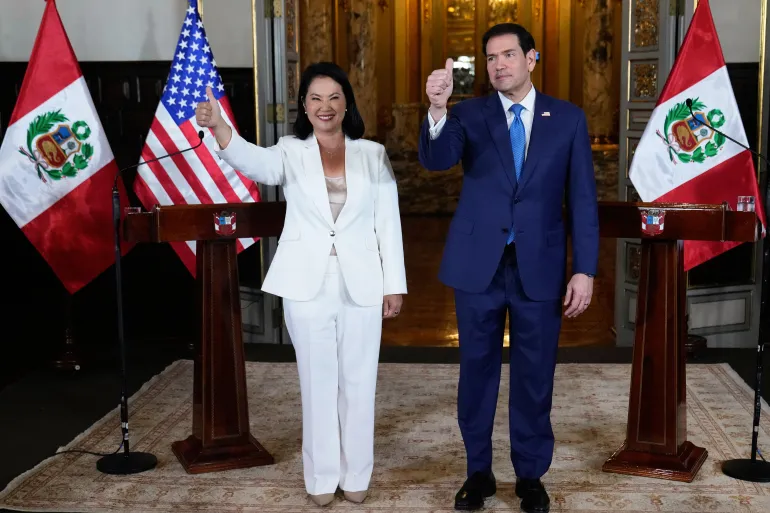
Peru has officially joined the “Shield of the Americas,” a US-led regional security alliance designed to bolster intelligence sharing and military cooperation against drug cartels. The announcement was made on Thursday by President Keiko Fujimori following high-level discussions with US Secretary of State Marco Rubio in Lima.
Fujimori, who assumed office in July after a campaign centered on national security, emphasized the necessity of the partnership. “We appreciate this opportunity, because for us, having previously had to tackle terrorism, we know how difficult it is to confront criminality today,” she stated. During the visit, the Peruvian government honored Rubio with the Order of the Sun, one of the nation’s most prestigious civilian awards.
Secretary Rubio, who is currently concluding a three-day tour across South America, framed the alliance as a vital defensive measure. “It is a shield against these threats to the sovereignty of these independent nations,” Rubio said, noting that the coalition—also referred to as the Americas Counter Cartel Coalition—aims to forcefully confront transnational criminal groups that often possess superior resources and military-grade equipment compared to state forces.
The move comes as Peru, the world’s second-largest producer of cocaine, faces a surge in extortion and other violent crimes. However, the closer military alignment with Washington has triggered public unease. Protesters gathered outside the government headquarters during the meeting, holding signs that demanded an end to the alliance and criticized Rubio’s presence. “We have said that Peru is nobody’s colony, and it is not the back garden of any country in the world,” said protester Soledad Lozano.
Addressing concerns regarding potential US overreach, Rubio insisted that American involvement would remain strictly collaborative. “We’re not going to do anything that our partners don’t ask us to do,” he assured, adding that the US would neither exceed nor fall short of the specific requests made by local authorities.
Beyond security, the alliance reflects a broader geopolitical effort by the Trump administration to counter Chinese influence in the Western Hemisphere. Washington has previously expressed concern over China’s economic footprint in Peru, specifically criticizing the construction of a mega-port in Chancay. US officials have warned that such investments can compromise national sovereignty, as China has become Peru’s primary trading partner.
The US is actively working to reduce Latin American economic dependency on Beijing while securing its own interests in the region, particularly regarding Peru’s status as the world’s third-largest copper producer. These strategic efforts were underscored in January when Washington designated Peru as a major non-NATO ally and the State Department authorized a potential $1.5 billion foreign military sale to upgrade the Callao Naval Base near Lima. The report also notes that also known as the Americas Counter Cartel Coalition (ACCC), which has advocated for greater military involvement in the fight against crime, the diplomat praised Fujimori’s decision to join the Shield of the Americas. The report also notes that and the only way to defeat it is to confront it forcefully.”, that is unacceptable. The report also notes that fujimori, a former first lady and the daughter of former President Alberto Fujimori, was sworn into office in July after campaigning heavily on security-related issues. The report also notes that given its history of past interventions and its support of right-wing leaders accused of human rights abuses, but Washington’s involvement in the region remains a controversial prospect. The report also notes that “This has generated lots of fear among many people in this part of the world of what a greater influence of the United States, of what a military influence of the United States, could bring about,” she said. The report also notes that saying the US would only intervene with the permission of local authorities, rubio attempted to tamp down those concerns during his visit.