

Yemen’s government has issued a stark warning regarding a new Houthi offensive along the Red Sea coast, describing the movement as a direct threat to international maritime security. Rajeh Badi, Yemen’s Ambassador to Qatar and a former government spokesman, stated that Houthi forces are currently pushing through the mountain ranges of Taiz province, specifically targeting areas near al-Makha and al-Waziyah to secure strategic vantage points.
According to Badi, these maneuvers are designed to give the rebels “commanding positions to launch more effective strikes on ships and disrupt navigation in the Red Sea.” He emphasized that the internationally recognized Yemeni government has maintained its commitment to the truce established in 2021, characterizing the Houthi rebels as “the aggressors” who are actively destabilizing the region.
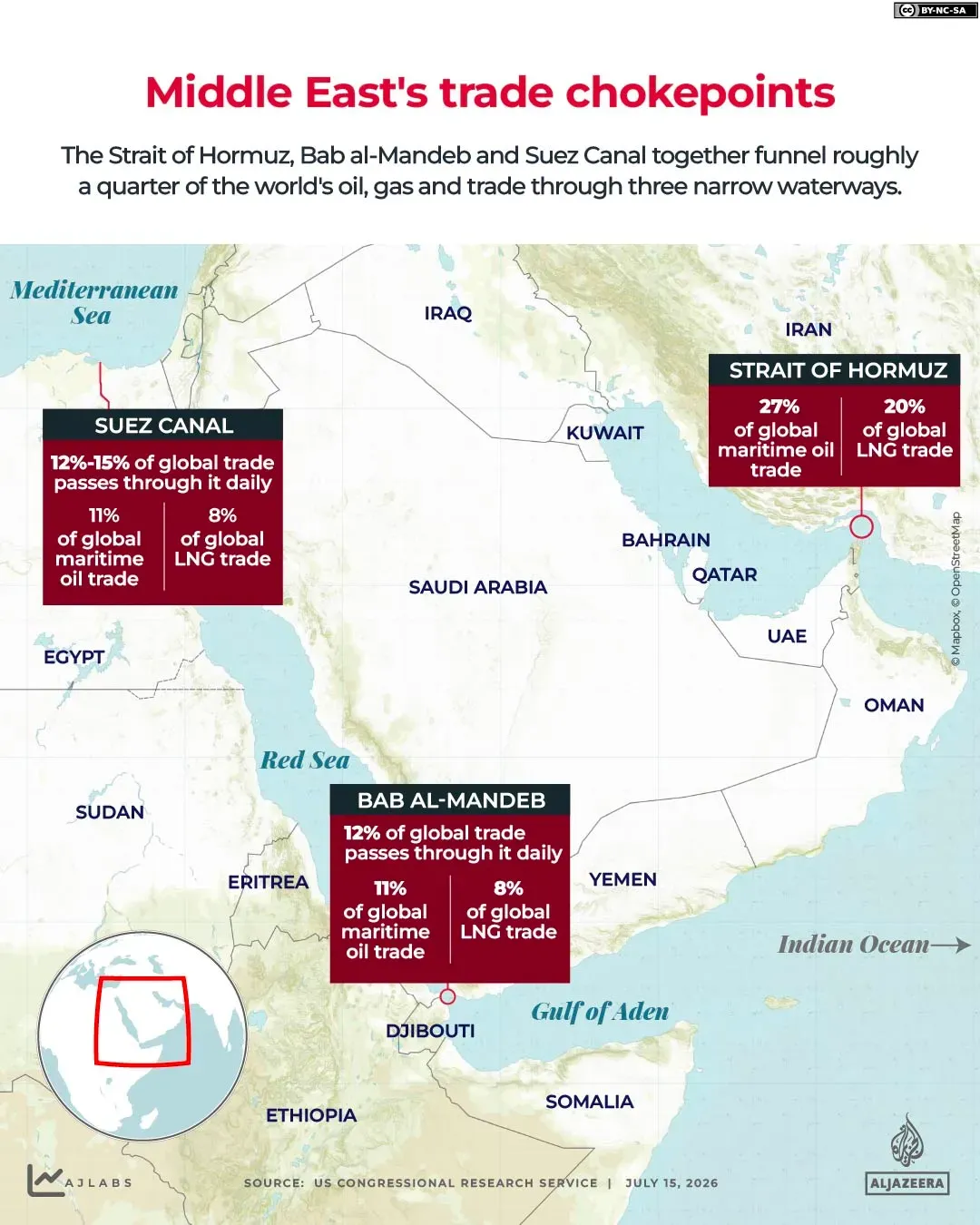
The ambassador warned that the consequences of this escalation extend well beyond Yemen’s borders. By attempting to choke vital maritime traffic, the Houthis risk creating a crisis similar to the strategic tensions seen at the Strait of Hormuz. The Bab al-Mandeb Strait serves as a critical artery for global energy and food supplies, connecting the Red Sea to the Gulf of Aden and the Suez Canal.
In response to the rebel advance, the Yemeni government has opened new military fronts in al-Jawf, Marib, and al-Bayda. Badi noted that the conflict is increasingly being driven by external influence, specifically identifying Iran as the architect behind the Houthi strategy. He stated that the relationship between Tehran and the rebels is now impossible to conceal, noting that both Iranian officials and Houthi leadership openly acknowledge their strategic ties.
Badi described the Houthis as an extension of the Iranian Revolutionary Guard Corps, comparing them to other regional proxies like Hezbollah in Lebanon and the Popular Mobilisation Forces in Iraq. He recalled that former President Abd-Rabbu Mansour Hadi had long warned that if Iran gained control over the Bab al-Mandeb and the Strait of Hormuz, its influence would surpass that of a nuclear arsenal.
The conflict has also seen a rise in cross-border attacks. Major-General Turki al-Maliki, spokesperson for the Saudi-led coalition, confirmed that the Houthis recently launched ballistic missiles and drones targeting the Saudi cities of Khamis Mushait, Abha, and Jizan. Badi argued that these strikes are a calculated effort to rebrand the civil conflict as a war between Yemen and Saudi Arabia, particularly when the rebels suffer setbacks on the ground.
Despite over 13 years of dialogue and various peace agreements, Badi asserted that the government has exhausted all peaceful avenues. He claimed that the Houthi leadership has effectively rejected diplomacy, stating that peace is not part of their mindset. Consequently, the government feels compelled to continue its military efforts to reclaim the state and restore stability.
The ambassador concluded by urging the international community to recognize the severity of the threat, emphasizing that the Houthi movement does not represent the Yemeni people. He called for global support to address what he described as a scourge that now poses a danger to the entire world, rather than just the local population. The report also notes that in Wednesday’s interview with, Yemen’s Ambassador to Qatar, Rajeh Badi, a former government spokesman, said that his government and its armed forces had not violated any truce since 2021. The report also notes that to the north, the Red Sea leads to the Suez Canal, while farther east, beyond the Arabian Sea, lies another critical chokepoint, the Strait of Hormuz. The report also notes that civilian infrastructure in the kingdom’s south and Saudi-linked vessels in the Red Sea, the Houthis have targeted Saudi territory. The report also notes that he did not elaborate on any casualties as a result of the attacks. The report also notes that badi, who has spoken to the media for the first time since taking up his post, said those attacks are designed to change the nature of the war. The report also notes that they respond by firing missiles and drones at civilian sites in Saudi Arabia, in an attempt to inflame Yemeni public opinion and convince the outside world that Yemen is at war with Saudi Arabia”, the ambassador assessed that “every time their militias suffer heavy losses inside Yemen at the hands of the Yemeni armed forces. The report also notes that many of Tehran’s other proxies have come under pressure,” he added.