

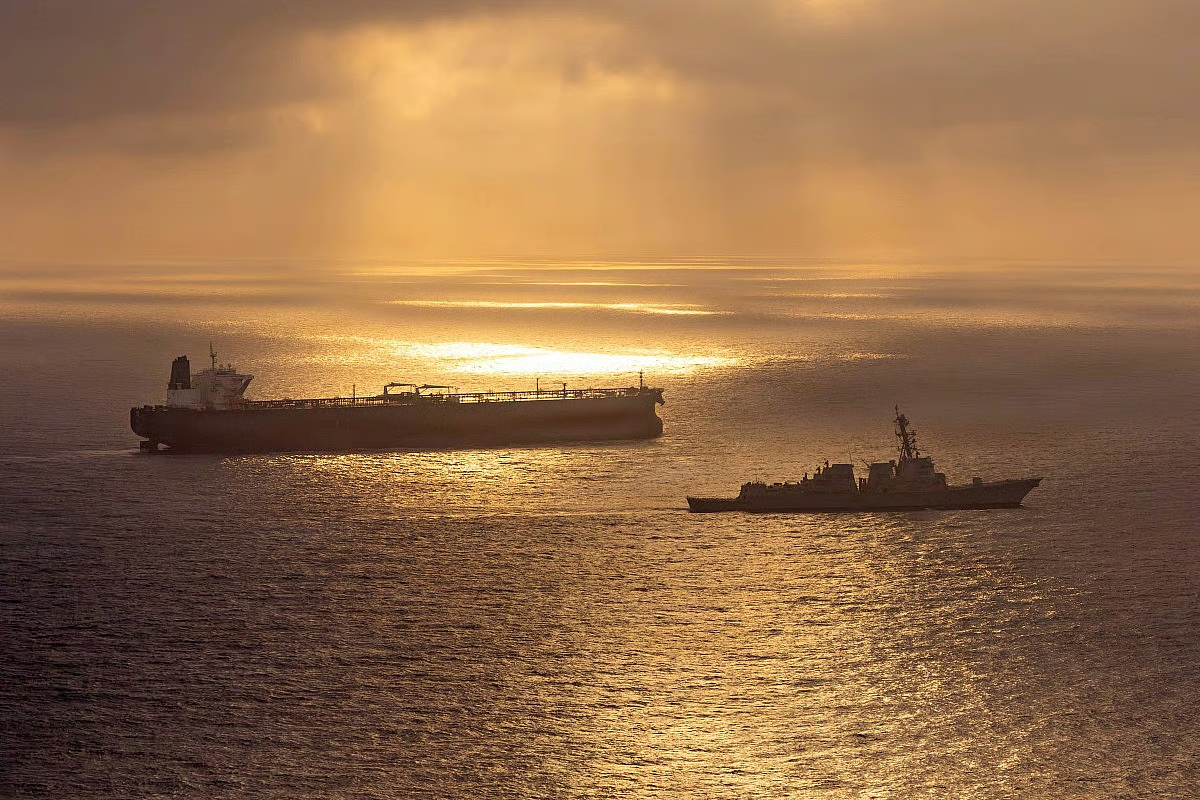
Strategic Overview of the US Campaign
- Strategy: A combination of naval escorts, targeted strikes, and economic strangulation.
- Objective: Compelling a shift in Tehran’s Hormuz policy or fostering internal regime change.
- Scope: The blockade has effectively halted Iranian crude exports and disrupted local fuel supplies.
- Operational Success: US officials report that over 40 vessels and 17 million barrels of oil moved through the Strait of Hormuz in a single day under US protection.
- Current Status: No formal negotiations exist between Washington and Tehran, though Pakistan reported progress in its own diplomatic engagement with Iran on August 25.
The United States has implemented a naval blockade that has successfully achieved what previous sanctions could not: the near-total cessation of Iranian oil exports. While earlier measures were often bypassed by shadow fleets, the current maritime cordon has physically severed access to key markets, including China, which was previously Tehran’s primary buyer. Analysts from the Institute for the Study of War (ISW) observe that Washington is now explicitly targeting the networks that facilitate sanctions evasion to deepen the country’s isolation.
The economic impact is profound. Recent data indicates that Iran has gone seven weeks without recording meaningful crude shipments through the Strait of Hormuz, a historic first. This collapse in export revenue is severely limiting the government’s access to foreign currency, placing immense strain on household finances and the state’s ability to fund security forces. A former senior US Treasury official suggested that this sustained pressure on elite patronage networks and the IRGC’s funding base could potentially destabilize the regime within months.
Experts at the Center on Global Energy Policy (CGEP) at Columbia University argue that the conflict has evolved beyond simple crude oil disputes. It is now a broader contest for regional energy security, involving the disruption of refined products and a struggle over control of Gulf energy flows. While the blockade imposes significant costs on the Iranian economy, it has not yet forced a change in Tehran’s maximalist position regarding the Strait of Hormuz.
The appointment of Mohsen Rezaei, a former senior IRGC commander and hard-liner, as secretary of the Supreme National Security Council in August, suggests that Tehran may be bracing for a long-term conflict. Upon taking office, Rezaei outlined six conditions for reopening the Strait of Hormuz, including the withdrawal of US forces from the region, the lifting of the naval blockade, the release of frozen overseas assets, and a permanent end to conflicts in Gaza, Iraq, Lebanon, and Yemen.
Tehran has responded to the blockade by announcing plans to establish a new maritime restricted zone near the Strait of Hormuz. Rezaei indicated that this zone would mirror the area covered by the US blockade, representing an attempt to impose reciprocal costs on regional shipping. Furthermore, reports from the ISW and the Critical Threats Project suggest that Iran is increasingly relying on drone and missile strikes against US positions to pressure Gulf states into urging Washington to seek an off-ramp.
The US response has expanded to include direct strikes on Iranian oil tankers and a comprehensive economic squeeze targeting all 27 of Iran’s airlines. Despite these measures, the ongoing conflict continues to drive up global freight rates and tighten markets for refined products. For policymakers and investors, the central uncertainty remains whether the current economic pressure will reach a tipping point that forces Tehran to negotiate, or if it will merely harden the regime’s resolve and escalate regional instability. The report also notes that oil supply gap widens, also Read: ‘Indefinite’ Iran blockade: Why it changes the equation as Hormuz crisis deepens. The report also notes that underscoring that the blockade is focused on stopping Iranian cargoes rather than closing the waterway to global trade, uS Energy Secretary Chris Wright has confirmed record post‑war volumes of oil transiting the strait. The report also notes that blockade ‘succeeds where sanctions failed. The report also notes that three think-tanks highlight how the blockade fits into a broader US strategy of economic warfare aimed at altering Iran’s strategic calculus. The report also notes that iSW argues increased economic pain may strengthen internal arguments for a deal. The report also notes that currently, hardline factions still dominate. The report also notes that some of those conditions were not explicitly included in the June memorandum of understanding.