

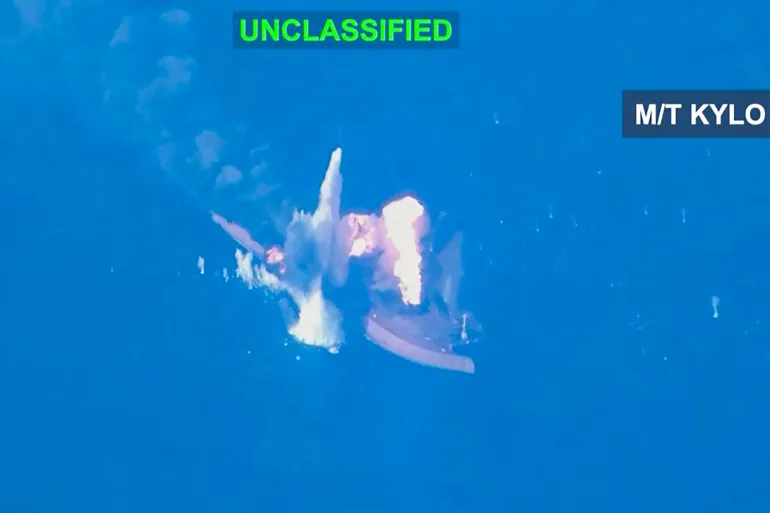
The United States is escalating its pressure on Iran through a combination of naval blockades and economic sanctions, a strategy that has pushed Tehran to abandon its policy of proportionate retaliation in favor of more aggressive military countermeasures. Tensions in the Strait of Hormuz have reached a critical point, with both nations trading accusations of illegal maritime activities and military strikes.
US Central Command (CENTCOM) recently released footage documenting the destruction of three Iranian crude oil tankers near Kharg Island, Jask, and the Gulf of Oman. According to CENTCOM, two of the vessels were permanently disabled, while a third was destroyed by extensive bombing. In response, Iran’s Islamic Revolutionary Guard Corps (IRGC) released its own video evidence showing explosive projectiles striking multiple ships within the Strait of Hormuz, claiming they also neutralized a US-built sea drone attempting to enter Iranian waters.
The conflict has extended to direct engagements between naval forces. The IRGC reported firing ballistic missiles at a US aircraft carrier and an accompanying warship involved in the months-long blockade of southern Iranian ports. While the IRGC asserted that both vessels sustained damage and were forced to retreat, CENTCOM maintained that these attacks were successfully evaded, with no immediate evidence of successful strikes. Tehran, however, characterized the US acknowledgement of the missile launches as proof of the IRGC’s offensive capabilities and a strategic defeat for Washington.
Political rhetoric in Tehran has hardened significantly. Speaker of Parliament Mohammad Bagher Ghalibaf stated during a private session that Iran has already inflicted substantial damage on US regional bases. He warned that the era of proportionate responses is over, signaling that future provocations would be met with faster and more severe strikes. Simultaneously, the Iranian Ministry of Foreign Affairs condemned the targeting of its tankers as a violation of the United Nations Charter and a war crime.
The effectiveness of the US-led blockade remains a point of contention. While the Trump administration claims that Operation Economic Outcast has successfully reduced Iran’s trade and isolated its economy, Iranian officials argue that the blockade has not completely halted exports. President Masoud Pezeshkian noted that significant volumes of oil were sold under a June memorandum of understanding. However, current data from TankerTrackers indicates that Middle Eastern crude exports dropped by 39 percent since the start of the year, with Iran’s baseline exports of 1.68 million barrels per day effectively stalled.
US Treasury Secretary Scott Bessent suggested that Iran’s remaining oil reserves are dwindling, estimating that only 30 million barrels remain for potential sale to China. Washington anticipates these supplies will be exhausted shortly, further tightening the economic noose. Despite these pressures, experts note that while Iran can utilize overland and rail routes to move refined products to neighboring countries like Iraq and Afghanistan, these methods cannot replace the massive volume typically transported by large crude carriers.
To manage the deepening crisis, Iran’s Economy Ministry has established an “economic war headquarters” to address record-high inflation, unemployment, and energy imbalances. IRGC spokesperson Hossein Mohebbi argued that the US is suffering its own economic consequences from the blockade, citing reduced strategic energy reserves and declining aluminum exports as evidence that the conflict is inflicting significant costs on Washington as well. The report also notes that tehran, Iran – The United States continues to rely on a mix of military force and economic sanctions against Iran, which has so far only prompted authorities in Tehran to consider more forceful responses. The report also notes that “Aggressor US must know that it has no way but to leave the region and stop its malignance,” the IRGC said in a statement on Sunday. The report also notes that through which one fifth of the world’s oil and gas passes in peacetime, it added that a US-built sea drone was hit while trying to enter Iranian waters in the vital waterway. The report also notes that uS and Iranian officials provide different readings of what is transpiring after months of disruptions in the Strait of Hormuz and the naval blockade imposed since mid-July. The report also notes that despite threats and attacks from Iran, with traffic allegedly nearing pre-war levels on some days, the administration of President Donald Trump says more vessels have transited the strategically important waterway over recent weeks under US guidance. The report also notes that with several more disabled or boarded, the US military said about 90 commercial vessels have been redirected as part of the blockade.